
Primary Source Set
Voting in Georgia
This primary source set was developed for the 2026-2027 Georgia History Festival.
Click here to download a printable version.(opens in new tab)
The History of Voting in Georgia through the Voting Rights Act of 1965
Voting in the United States has never followed a single, uniform path. In the 18th and 19th centuries, voting rights and eligibility varied widely. Wealthy White men who owned property were usually the most consistently protected voters, while other groups, including landless White men, African Americans, and women, sometimes gained access to the ballot only to lose it later through political change.
States created most voting rules, and local election officials were responsible for carrying them out. These rules often included requirements about residency, registration, taxes, citizenship, criminal convictions, property ownership, race, gender, and other qualifications. Federal voting protections were more limited and came mainly through constitutional amendments and broad national laws that protected citizens’ rights and set basic requirements all states had to follow. Even after those federal protections were adopted, some states, including Georgia, used local rules, taxes, registration systems, intimidation, and other barriers to follow the letter of federal law while still preventing Black citizens from voting.
As a result, voting access expanded and contracted at different times and in diverse ways depending on the state, region, and historical period. The history of voting in the United States is not a simple story of steady progress. It is a story of conflict, political power, and changing definitions of who was allowed to participate in democracy.
Voting in Early America
During the colonial period, voting was limited to White men over age 21 who owned property and who were members of the established (Anglican or Congregationalist) church. Many leaders at the time believed that property owners had a stronger “stake” in political decisions because laws often affected land, taxes, and wealth. People without property were often viewed as less independent and more likely to be influenced by employers, landlords, merchants, or other powerful figures. This concern was especially strong because voting usually took place in public, without a secret ballot, making it easier for others to pressure or monitor voters.
By the early 19th century, on the heels of the American Revolution, there was a growing call for expanded suffrage and a greater voice in government affairs. Many Americans pushed to remove property ownership as a requirement for voting, arguing that political participation should not be limited only to wealthy or landowning men. Over time, most states eliminated property requirements. However, it did not create equal voting rights for all. While reducing property ownership requirements, states added or maintained other restrictions, including tax requirements, residency rules, and laws that excluded people receiving public assistance, people with criminal convictions, and those who had recently moved from other states, increasingly limiting voting rights to White men, excluding women, African Americans, Native Americans, and other groups from full political participation.
Voting in Georgia
Georgia’s early voting history reflected this broader pattern, but it also included some unusual experiments and restrictions. For example, Georgia attempted to establish compulsory voting in Article XII of the 1777 Constitution of Georgia.
Every person absenting himself from an election, and shall neglect to give in his or their ballot at such election, shall be subject to a penalty not exceeding five pounds; the mode of recovery and also the appropriation thereof, to be pointed out and directed by act of the legislature: Provided, nevertheless, That a reasonable excuse shall be admitted.
Under this system, eligible voters could be fined five pounds for failing to vote. However, this requirement was dropped in Georgia’s 1789 state constitution along with Georgia’s property requirement for voting.
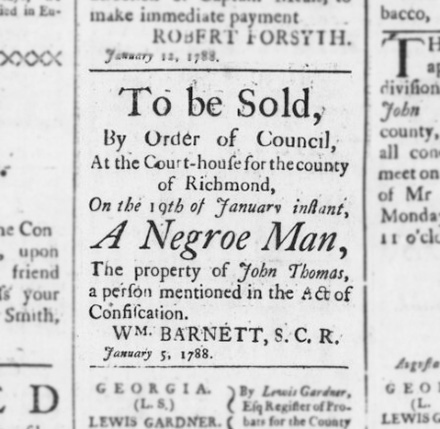
In May 1782, Georgia’s legislature passed the Georgia Confiscation and Banishment Act in which 270 Loyalist (those who supported the British during the Revolution) were found guilty of treason to the state. They were banished as citizens, “declared to be disqualified and rendered incapable to serve on a jury, or vote in any election for members of the Assembly or to serve on the same.” Later, their property was seized and sold at public action. This sales advertisement from 1788 shows that this was still being enforced six years later.
Primary Source Investigation
Advertisement from The Georgia State Gazette, or, Independent Register. (Augusta, Ga.) 1786-1789, January 12, 1788.
https://gahistoricnewspapers.galileo.usg.edu/lccn/sn84020084/1788-01-12/ed-1/seq-3/
- Based on this advertisement, what can you infer about John Thomas?
- Why would the legislature create a law specifically naming and removing citizenship from Loyalist Georgians?
In 1798, Georgia established a new requirement that connected political participation to a voter’s ability to pay taxes and that White voters be current on all taxes owed to the state before being allowed to vote.
In 1860, Georgia reintroduced the land ownership requirement to disenfranchise landless White men, a decision connected to concerns about the rapidly growing Irish population in Augusta and Savannah. Unable to compete with enslaved labor, these immigrants tried to gain political power to push for legal restrictions about where slave labor could be used and protect Irish immigrant’s political interest. Georgia’s leaders saw this as an attack on slavery and removed the new immigrants’ voting rights.
After the Civil War, Reconstruction brought major changes to voting rights in Georgia. In 1867, Black men were allowed to vote in state elections. Between 1867 and 1872, 69 African-American men were elected to Georgia’s state constitutional convention or state legislature. Their election marked a major expansion of political participation in the state. However, this progress was quickly challenged. In September 1868, White Republicans and Democrats voted to expel 33 African-American members from the Georgia legislature.
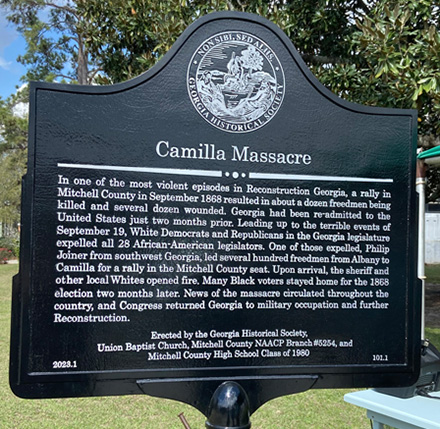
In protest, Black Georgians and their white Republican allies marched from Albany to Camilla, Georgia, for a political rally. The march can be understood as one of Georgia’s first civil rights protests because participants were publicly demanding the right of Black citizens to vote, hold office, assemble peacefully, and take part in political life. When the group reached Camilla, armed White residents and local officials attacked them, killing about a dozen freedmen and wounding many others. The event, known as the Camilla Massacre, showed that civil rights were not protected by law alone. Even when Black men gained the legal right to vote and hold office, intimidation, mob violence, and local resistance were used to keep them from exercising those rights.
Primary Source Investigation
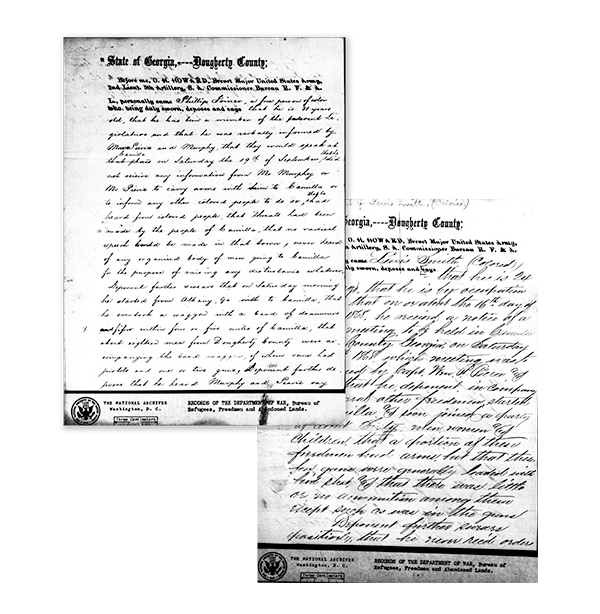
Affidavit of Philip Joiner: Albany, Georgia, 1868 Sept. 23
https://dlg.usg.edu/record/dlg_zlcu_cam022?canvas=0&x=278&y=1986&w=3028
- How does Philip introduce himself?
- What does Philip know about the potential of violence before the group enters Camilla?
Affidavit of Lewis Smith: Albany, Georgia, 1868 Sept. 24
https://dlg.usg.edu/record/dlg_zlcu_cam031#text
- How does Philip introduce himself?
- What does Lewis say about previous interactions in Camilla
Read more about the Camilla Massacre:
- Historical Marker
- Off the Deaton Path: Dr. Stan Deaton discusses the affidavits that were hidden away in the Freeman’s Bureau archives, below are two examples. One is from the organizer of the protest, Philip Joiner.
In 1870, the 15th Amendment was ratified, the last of the three Civil War Amendments, which made the denial of voting based on race illegal. This expanded voting rights by allowing former slaves to cast ballots and have a voice in the national, state, and local elections. Considering these changes, Georgia reinstated poll taxes, and local officials often made it difficult for African Americans to pay those taxes by making them payable to the sheriff’s department and creating an intimidation factor to register to vote. These tactics limited voting without directly saying that Black men could not vote. By the 1880s, many African-American voters understood that even when they were allowed to cast ballots, their votes were not always fairly counted. In 1883, one African-American man testified before the U.S. Senate that even in places where Black voters were the majority, their votes seemed to disappear before they could affect the outcome. His testimony reflected the use of fraud, intimidation, and manipulation to suppress African-American political participation.
By 1900, Black voters in Georgia were banned from voting in Democratic primaries, creating what became known as “White Primaries.” This was especially important because Georgia was effectively a one-party state. If African-American voters could not participate in Democratic primaries, they had little real influence over who would hold political power.
In 1908, Georgia passed the Felder-Williams Act, which further restricted voting. The law included requirements connected to military service, ancestry, property ownership, literacy, and “good character.” These rules created exceptions that allowed many White voters to remain eligible, while literacy tests and poll taxes eliminated almost all Black voting in the state. By 1910, only about 4 percent of Black men in Georgia were registered to vote. While the Felder-Williams Act was designed to limit Black voting, it also limited some illiterate Whites from voting. Despite having other avenues to qualify as a voter, like military service, not completing the literacy test was acknowledging publicly that the person was illiterate. As a result, all Blacks and many lower-class Whites were no longer eligible to vote. In fact, between 1920-1944 elections in Georgia rarely had more than one-third of the eligible White voters show up to the polls.
Women also faced exclusion from the political process. In 1916, as the push for women’s suffrage hit a fever pitch in the United States, the Georgia State Senate scheduled a hearing on women’s suffrage for the day after the legislature adjourned, effectively avoiding serious debate on the issue. This reflected the resistance many women and African Americans faced as they fought for the right to vote.
In 1917, Georgia adopted the county unit system through the Neill Primary Act. This system worked like the Electoral College, giving political power to counties rather than counting every vote equally statewide. As a result, smaller rural counties received outsized influence compared to large urban counties. By 1960, the small counties of Echols, Glascock, and Quitman, with a combined population of 6,980 people, had the same voting power as Fulton County, which had a population of 556,326. This gave rural counties and their more conservative views far more influence in statewide elections than their population justified.
Despite the pushback from Southern states, like Georgia, the 19th Amendment was ratified in 1920. It prohibited the denial of voting based on sex. This expanded political participation to women of all races. However, Black women faced the same literacy test and poll taxes that Black men had faced since the 1870s. They had a desire to vote and the legal standing to do so, but now the rules and regulations of the local voter registration were the final hurdle before they could cast a ballot. Despite being officially ratified in 1920, Georgia did not officially ratify the amendment until 1970, after initially rejecting it in 1919.
Primary Source Investigation
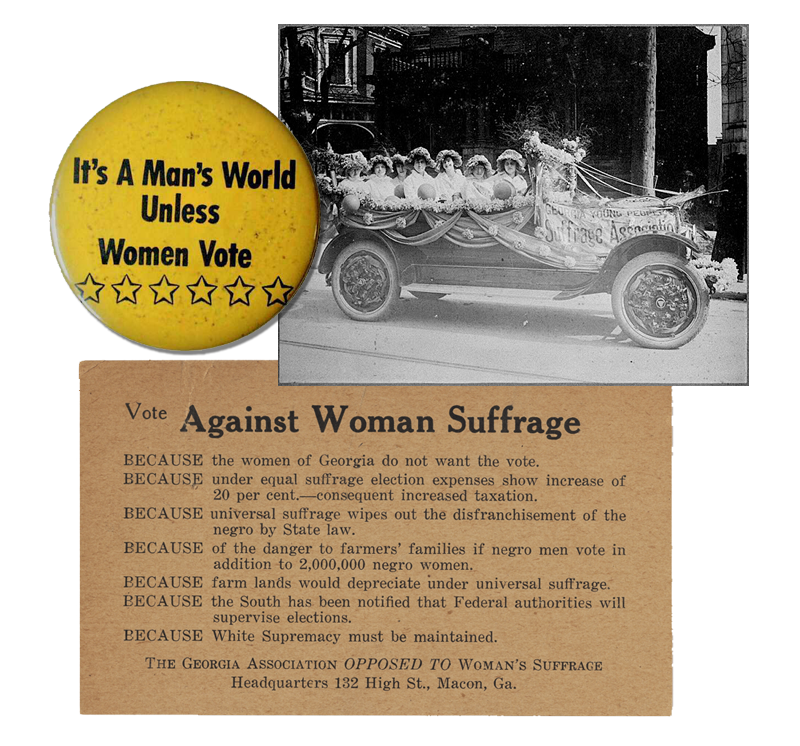
Postcard from the Georgia Association Opposed to Woman’s Suffrage
https://catalog.archives.gov/id/119222090
- What does this postcard suggest about reasons groups were against women’s suffrage?
Woman Suffrage Button
https://dlg.usg.edu/record/nge_ngen_m-782
- What does this button’s language suggest about the importance of women getting the right to vote?
Photograph of representatives of Georgia Young People Suffrage Association in parade with Margaret Koch driving vehicle, Georgia, not after 1920 Aug. 26
https://dlg.usg.edu/record/dlg_vang_geo088
- Along with advocating for women’s suffrage, this photo shows a woman driving a car. Why would that be an important image in 1915?
Woman’s Suffrage Act of Georgia
https://vault.georgiaarchives.org/digital/collection/adhoc/id/309
- After the ratification of the 19th Amendment, Georgia changed its laws so that women could vote.
- Section 1 lists the limitations of Section 2167 of the Civil Code of Georgia of 1910. According to this code, what were women allowed to do before the 19th Amendment?
- Section 2 alters the 1910 civil code to allow women to vote and hold civic office; however, what are the roles that are still off limits to women under the new provisions?
Resources on Women’s Suffrage in Georgia
In 1944, the U.S. Supreme Court ruled in Smith v. Allwright that political parties could not exclude Black voters from primaries. Although the case came from Texas, the ruling affected White primaries across the South, including Georgia.
In addition to eliminating the White primary, Georgia eliminated the poll tax in 1945. An early state-level repeal eliminated the tax decades before the U.S. Constitution banned it nationwide for federal elections in 1964 with the 24th Amendment.
Georgia also became an early example of lowering the voting age. During World War II, Georgia lowered the voting age to eighteen, based on the argument that if young people could be drafted and sent to war, they should also be able to vote for the government making those decisions. Decades later, this same argument helped support the national ratification of the 26th Amendment in 1971.
In 1945, King v. Chapman further challenged Georgia’s White primary system. Primus King, an African-American man in Muscogee County, was turned away when he tried to vote in a Democratic primary. The U.S. District Court for the Middle District of Georgia ruled that Georgia’s attempt to treat primaries as a “private affair” was illegal because primaries were an integral part of the state’s electoral process. The court found that King’s rights under the 14th, 15th, and 17th Amendments had been violated.
After these legal victories, Black voter registration in Georgia increased. By 1946, 118,387 Black Georgians had registered to vote. This marked an important shift, but voting rights were still not fully protected or equally accessible.
In 1963, the U.S. Supreme Court outlawed Georgia’s county unit system in Gray v. Sanders. The Court’s decision helped establish the principle of “one person, one vote,” meaning that political representation should be based more fairly on population. In 1964, Georgia moved to a majority-vote system, requiring candidates to receive 50 percent plus one vote to win. If no candidate received a majority, the election moved to a runoff between the top two vote-getters.
On January 23, 1964, the 24th Amendment was ratified, making it illegal to require poll taxes in federal elections. Later, in 1966, Harper v. Virginia State Board of Elections made all poll taxes unconstitutional because they violated the equal protection clause of the 14th Amendment. Georgia never ratified the 24th Amendment.
The Voting Rights Act of 1965 created another major turning point. It outlawed literacy tests and enforced the 15th Amendment to guarantee the right to vote to all US Citizens.
Since 1965, two sections of the law have been altered by the Supreme Court. Section 2 of the Voting Rights Act allowed states to create majority minority districts, a process the US Supreme Court upheld in 1993 in Shaw V. Reno. However, the Supreme Court reversed itself in Louisiana V. Calais (2026), finding that creating majority-minority districts was unconstitutional. Additionally, Section 5 of the law required certain states and local governments with histories of voting discrimination, including Georgia, to receive federal approval before making changes to voting laws. This process, known as preclearance, was designed to prevent new voting rules from being used to discriminate against voters. This perversion was ruled unconstitutional by the U.S. Supreme Court in Shelby County V. Holder (2013).
The history of voting in the United States, and especially in Georgia, is a history of both expansion and restriction. Voting rights widened over time, but those gains were met with new barriers designed to limit political power. Many groups, including African Americans, women, poor and uneducated citizens, young people, and others, had to fight for generations to secure, use, and protect their voting rights.
Primary Source Investigation
Interview with Primus King, 1979, pages 21-31.
https://csuepress.columbusstate.edu/cgi/viewcontent.cgi?article=1065&context=muscogiana
On page 22 (27 of the PDF) King describes what happened to him when he went to vote.
- Why was this a test case?
- How was he selected as the one to try and vote?
- After Primus King was denied the right to vote, what did he do?
- When he testified in court, what did King say about voting?
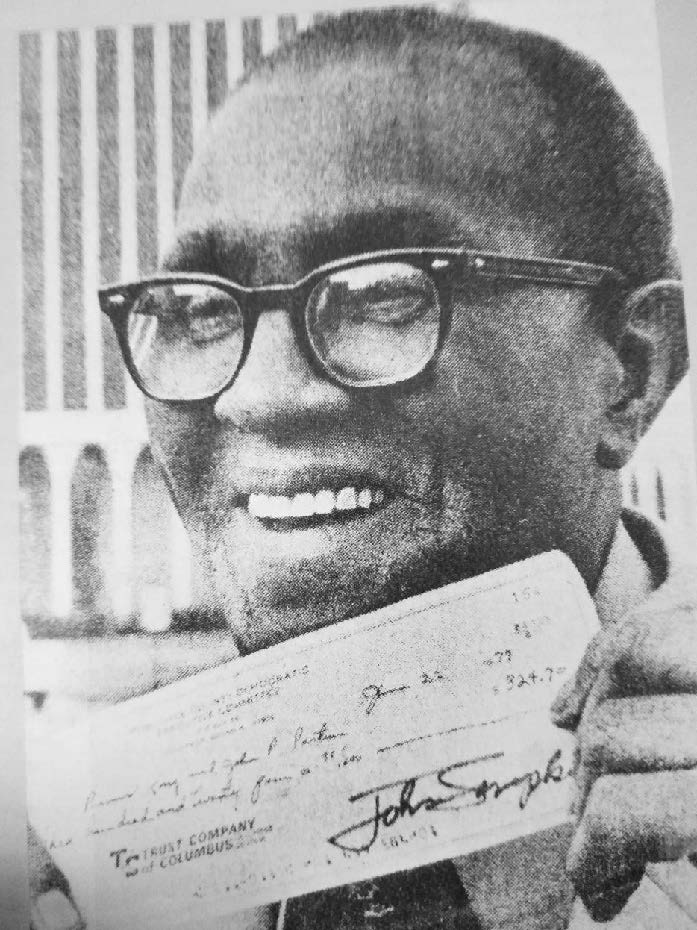
Photo of Primus King
https://csuepress.columbusstate.edu/cgi/viewcontent.cgi?article=1065&context=muscogiana
King was awarded $100 plus 7% interest when he won his case in the US District court for Middle Georgia in 1945. It took almost 30 years for King to be paid.
- What year did King receive his payment?
- How much money did King receive?
Read more about Primus King here.
Pulling it all together
Thinking about what you have learned, answer one of the questions below.
- Why is the history of voting in Georgia better described as a story of expansion and restriction rather than a story of steady progress?
- After the 15th Amendment, Black men had the legal right to vote, but Georgia created new barriers such as poll taxes, literacy tests, and intimidation. What does this show about the difference between having a right on paper and being able to exercise that right in real life?
- Which event or law in the reading do you think created the most meaningful change in voting rights in Georgia? Defend your answer by explaining both what changed and what barriers still remained afterward.