
Lesson Plan
Voting Rights and American Democracy
Essential Question
How have constitutional amendments expanded voting rights, and how has access to the ballot shaped American democracy?
Grade Level: High School U.S. History, American Government, Civics, or Georgia Studies connections
Time Needed: 45-60 minutes
Standards:
SSUSH13.d: Describe Progressive legislative actions including empowerment of the voter, labor laws, and the conservation movement.
SSCG7: Demonstrate knowledge of civil liberties and civil rights.
SSCG7.a: Define civil liberties as protections against government actions (e.g., First Amendment).
SSCG7.c: Analyze due process of law as expressed in the 5th and 14th amendments, as understood through the process of incorporation.
SSCG7.d: Identify how amendments extend the right to vote.
Notes have been added to the presentation to help explain the information being presented and highlight when there are student handouts to go along with content.
Lesson Overview
In this lesson, students will study how constitutional amendments expanded voting rights over time and consider how access to the ballot has shaped American democracy. Students will examine the relationship between citizenship, voting, representation, and political power by analyzing major amendments connected to suffrage.
Students will explore how voting rights were not extended to all Americans at once. Instead, the right to vote expanded through constitutional change, civic activism, federal legislation, court cases, and continued public debate. By studying these changes, students will better understand how democracy has developed over time and why access to the ballot remains central to civic life.
Learning Objectives
Students will be able to:
- Identify constitutional amendments that expanded voting rights in the United States.
- Explain how voting rights changed over time for different groups of Americans.
- Analyze the connection between voting, citizenship, representation, and democracy.
- Evaluate how citizens and civic movements worked to expand access to the ballot.
- Connect historical struggles over voting rights to the responsibilities of citizenship today.
Materials

- Google Slide Presentation
- Copies of “Primary Source Excepts” for each student
- Copy of “Group Discussion Handout” to be cut into parts for each group
- Copies of “Timeline” for each student
Key Vocabulary

Suffrage: The right to vote.
Franchise: The legal right to vote.
Amendment: A formal change or addition to the U.S. Constitution.
Disenfranchisement: The denial or restriction of the right to vote.
Poll tax: A fee once required in some places before a person could vote.
Literacy test: A test once used in some states to restrict voter registration, often unfairly applied to Black citizens and other groups.
Representation: The idea that citizens have a voice in government through elected officials.
Popular sovereignty: The principle that the government gets its power from the people.
Civic participation: Taking part in public life, including voting, staying informed, volunteering, organizing, and communicating with public officials.
Introduction / Hook: Who Had the Right to Vote?
(5 minutes)

Ask students to respond individually to this prompt:
At the founding of the United States, who had access to the ballot? Who was left out?
After students write briefly, discuss as a class. Guide students toward the understanding that voting is controlled by states, and access was often limited by race, gender, property ownership, age, and other state defined qualifications.
Then ask:
What does it reveal about American democracy that voting rights expanded over time through constitutional amendments and civic action?
Explain that voting is one of the clearest ways citizens participate in representative government. Through voting, citizens help choose leaders, influence laws, and shape public priorities.
However, American democracy has changed significantly over time. The Constitution did not originally guarantee universal voting rights. Many groups had to organize, protest, petition, lobby, litigate, and campaign to gain access to the ballot.
Voting rights amendments show that democracy has been both an ideal and a work in progress. The expansion of voting rights reflects major debates over citizenship, equality, representation, federalism, and the power of government to protect individual rights.
Direct Instruction: Constitutional Amendments Connected to Voting Rights
(15 minutes)

Timeline Activity: Expanding the Ballot
Hand out copies of the “Student Timeline” for students to complete as you walk though the different amendments presented on the Google Slides.
Students should include:
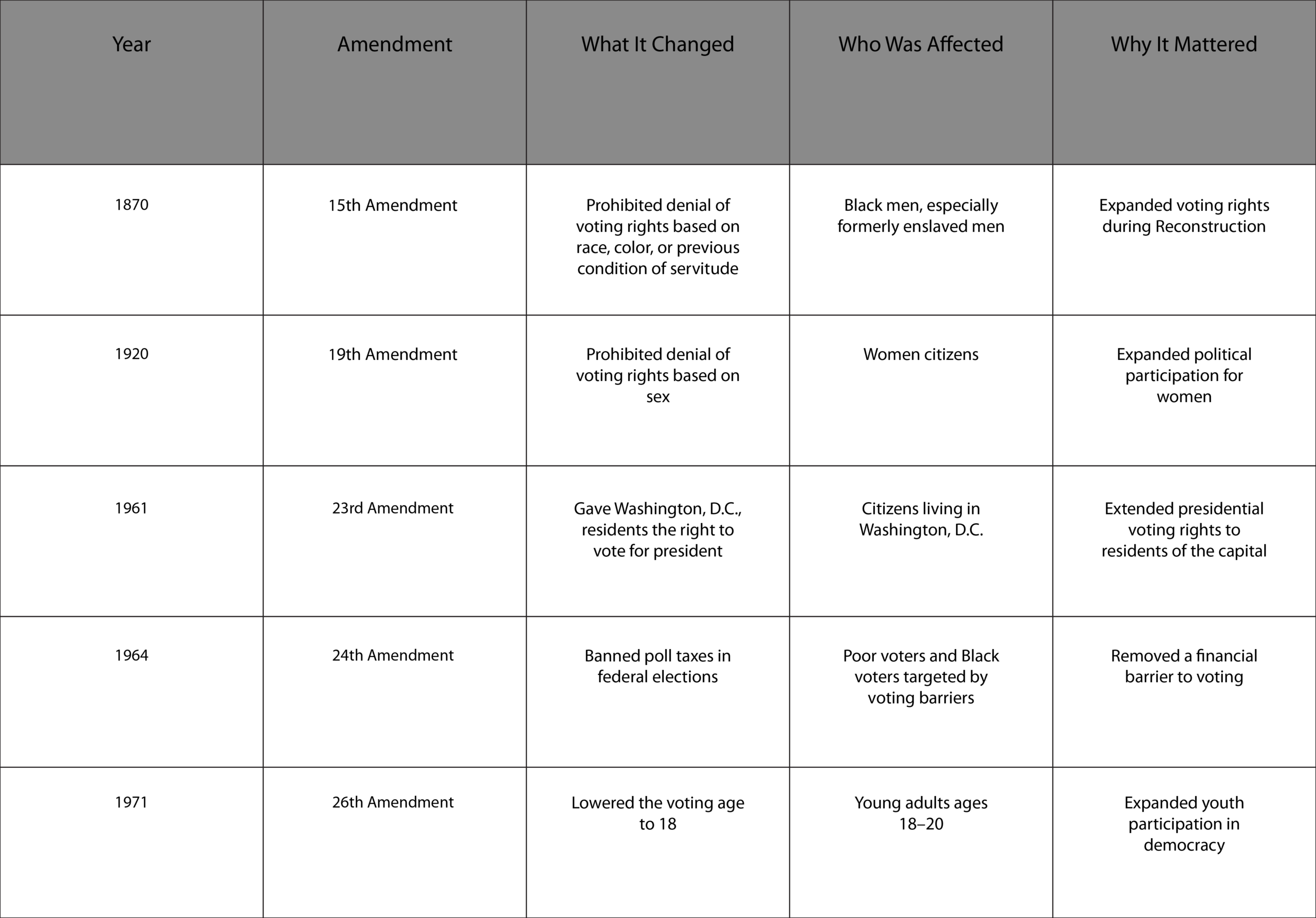
15th Amendment, 1870
The 15th Amendment stated that the right to vote could not be denied based on “race, color, or previous condition of servitude.” It was passed after the Civil War during Reconstruction and was intended to protect voting rights for Black men.
However, many states later used poll taxes, literacy tests, intimidation, violence, and other barriers to prevent Black citizens from voting.
19th Amendment, 1920
The 19th Amendment stated that the right to vote could not be denied based on sex. It followed decades of work by women’s suffrage activists who organized conventions, marches, petitions, speeches, publications, and lobbying campaigns.
The amendment greatly expanded democratic participation, though many women of color still faced barriers to voting.
23rd Amendment, 1961
The 23rd Amendment gave citizens living in Washington, D.C., the right to vote in presidential elections. Before this amendment, residents of the nation’s capital could not vote for president, even though they were U.S. citizens.
24th Amendment, 1964
The 24th Amendment banned poll taxes in federal elections. Poll taxes had been used as a barrier to voting, especially against Black citizens and poor citizens in the South.
26th Amendment, 1971
The 26th Amendment lowered the voting age from 21 to 18. Supporters argued that if 18-year-olds could be drafted to serve in the military, they should also have the right to vote. The common phrase was “old enough to fight, old enough to vote.”
After completing the timeline, students should answer:
Independent Practice: What patterns do you notice about how voting rights expand over time?
(15 minutes)

Primary Source Analysis Activity
Student Handout with information
Provide students with short excerpts from one or more of the following:
- The 15th Amendment
- The 19th Amendment
- The 24th Amendment
- The 26th Amendment
- A women’s suffrage speech or petition
- A civil rights-era voting rights speech
- A voter registration document, political cartoon, newspaper article, or photograph
Students analyze the source using these questions:
- Who created this source?
- When was it created?
- What issue or problem does it address?
- What does it reveal about voting rights?
- What constitutional principle is connected to this source?
How does this source show citizens working for change?
Closure: Civic Participation Connection
(5 minutes)
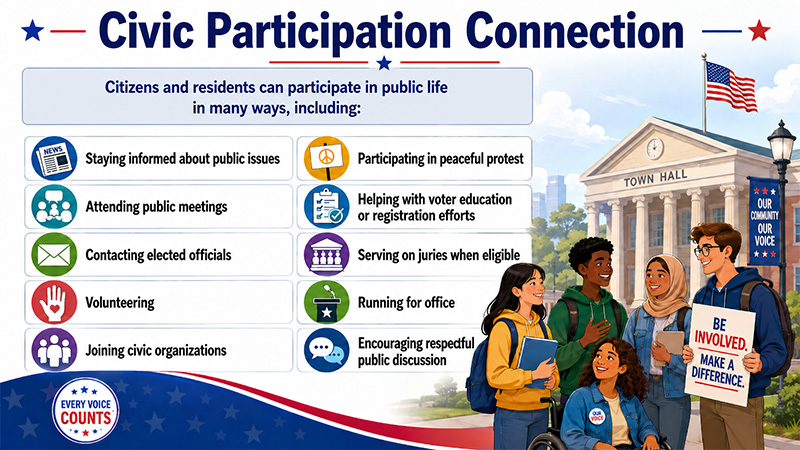
Image included in the Google Presentation for full class discussion
Explain to students that voting is an important form of civic participation, but it is not the only one. Citizens and residents can participate in public life in many ways, including:
- Staying informed about public issues
- Attending public meetings
- Contacting elected officials
- Volunteering
- Joining civic organizations
- Participating in peaceful protest
- Helping with voter education or registration efforts
- Serving on juries when eligible
- Running for office
- Encouraging respectful public discussion
Ask students:
How did people use civic participation to expand voting rights before they had full access to the ballot?
This question helps students understand that people can shape democracy even when they are excluded from formal political power.
Skill Review: Exit Ticket
(2 minutes)

Have students answer:
What is one way access to voting has changed American democracy, and what is one responsibility citizens have when using the right to vote?
Assessment
Students can be assessed on their ability to:
- Identify major constitutional amendments related to voting rights.
- Explain how voting rights expanded over time.
- Connect voting rights to constitutional principles.
- Analyze historical examples of civic participation.
- Explain the relationship between ballot access and democratic government.
- Support claims with evidence from amendments, history, or primary sources.
Closing Thought for Students
The history of voting rights shows that democracy has expanded because citizens demanded a voice. Constitutional amendments changed who could participate, but civic action gave those changes meaning. Access to the ballot has shaped American democracy by deciding who has power, whose voices are heard, and how the nation defines citizenship.