
Lesson Plan
The Three Branches of Government and Checks and Balances
Lesson Overview
In this lesson, students will learn that the United States Constitution divides the federal government into three branches: legislative, executive, and judicial. Each branch has its own responsibilities, but none of the branches has total power. The Constitution also creates a system of checks and balances, which allows each branch to limit or “check” the power of the others.
Students will examine the basic roles of each branch, explore examples of checks and balances, and apply what they learn to real-world scenarios. By the end of the lesson, students should understand that the three-branch system was designed to prevent one person or group from becoming too powerful.
Essential Question
Why did the Founders divide the federal government into three branches, and how does each branch help limit the power of the others?
Grade Level: Upper Elementary / Middle School
Topic: U.S. Government, Separation of Powers, Checks and Balances
Lesson Length: approximately 45–60 minutes
Standards: SS3CG1.a; SS4CG1.c; SS4CG1.d; SS8CG1; SS8CG2; SS8CG3; SS8CG4
Notes have been added to the presentation to help explain the information being presented and highlight when there are student handouts to go along with content.
Learning Objectives
Students will be able to:
- Identify the three branches of the federal government.
- Explain the main responsibility of each branch.
- Define separation of powers and checks and balances.
- Describe examples of how one branch can check another.
- Explain why checks and balances are important in a constitutional democracy.
Materials

- Google Presentation
- Copy of Student Handout for all students
- Copy of Scenario Group one copy to be divided between the groups
- Copies of the Exit Tickets
Key Vocabulary
(10 minutes)
Constitution: The written plan of government for the United States.
Legislative Branch: The branch of government that makes laws. Congress, made up of the Senate and the House of Representatives, is the legislative branch.
Executive Branch: The branch of government that carries out and enforces laws. The president leads the executive branch.
Judicial Branch: The branch of government that interprets laws and decides whether laws or government actions follow the Constitution. The Supreme Court and other federal courts make up the judicial branch.
Separation of Powers: The idea that government power should be divided among different branches so that no one branch controls everything.
Checks and Balances: A system that allows each branch of government to limit the power of the other branches.
Veto: The president’s power to reject a bill passed by Congress.
Override: Congress’s power to pass a bill into law even after a presidential veto, if enough members vote to do so.
Judicial Review: The power of the courts to decide whether a law or government action is constitutional.
Teacher Background
The Founders of the United States were concerned about giving too much power to one ruler or one part of government. Many Americans had experienced British rule under King George III and worried that a strong central government could become unfair or abusive. At the same time, they knew the government needed enough power to make laws, enforce laws, and settle legal disputes.
To solve this problem, the Constitution divided power among three branches. This is called separation of powers. The legislative branch makes laws, the executive branch enforces laws, and the judicial branch interprets laws. The Constitution also gives each branch ways to check the others. This system of checks and balances helps prevent any one branch from becoming too powerful.
Introduction / Hook: Who Should Have the Power?
(5 minutes)

Ask students to imagine that their school is creating a new set of rules. One person will be in charge of making the rules, enforcing the rules, and deciding whether people broke the rules.
Ask students:
- What could go wrong if one person had all that power?
- Would that system feel fair? Why or why not?
- How might the school divide those responsibilities to make the system more balanced?
After students respond, explain that the Founders asked similar questions when they created the Constitution. They wanted a government strong enough to lead the country, but not so powerful that it could threaten people’s rights.
Direct Instruction: The Three Branches
(10 minutes)

The Legislative Branch: Making the Laws
The legislative branch is Congress. Congress is divided into two parts: the Senate and the House of Representatives. Its main job is to make laws. Members of Congress debate problems, write bills, vote on proposed laws, approve government spending, and represent the people of their states and districts.
Congress also has other important powers. It can declare war, approve treaties, confirm certain presidential appointments, and investigate government actions. Because Congress represents the people, it plays a central role in deciding what laws the country should have.
The Executive Branch: Carrying Out the Laws
The executive branch is led by the president. Its main job is to carry out and enforce the laws passed by Congress. The president also serves as commander in chief of the military, works with leaders from other countries, appoints certain government officials, and can sign or veto bills passed by Congress.
The executive branch includes many departments and agencies that help run the government. For example, some departments focus on education, defense, transportation, agriculture, or justice. These agencies help put laws into action.
The Judicial Branch: Interpreting the Laws
The judicial branch is made up of the federal courts, including the Supreme Court. Its main job is to interpret laws and decide legal cases. Courts help determine what laws mean and whether government actions follow the Constitution.
One of the most important powers of the judicial branch is judicial review. This means courts can decide that a law or government action is unconstitutional. This power helps protect the Constitution as the highest law of the land.
Guided Practice: What Does Each Branch Do?

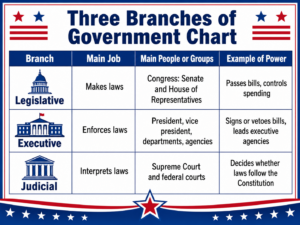 STUDENT HANDOUT: Three Branches of Government Chart
Read each statement aloud and have students identify the branch being described.
- This branch makes federal laws.
- This branch is led by the president.
- This branch includes the Supreme Court.
- This branch can veto a bill.
- This branch decides whether laws follow the Constitution.
- This branch includes the Senate and House of Representatives.
- This branch carries out and enforces laws.
After each answer, ask students to explain how they know.
Direct Instruction: Checks and Balances Explanation
(10 minutes)
The three branches have separate jobs, but they also work together and limit one another. This is called checks and balances.
A “check” is a power one branch has over another branch. A “balance” means that power is shared so no branch becomes too strong.
For example, Congress can pass a bill, but the president can veto it. That is a check by the executive branch on the legislative branch. However, Congress can override the veto with enough votes. That is a check by the legislative branch on the executive branch.
The courts can decide that a law is unconstitutional. That is a check by the judicial branch. However, the president appoints federal judges, and the Senate confirms them. That means the executive and legislative branches both have roles in shaping the judicial branch.
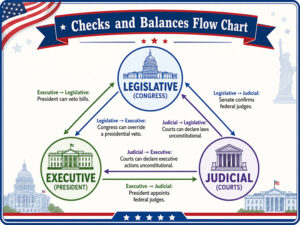 STUDENT HANDOUT: Checks and Balances Chart
Examples of Checks and Balances
Legislative Branch Checks the Executive Branch
Congress can:
- Override a presidential veto.
- Approve or reject presidential appointments.
- Approve or reject treaties.
- Control government spending.
- Impeach and remove federal officials, including the president.
Executive Branch Checks the Legislative Branch
The president can:
- Veto bills passed by Congress.
- Suggest laws or policy goals.
- Call special sessions of Congress.
Judicial Branch Checks the Legislative and Executive Branches
Federal courts can:
- Declare laws unconstitutional.
- Declare executive actions unconstitutional.
- Interpret how laws should be applied.
Executive and Legislative Branches Check the Judicial Branch
The president and Congress can:
- Appoint and confirm federal judges.
- Create lower federal courts.
Propose and approve constitutional amendments if they disagree with a court’s interpretation.
Guided Practice: Checks and Balances Scenarios

Divide students into small groups. Give each group one of the following scenarios. Students should identify:
- Which branch is acting?
- Which branch is being checked?
- Why this check matters.
Scenario 1
Congress passes a bill, but the president believes it is harmful and vetoes it.
Scenario 2
The president appoints a new Supreme Court justice, but the Senate must vote on whether to confirm the appointment.
Scenario 3
Congress passes a law, but the Supreme Court decides that the law violates the Constitution.
Scenario 4
The president signs an executive order, but a federal court rules that the action is unconstitutional.
Scenario 5
The president vetoes a bill, but Congress votes again and overrides the veto.
Scenario 6
Congress investigates how an executive agency used public money.
Have each group share its answers with the class.
Class Discussion Question
Why might it be dangerous for one branch of government to have all the power?
Assessment
Closing / Skill Review: Exit Ticket
(5 minutes)
Have students answer the following questions:
- Name the three branches of government.
- What is the main job of each branch?
- What does “checks and balances” mean?
- Give one example of one branch checking another branch.
- Why is it important that no branch has all the power?
Extension Activity: Create a Government Balance Poster
Students create a poster, diagram, or digital slide showing the three branches of government and at least three examples of checks and balances. Their work should include:
- The name of each branch.
- The main job of each branch.
- At least three arrows showing how one branch checks another.
- A short explanation of why checks and balances are important.
Differentiation
For Younger or Struggling Students
Provide sentence starters:
- The legislative branch ______.
- The executive branch ______.
- The judicial branch ______.
- Checks and balances means ______.
- One branch can check another by ______.
For Advanced Students
Ask students to research a real historical example of checks and balances, such as a presidential veto, a Supreme Court case, an impeachment, or a Senate confirmation hearing. Students should explain which branches were involved and how the system of checks and balances worked.
Closing
Remind students that the Constitution created a government with enough power to lead the country, but not so much power that one person or group could control everything. The three branches of government and the system of checks and balances are designed to protect liberty, encourage debate, and make sure government power is shared.