
Lesson Plan
Rights and Responsibilities: Citizens Working for Change
Essential Question
How do citizens use their rights and responsibilities to participate in democracy and create change?
Grade Level: Middle School, especially 8th grade Georgia Studies, civics, and U.S. history connections
Time Needed: 50-60 minutes
Standard: SS8CG1.c: Describe the rights and responsibilities of citizens according to the Georgia Constitution.
Notes have been added to the presentation to help explain the information being presented and highlight when there are student handouts to go along with content.
Lesson Overview
In this lesson, students examine the rights and responsibilities of citizens by connecting constitutional principles to civic participation, public service, and historical examples of citizens working for change. Students will explore how rights such as speech, assembly, petition, voting, and due process allow people to participate in civic life, while responsibilities such as staying informed, obeying laws, serving communities, and respecting the rights of others help democracy function.
Students will also consider how individuals and groups throughout history have used civic action to address problems, challenge injustice, and improve their communities.
Learning Objectives
Students will be able to:
- Explain the difference between a right and a responsibility.
- Identify constitutional rights connected to civic participation.
- Describe ways citizens participate in democracy.
- Analyze historical examples of citizens working for change.
Create a personal civic action statement connected to rights and responsibilities.
Materials

- Google Slide Presentation
- Copies of “Citizens working for Change” for each student
- Copies of "Answer Sheet" for each student
- Copies of “Role as a Citizen”
Vocabulary

Right: A freedom or protection guaranteed to people by law.
Responsibility: A duty or action citizens are expected to carry out to help their community and government work well.
Civic participation: Taking part in public life, government, or community decision-making.
Public service: Work done to help the community or the public good.
Petition: A formal request asking the government or leaders to take action.
Common good: What benefits the community as a whole.
Constitutional principle: A major idea found in the U.S. Constitution, such as liberty, justice, rule of law, popular sovereignty, and limited government.
Introduction / Hook: Rights or Responsibilities?
(5 minutes)

Display or read the following examples to students. Ask them to decide whether each one is a right, a responsibility, or both.
- Voting in an election
- Speaking out about an issue
- Obeying laws
- Serving on a jury
- Respecting the rights of others
- Peacefully protesting
- Staying informed about public issues
After students respond, discuss the idea that some actions can be both. For example, voting is a right for eligible citizens, but it is also a responsibility because democracy depends on public participation.
Direct Instruction: Rights Make Participation Possible
(15 minutes)

Explain to students that the United States Constitution and the Bill of Rights protect many freedoms that allow people to participate in civic life. These rights do not only exist on paper. Citizens use them when they speak, write, organize, vote, protest, serve, and ask leaders to solve problems.
Important examples include:
Freedom of Speech: Citizens can express ideas, share opinions, and speak out about public issues.
Freedom of the Press: Newspapers, journalists, and citizens can share information and report on government actions.
Freedom of Assembly: People can gather peacefully to support a cause or call for change.
Right to Petition: Citizens can ask the government to address problems or change policies.
Right to Vote: Eligible citizens can help choose leaders and influence public decisions.
Due Process: The government must follow fair legal procedures before taking away a person’s life, liberty, or property.
Emphasize that rights come with responsibilities. A healthy democracy requires citizens to use their rights thoughtfully, respect others, stay informed, and work toward the common good.
Guided Practice: Citizens Working for Change
(15 minutes)

Divide students into small groups. Assign each group one historical example of civic participation. Students should identify the right or responsibility involved and explain how people worked for change.
Example 1: The American Revolution
Colonists used speeches, pamphlets, petitions, boycotts, committees, and public meetings to challenge British policies. They argued that government should protect the rights of the people and that citizens had a role in shaping public decisions.
Rights and responsibilities connected: speech, press, petition, assembly, public debate, civic action
Example 2: The Women’s Suffrage Movement
Women and their allies organized meetings, wrote articles, marched, petitioned lawmakers, and campaigned for the right to vote. Their efforts helped lead to the ratification of the 19th Amendment in 1920.
Rights and responsibilities connected: voting, assembly, petition, speech, equal participation
Example 3: The Civil Rights Movement
Citizens used marches, boycotts, lawsuits, speeches, sit-ins, voter registration drives, and nonviolent protest to challenge segregation and discrimination. Their work helped bring national attention to injustice and led to major legal and political changes.
Rights and responsibilities connected: assembly, speech, petition, voting rights, equal protection, public service
Example 4: Community Service and Civic Organizations
Groups such as scouting organizations, churches, clubs, neighborhood associations, and student groups have helped communities through service projects, fundraising, education, and volunteer work.
Rights and responsibilities connected: public service, common good, community participation, informed citizenship
Student Activity: Civic Action Analysis Chart (On Google Presentation for full class review)
Have students complete the following chart for their assigned example.
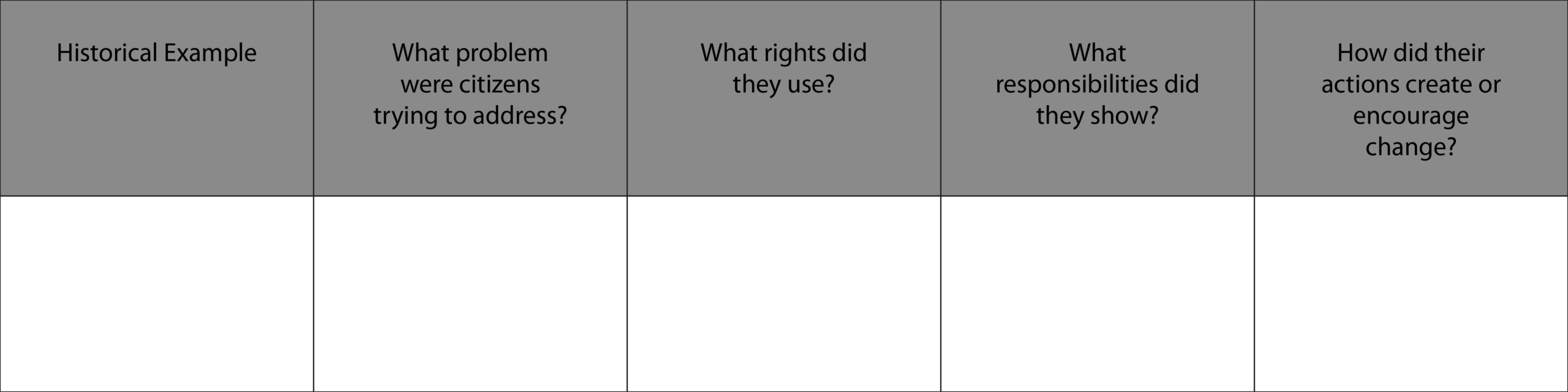
After groups complete the chart, each group shares a brief summary with the class.
Independent Practice: My Role as a Citizen
(10 minutes)

Ask students to choose one issue they care about in their school, community, state, or country. It does not need to be political. Examples may include school safety, litter, animal shelters, parks, hunger, bullying, traffic, historic preservation, or helping younger students.
Students complete the following prompts:
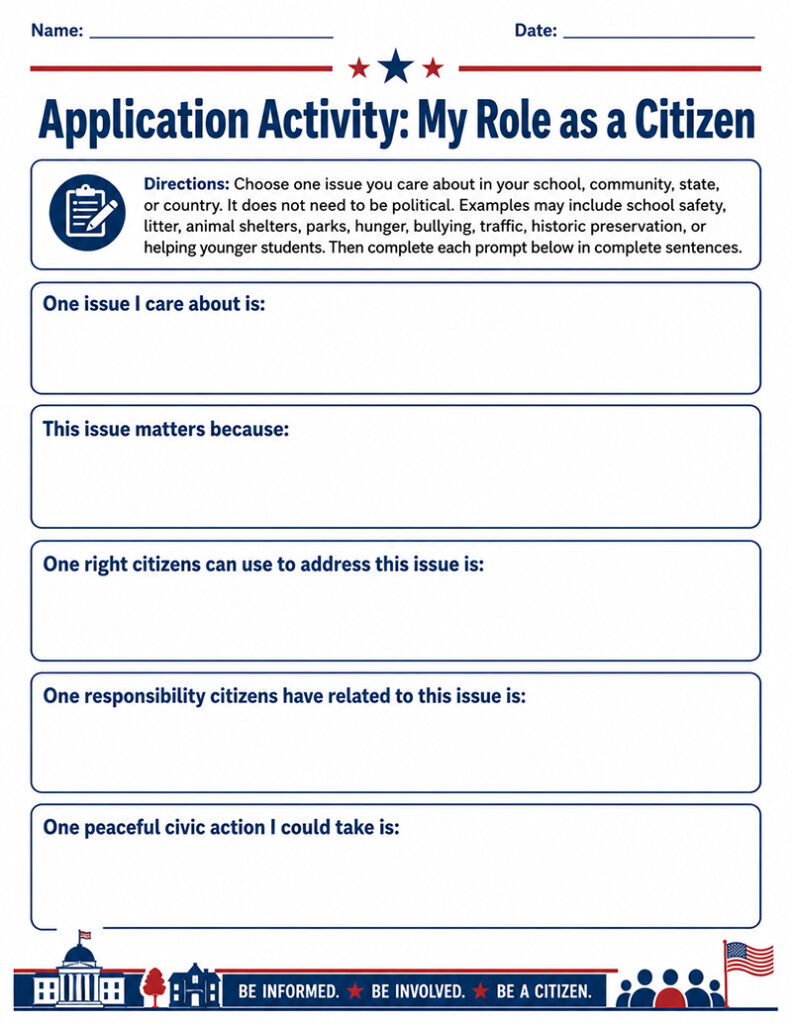
Possible civic actions include writing a letter, creating an awareness poster, volunteering, researching the issue, speaking at a meeting, interviewing community members, or organizing a service project.
Closing / Skill Review: Exit Ticket
(5 minutes)
Have students answer the following question in 3–5 sentences:
How can citizens use their rights and responsibilities to help improve their communities?
Assessment
Students can be assessed on their ability to:
- Correctly distinguish between rights and responsibilities.
- Identify constitutional principles connected to civic participation.
- Explain how historical examples show citizens working for change.
- Connect civic participation to public service and the common good.
- Propose a responsible civic action for a real-world issue.
Extension Activity
Students may research a Georgia example of civic participation, such as voting rights activism, civil rights demonstrations, historic preservation efforts, community service organizations, or local citizens who worked to improve their communities. Students can present their example as a short paragraph, poster, or one-slide presentation.
Closing Thought for Students
Rights give citizens the freedom to speak, vote, gather, question, and ask for change. Responsibilities remind citizens to use those freedoms wisely. Democracy works best when people do more than watch history happen. They participate in it.