
Introduction
by W. Todd Groce, Ph.D. President and CEO
Anyone traversing modern-day Georgia will find a land that both resembles and stands in stark contrast to the image of the state in popular culture. From the towering skyscrapers and traffic jams of Atlanta to the moss-draped oaks and historic squares of Savannah, the state seems a paradox, comfortably straddling both the old and the new. Somehow, in that uniquely Southern way, the past and the present merge into one. Georgians may not live in the past, but the past clearly lives in Georgians.
The Colony
Savannah is one of the world's premier tourist destinations, its stately squares and moss-draped oaks offering one of the most scenic and historic landscapes in America. Its origins lie in the vision of its founder, James Edward Oglethorpe, and in that of the group he represented, the Georgia Trustees, who received a charter from King George II in 1732 for what turned out to be the last British colony in mainland North America. Oglethorpe arrived with the first colonists in February 1733. He remained for ten years, working tirelessly to ensure political, military, and economic stability. He left behind a colony that grew to become the largest American state east of the Mississippi, and a city of incomparable beauty. Richard West Habersham's 1885 portrait of "Oglethorpe at Belgrade, 1718," imagines Georgia's young founder as he appeared fighting under Prince Eugene of Savoy in the Austro-Turkish War.
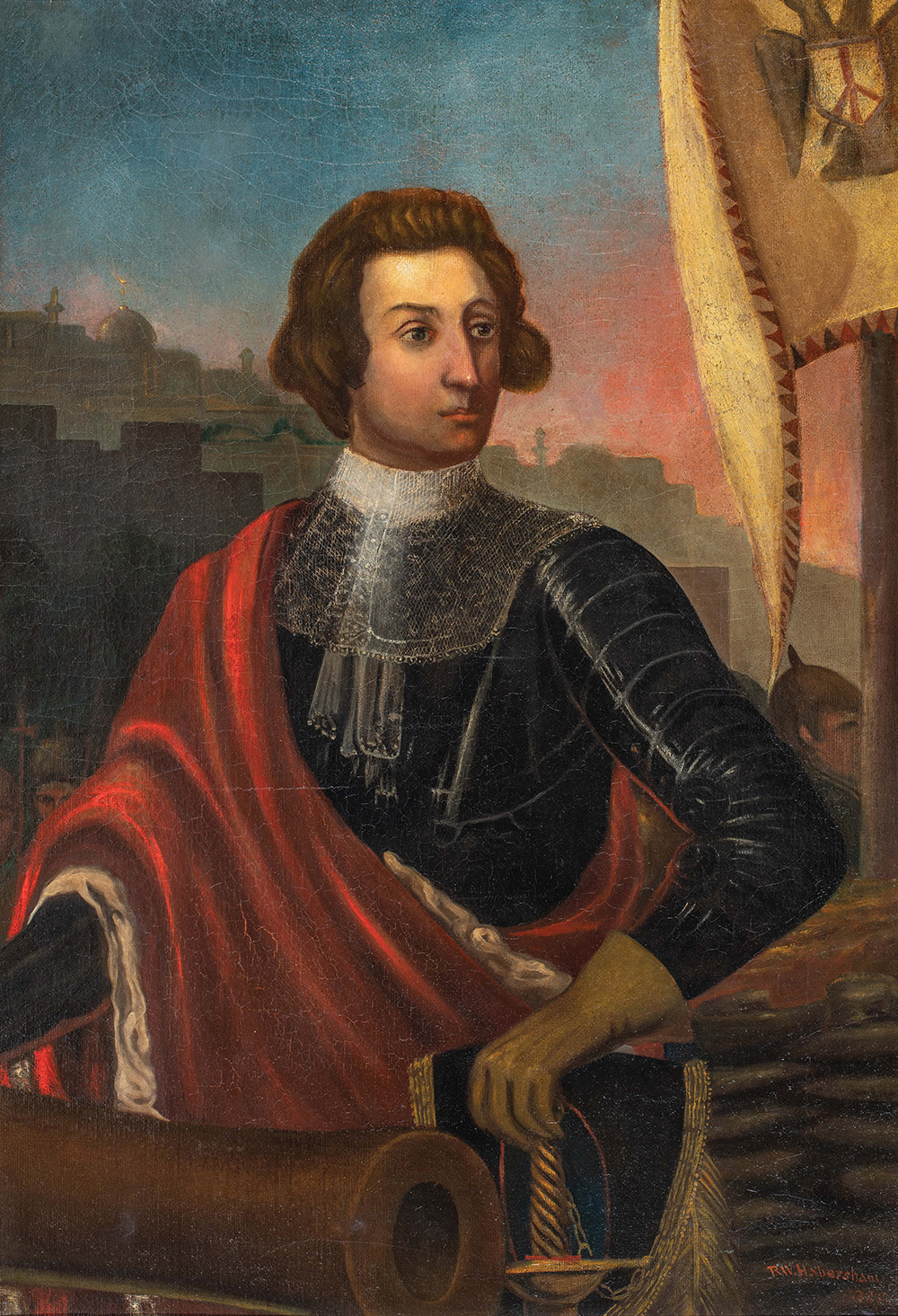
Richard West Habersham, "Portrait of James Edward Oglethorpe in 1718," GHS 1361-AF-327.
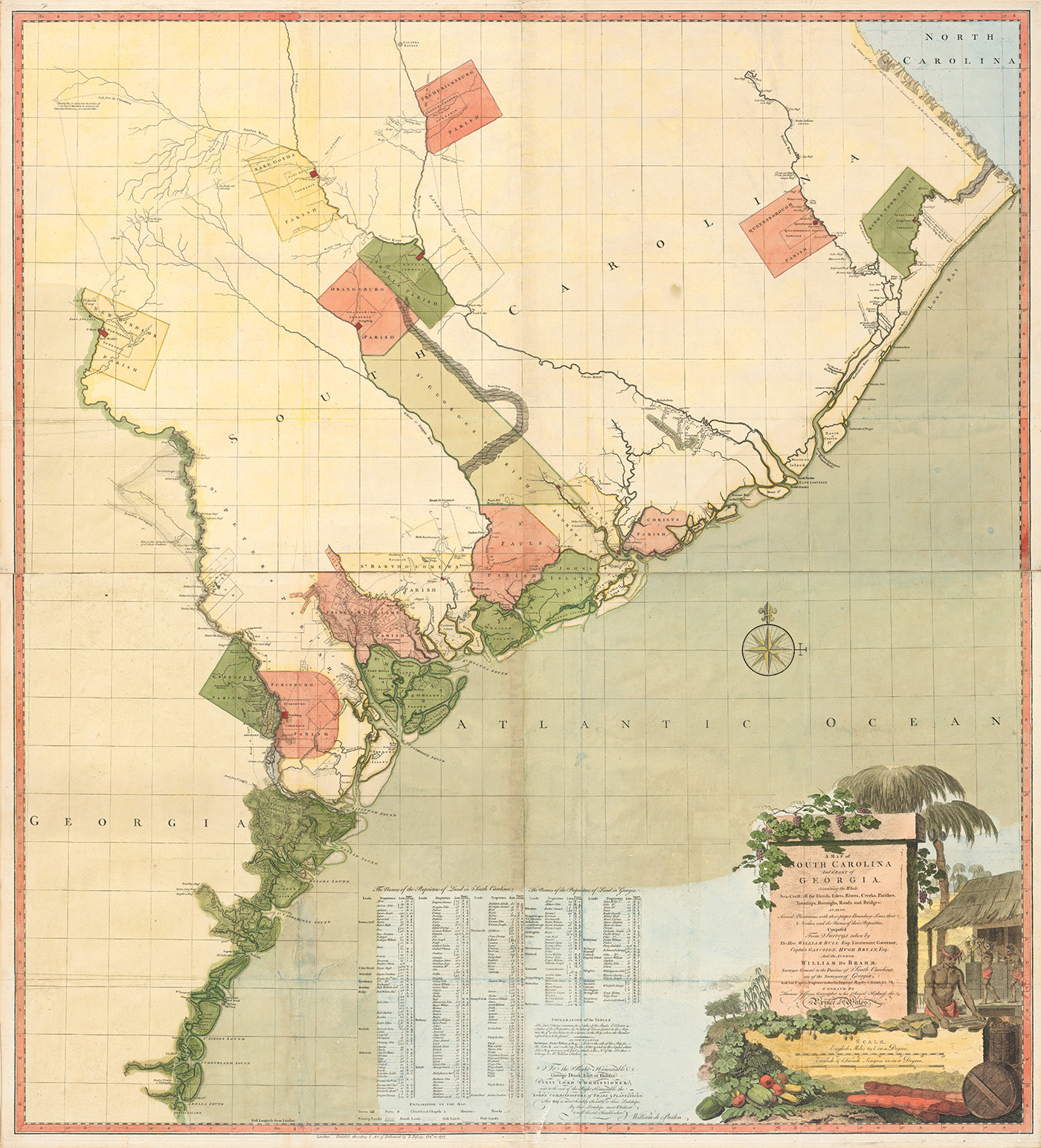
John Gerard William DeBrahm, "A map of South Carolina and part of Georgia," 1757, GHS 1361-MP-0423.
The American Revolution
The men and women who sacrificed so much in carrying out the American Revolution are all long gone, but their legacy is all around us in our democratic institutions and the hard-won freedoms that we all enjoy. Though we don't know who carried it, or whose hands beat out the call to arms, this rare drum from that era is a more material legacy and evokes the violence and martial spirit of that conflict that resonates with us still. The inscription states: "This Drum was used in the American Army of the Revolution, at the Battles of Eutaw, Saratoga and Cowpens. Presented to the Georgia Historical Society by General Charles R. Floyd in 1841." This drum and the grapeshot that killed Count Casimir Pulaski at the siege of Savannah in 1779 were two of the first artifacts donated to GHS and remain among the rarest and most venerable in the collection, a tangible link to the birth of the Republic 250 years ago.
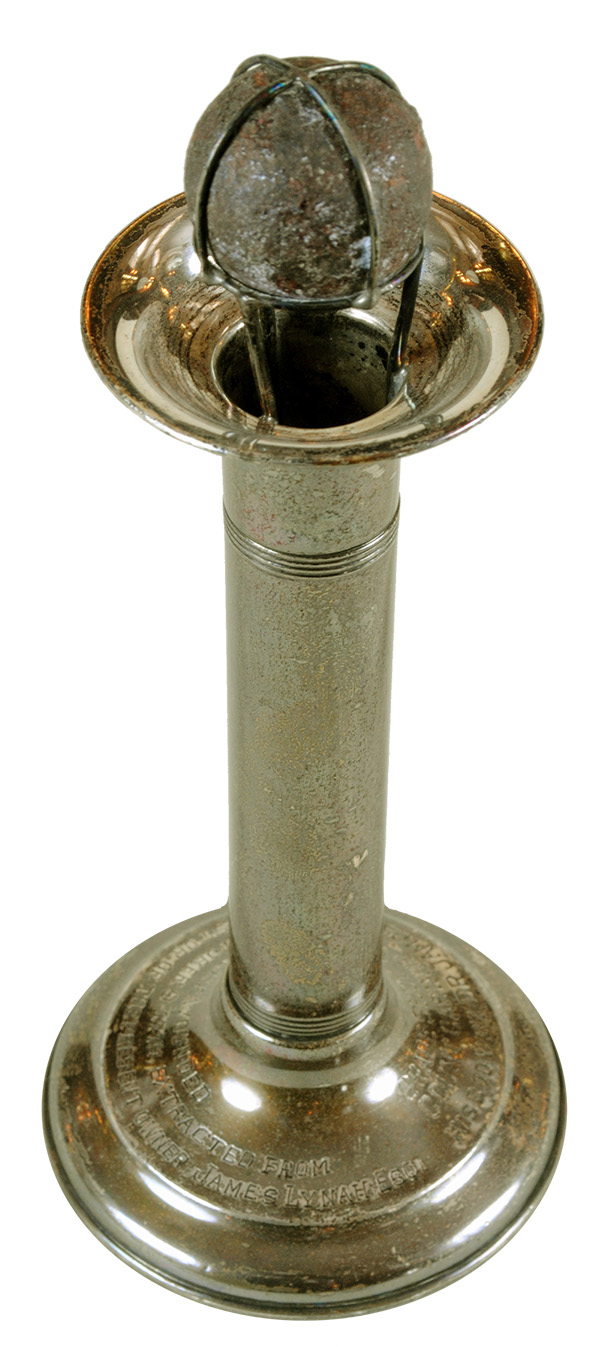
Grapeshot that Killed Casimir Pulaski, GHS 0509-AF-052-002.
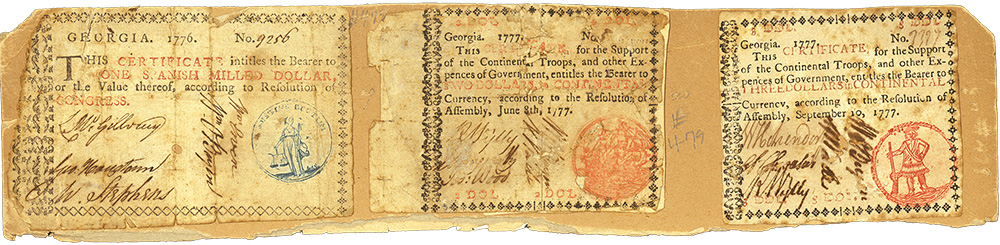
Certificates Issued by State of Georgia During Revolutionary War, 1776, GHS 1361-AF-099-362 a.
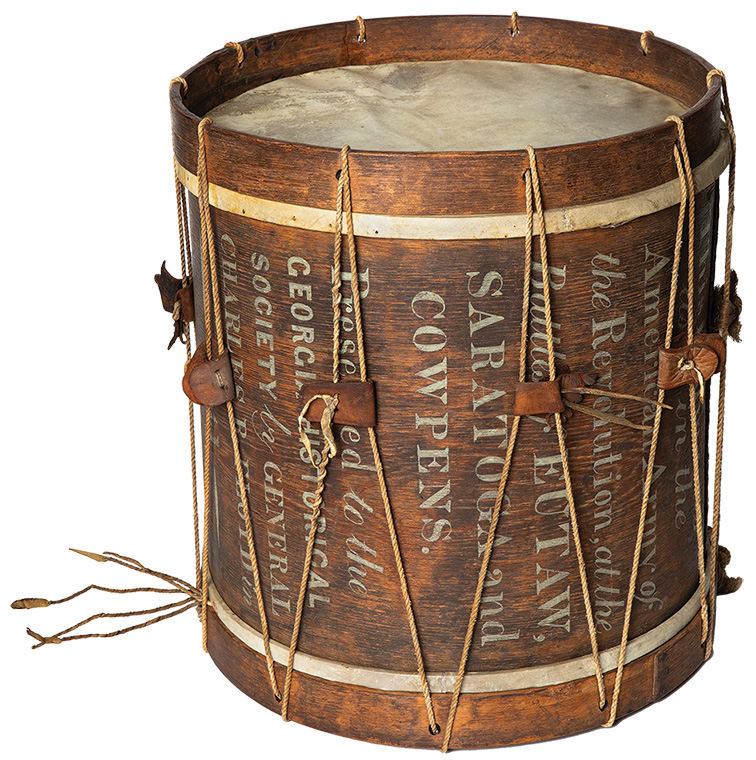
Revolutionary Drum, c. 1780. GHS 1361-Af-107.
The Constitution
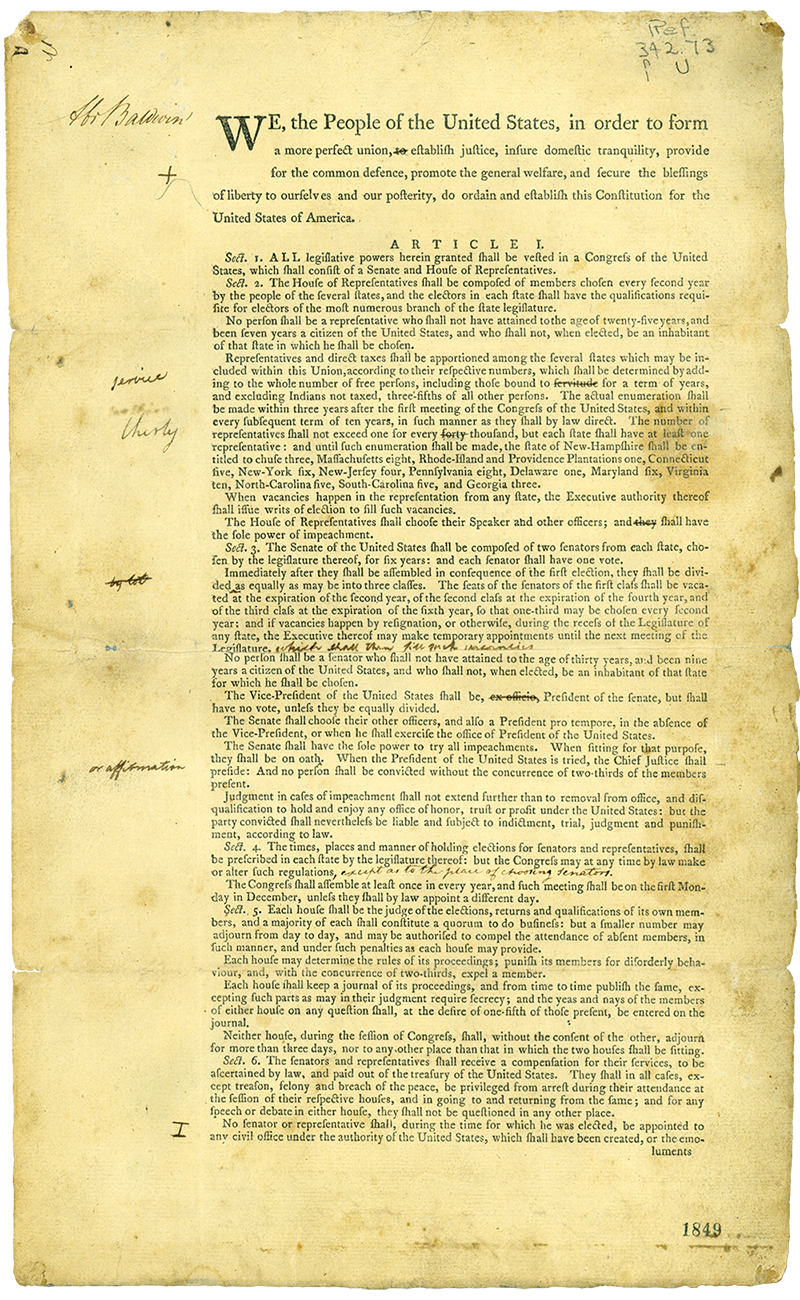
Few documents in American history are more iconic-or continue to have more impact on our daily lives-than the US Constitution. This draft copy of the Constitution belonged to Georgia delegate Abraham Baldwin and is one of the crown jewels of the GHS collection. Baldwin, one of 55 delegates to the 1787 Convention, received this draft, printed by Dunlap and Claypoole, for review. This first printing of the Constitution, printed on four folio leaves complete with Baldwin's signature and marginal notes, is one of only twelve in existence. Baldwin's annotations include deletions and additions that were included in the final version of the document that was ratified by the Convention. It reflects the evolving collaborative approach of the framers that is also part of our collective heritage. Besides its significance as a priceless artifact, this rare document is crucial to understanding the development of our federal system of government.
United States Constitution draft annotated by Abraham Baldwin, 1787, GHS 1703.
Antebellum Georgia: The Cherokee
Impressed by the Whites' ability to communicate over distances by writing, Sequoyah, a Cherokee, invented a system of 84 to 86 characters that represented syllables in spoken Cherokee. Completed in 1821, the syllabary (pictured here with Sequoyah) was rapidly adopted and was used to print articles in the Cherokee Phoenix newspaper, published in New Echota from 1828 to 1834. Georgia authorities viewed the newspaper and the Cherokee as a direct threat to White expansion into the territory. The discovery of gold in North Georgia (an 1852 Dahlonega gold coin is pictured here) led to the Cherokee Removal Bill in 1830, and Whites swarmed over Cherokee land. Major Ridge and other Cherokee signed the Treaty of New Echota without authorization from Chief John Ross and agreed to removal west of the Mississippi in exchange for $5 million. Though ratified by one vote in the US Senate, the Cherokee Nation rejected the treaty, leading directly to forced removal-the Trail of Tears-by the federal government in 1838, one of the most infamous acts in American history. Pictured here is "A Lexicon of the Cherokee Tongue," compiled by Jacob R. Brooks of DeKalb County in the 1840s, and a Record of Spoliations containing 423 claims made by the Cherokee of property taken from them during this period.
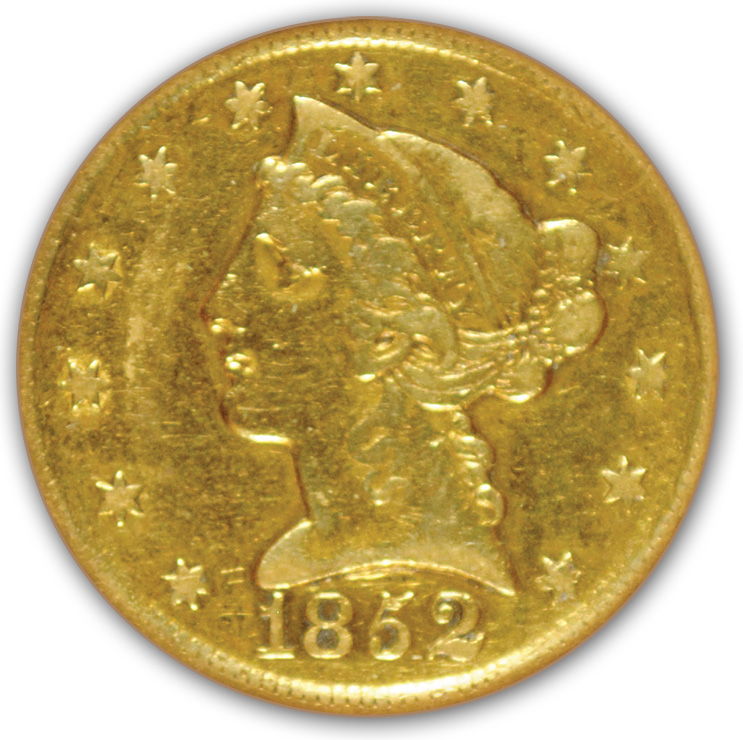
Five Dollar Half Eagle Gold Coin Made from Dahlonega Gold, GHS 2403-AF-068-003.
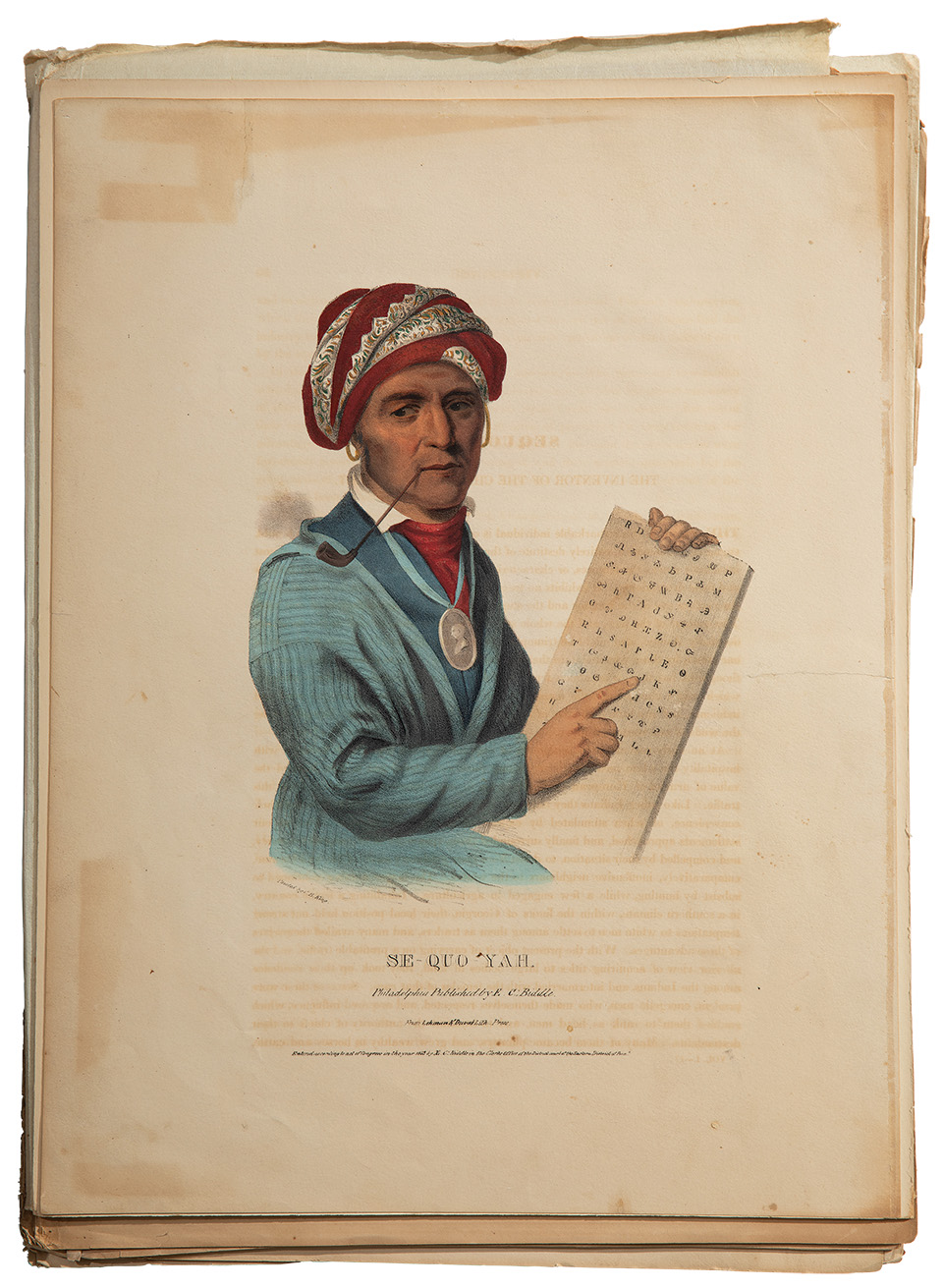
Sequoyah, Thomas L. M'Kenney and James Hall, History of the Indian Tribes of North America (Philadelphia, 1836-1844).
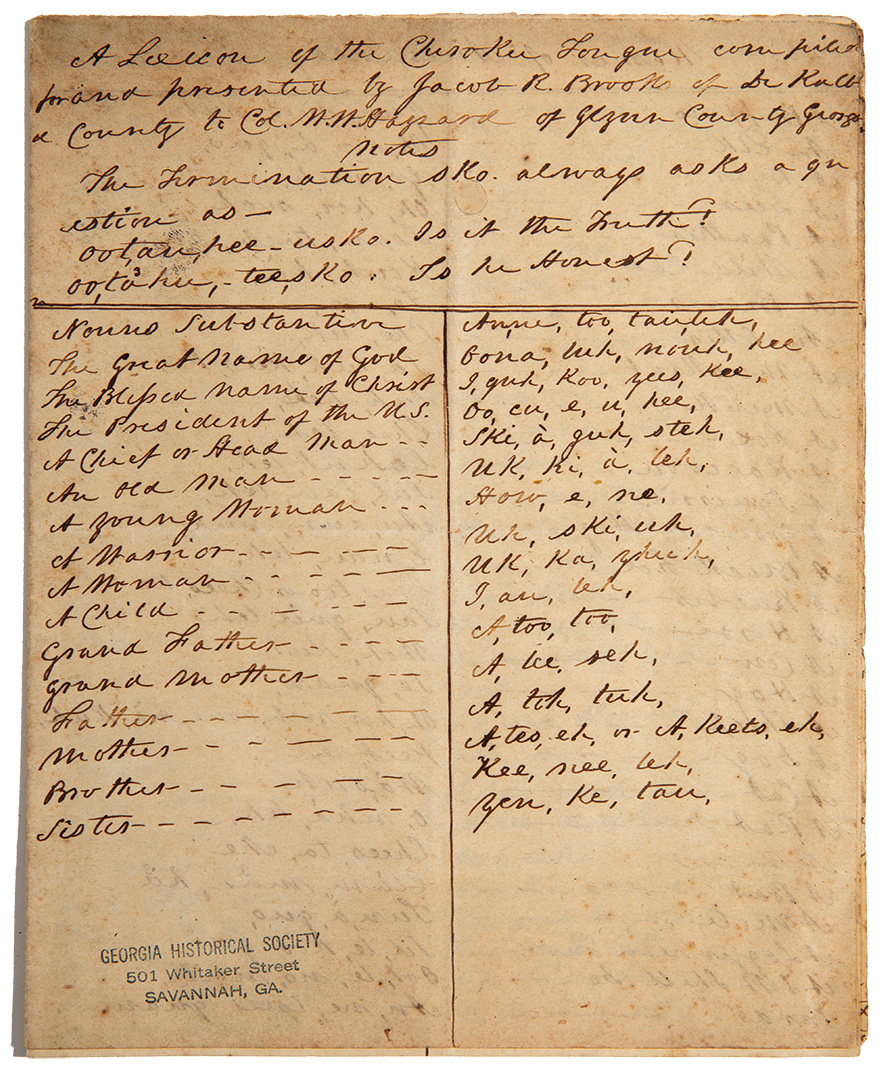
Jacob R. Brooks Cherokee Language Lexicon, GHS 0093.
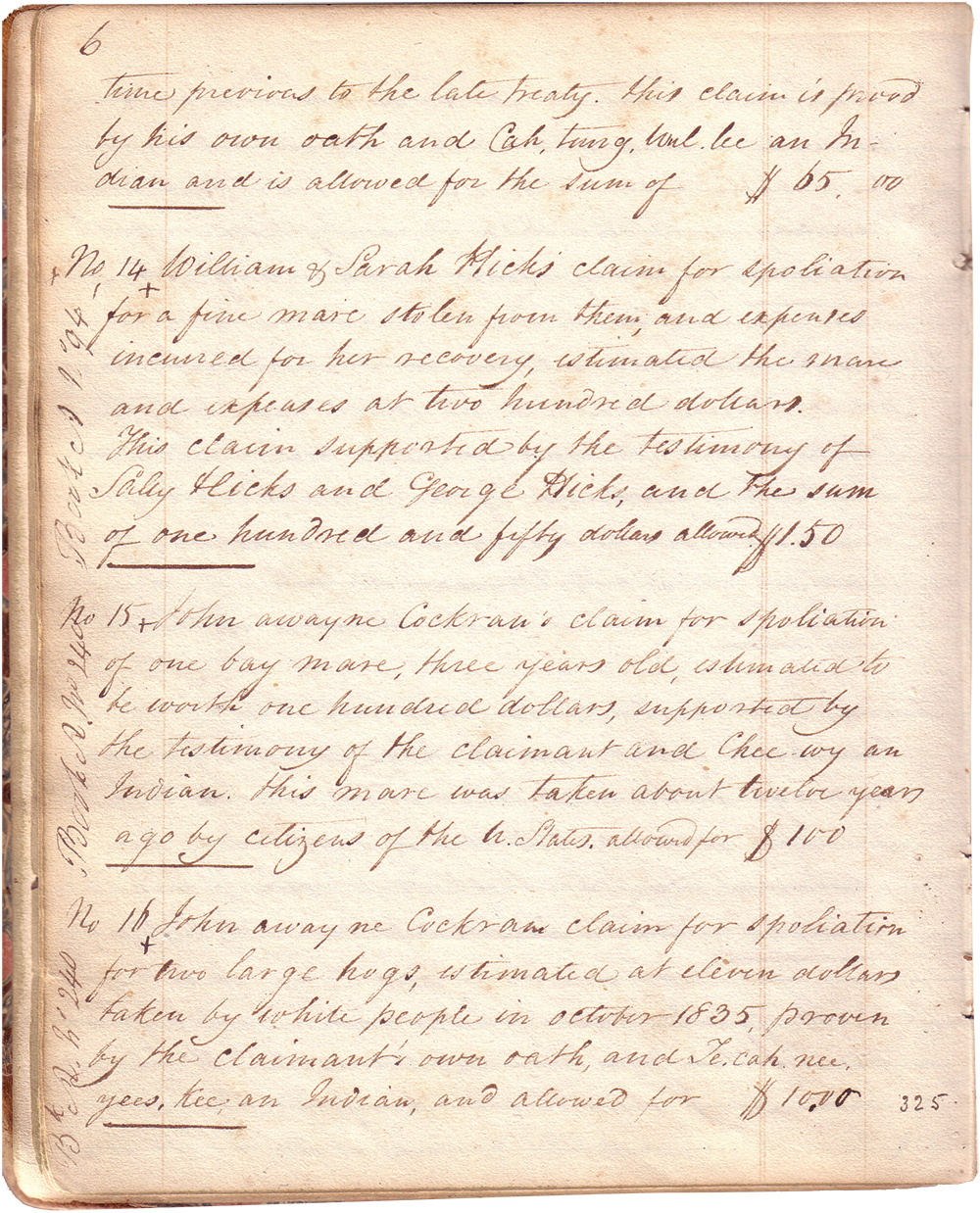
Record of Spoliations (Claims), No. 1, 1836-1838, 1 volume. Harvey Dan Abrams Collection on Cherokee Indians Relocation. GHS 0927-01-02-09.
Slavery
The institution of slavery was banned in the Georgia colony between 1733 and 1750 by the Georgia Trustees, but economic pressure from Whites succeeded in overturning the ban. Slavery spread rapidly as a plantation economy developed that centered first on the export crop of rice and later on cotton. Between 1750 and 1775 Georgia's enslaved population grew from less than 500 to approximately 18,000 people. As westward White settlement displaced Georgia's indigenous population, slavery spread throughout the state. In 1860, on the eve of the Civil War, Georgia held more than 462,000 enslaved people, 44 percent of the state's total population-more enslaved people and slaveholders than any state in the lower South and second only to Virginia nationally. Enslaved individuals had no legal rights, and they struggled to establish some degree of autonomy for themselves. Still, against overwhelming odds, enslaved people created families, worshipped, resisted their owners in large ways and small, and asserted their humanity in ways that kept alive their enduring quest for freedom.
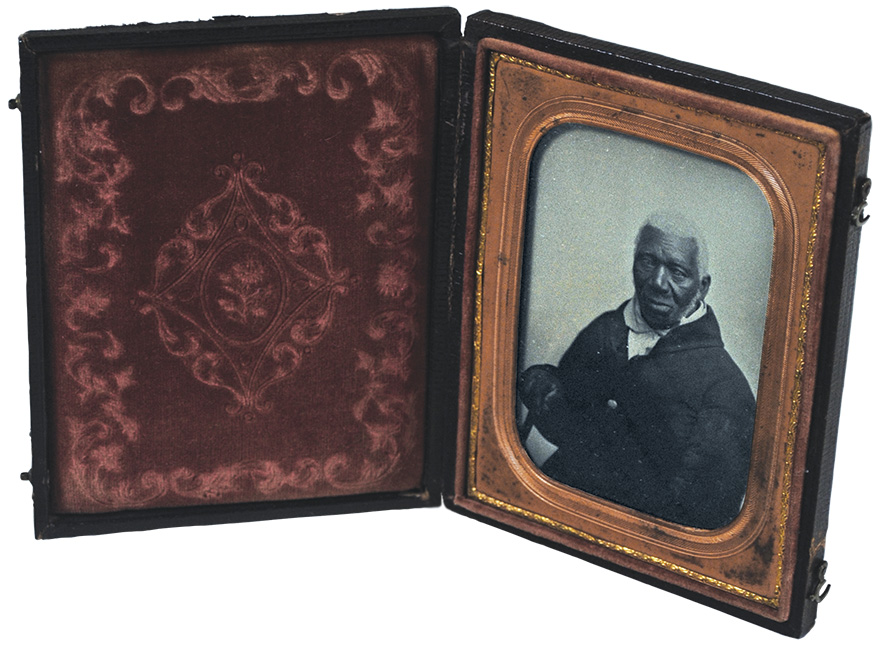
Portrait, unidentified Black man, GHS 1361-PH-42-18-01.
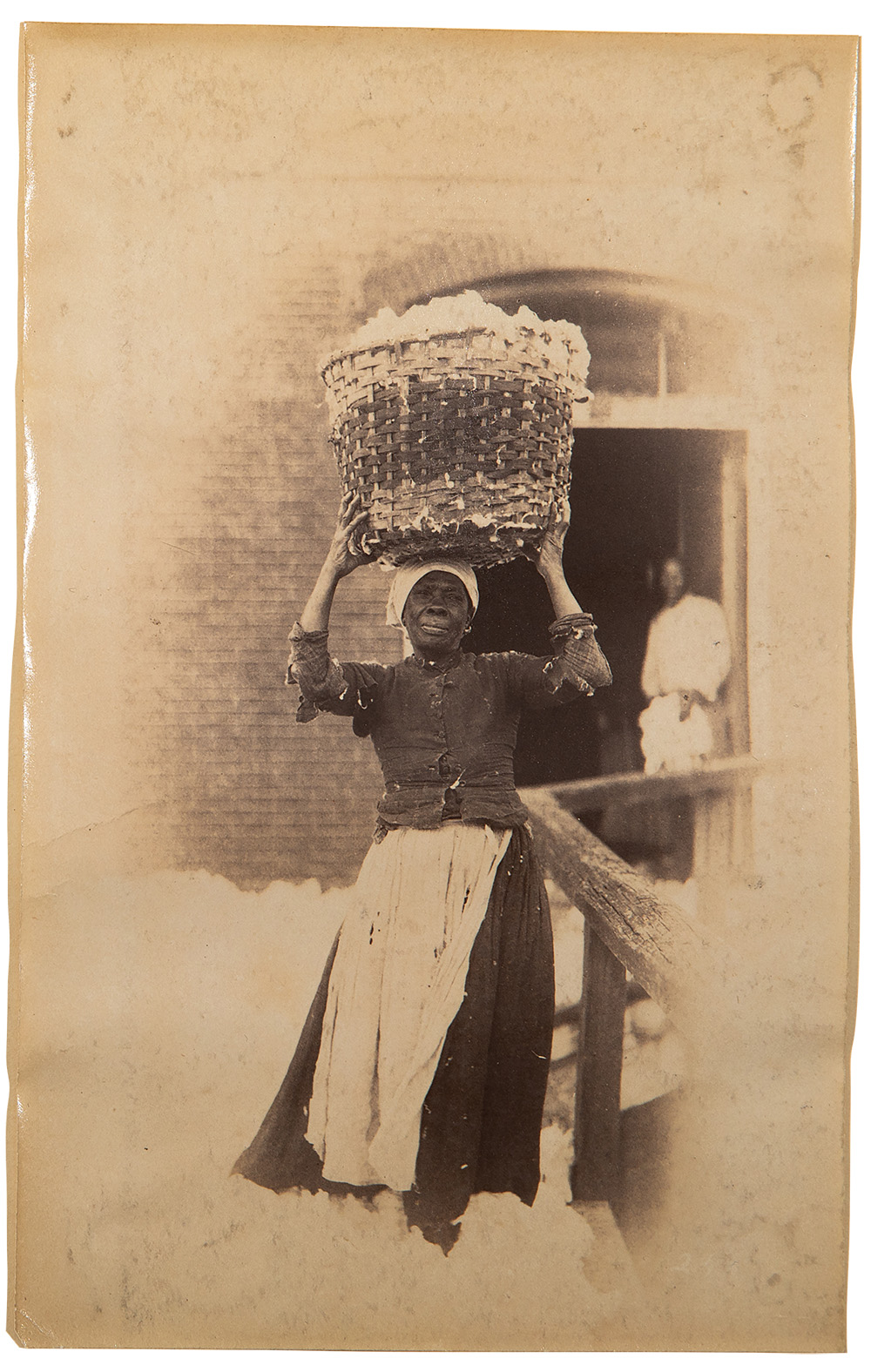
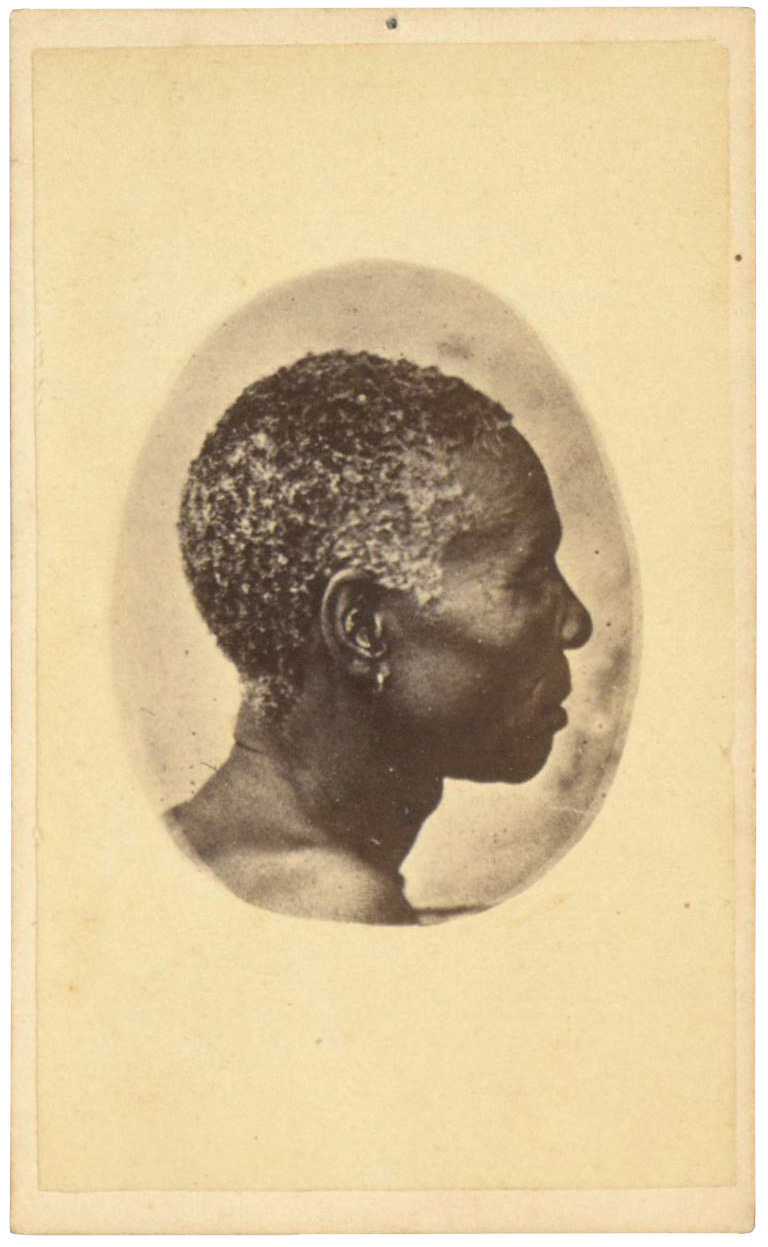
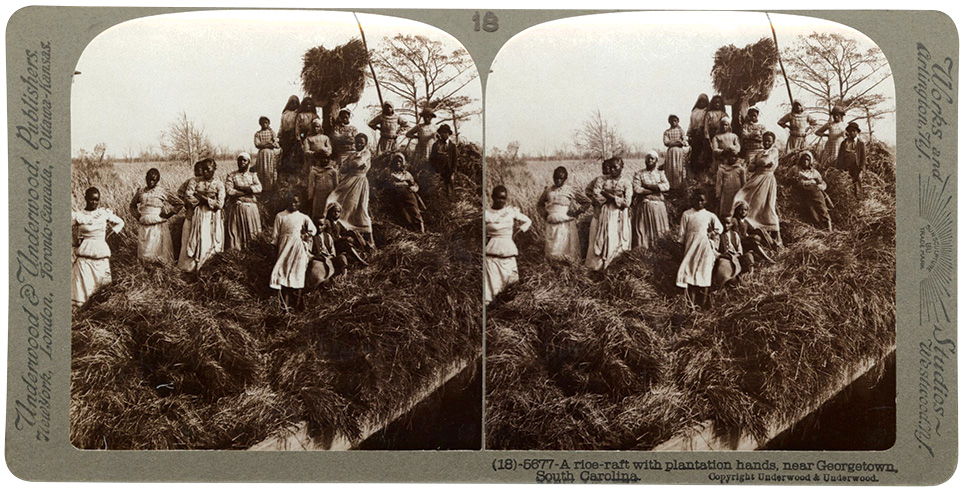
Portrait, unidentified Black woman, GHS 1361-PH-41-67-01; Unidentified Black Male, GHS 1361-CP-02-01; Group portrait of people on a rice raft, GHS 1361-SG-03-04-B-01.
The Civil War and Emancipation
The Civil War repudiated the doctrine of secession and destroyed the institution of slavery-more than 460,000 enslaved people were freed in Georgia during and after the war. The War also brought African Americans into the armed forces of the United States. Over 200,000 served in the US Army and Navy. Included here is a stereograph of the First South Carolina (US). Organized in 1862, the "First South," as it was called, was the first African-American regiment ever raised for United States service. Among its ranks were hundreds of Black Georgians, men who had self-liberated before the issuance of the Emancipation Proclamation. The regiment was later re-designated the 33rd USCT (United States Colored Troops). Harriet Tubman and Susie King Taylor (who was married to a member of the regiment) served with the First South, providing vital services as nurse and scout. Other Black Americans served as well, including the formerly enslaved William Butler, in Company H, 2nd US Colored Troops. This poignant letter from his wife Ann, dated January 1865, begs for news from William. She longs for his safe return, and sends news of their children, who are attending school. The letter was found in a knapsack near a dead soldier's body, presumably William, at the Battle of Natural Bridge in Florida in March 1865. There were three quarters of a million casualties in the Civil War, including one newly freed soldier, beloved by his family, who died to help preserve the American Republic and extend the promise of the Declaration of Independence to all Americans.
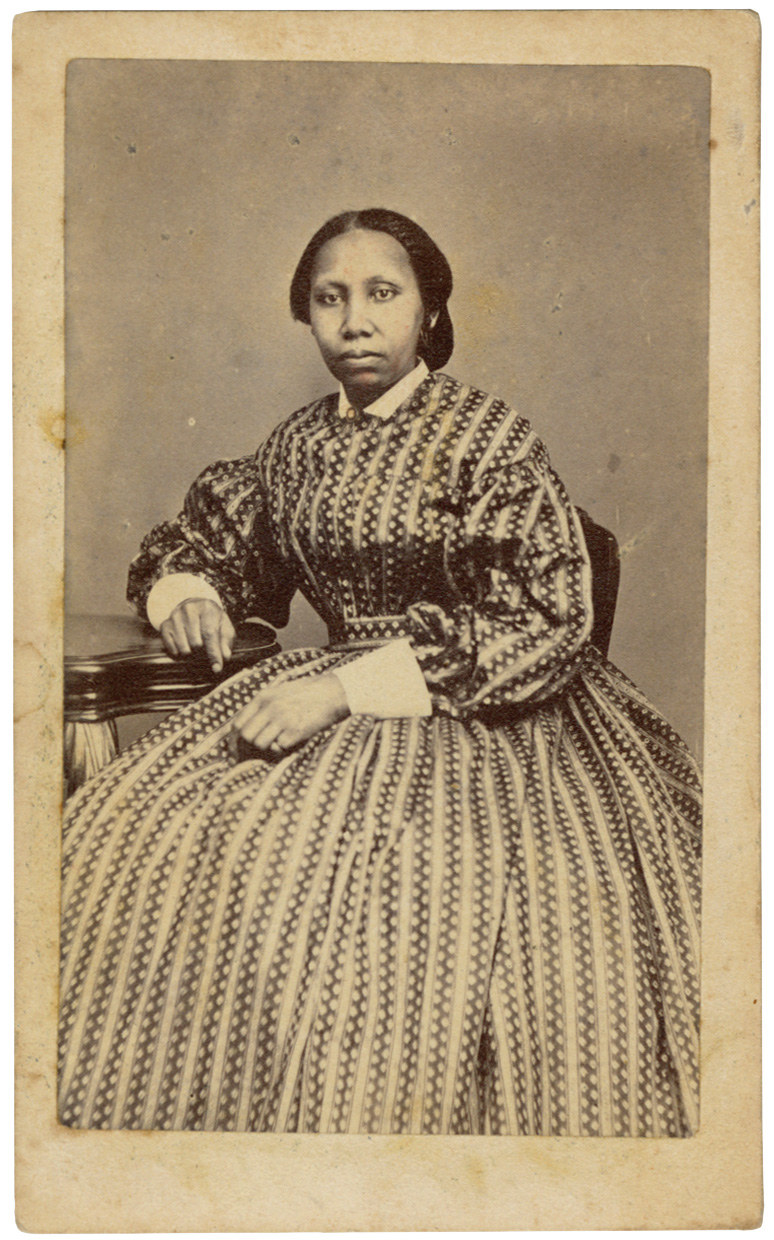
Unidentified Black woman, GHS 1361-PH-41-67-01.
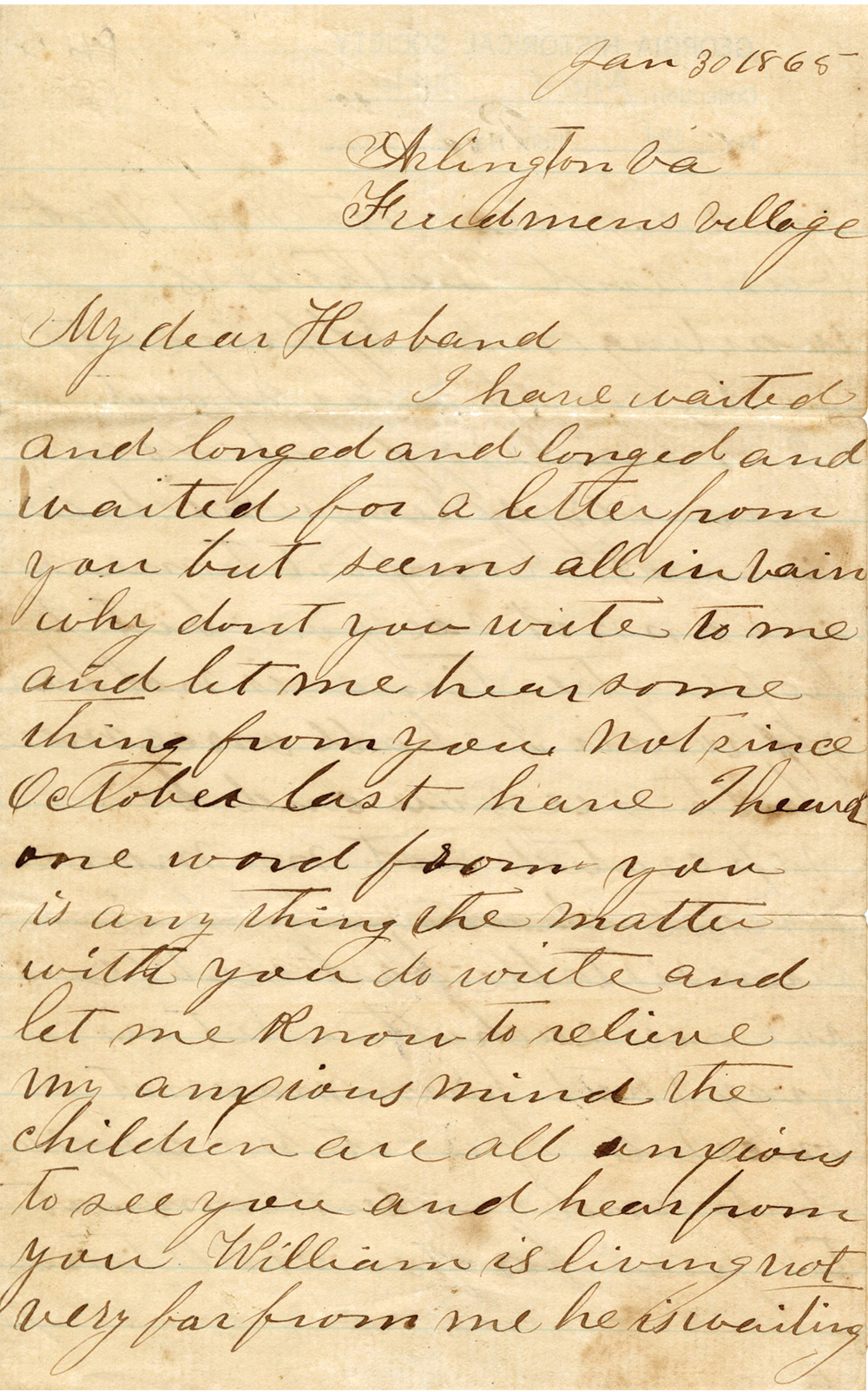
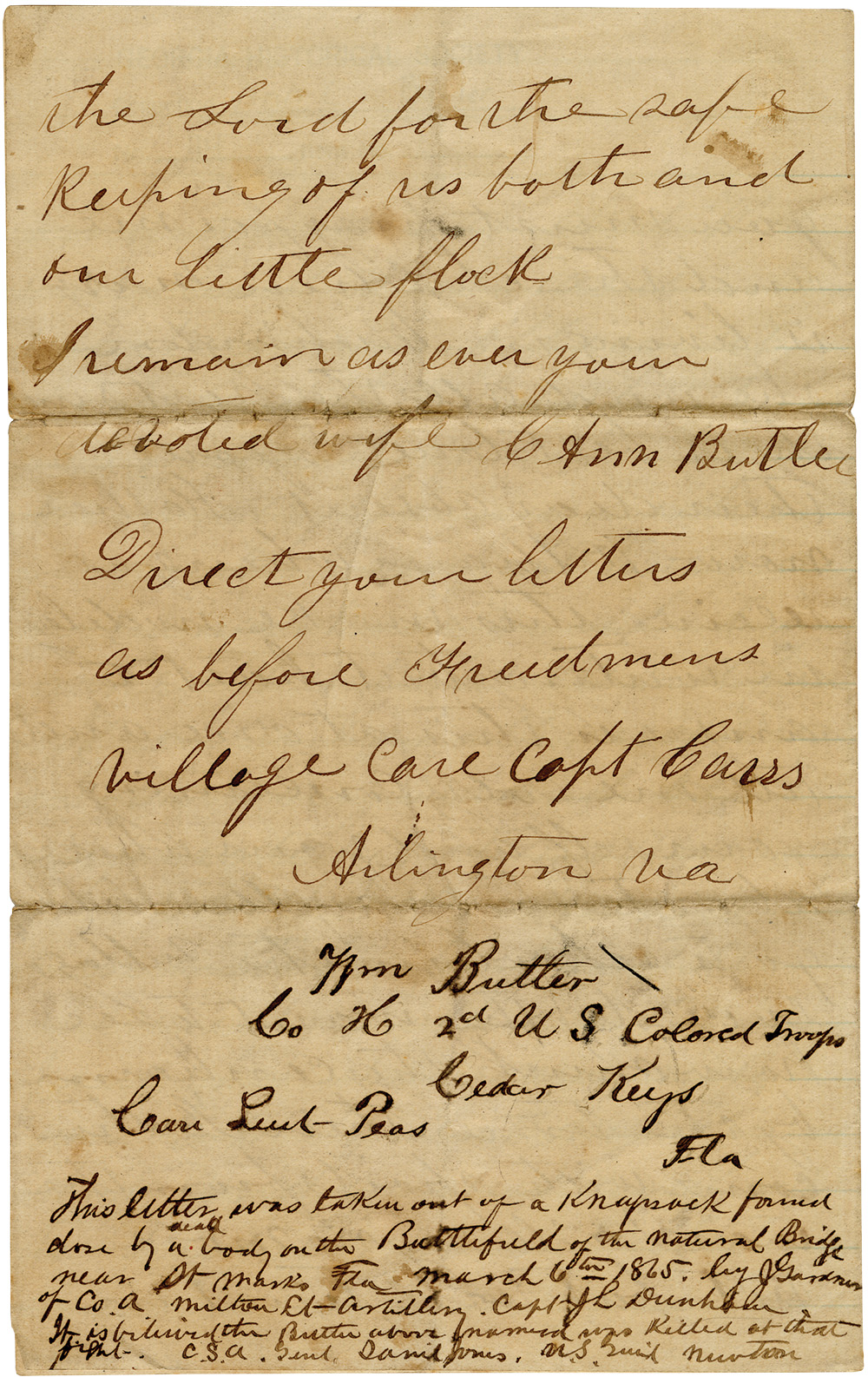
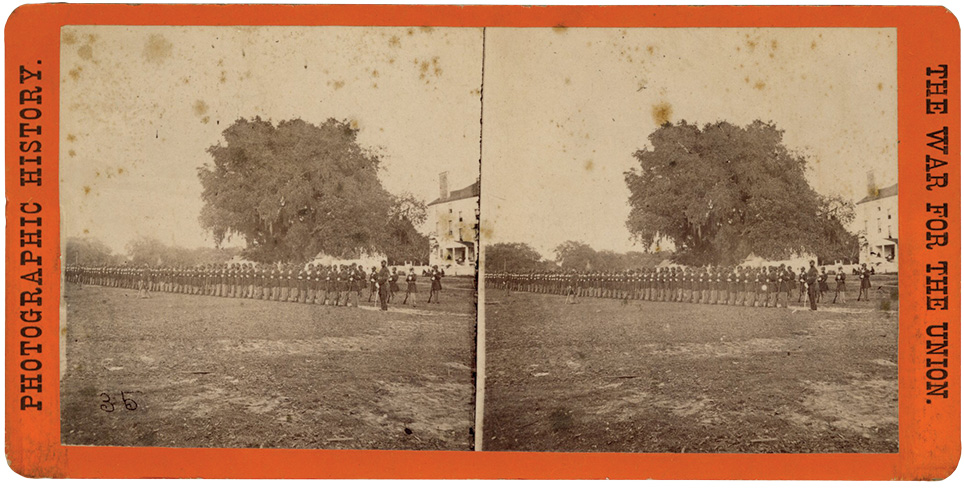
C. Ann Butler Civil War letter to William Butler, 1865, GHS 0114; 1st South Carolina Volunteer Infantry Regiment dress parade, GHS 1361-SG-04-02-A-04.
Sherman
Georgia had the largest population and the largest number of both enslaved people and enslavers of any Deep South state in 1861, and thus played a crucial role in the secession crisis and the formation of the Confederacy. Georgia was also home to the most decisive US military incursion into the Deep South: US General William Tecumseh Sherman's campaign from Chattanooga to Atlanta in 1864. Atlanta's importance as a railroad hub made it strategically vital to the Confederacy and a major target for the United States Army. Sherman's campaign began in May and ended with Atlanta's fall in September, a major military and psychological setback to the Confederacy. It also secured President Abraham Lincoln's re-election in November. Sherman's subsequent March to the Sea was an equally devastating blow to Confederate morale, capped by the December capture of Savannah. This wartime photograph of Sherman was taken by famed Civil War photographer Matthew Brady in his Washington, DC studio, probably when Sherman and his troops participated in the May 1865 Grand Review of the Armies in celebration of the US victory. Note the high-topped officer's riding boots that he would have worn in the field and were rarely captured in photographs. The 1864 map of northern Georgia, so crucial to Sherman's Atlanta campaign, was made under the direction of Captain William Emery Merrill, Chief Topographical Engineer, Army of the Cumberland. It was drawn and printed in the field during the war and is a copy of the one used by Sherman on his campaign from Chattanooga to Atlanta.
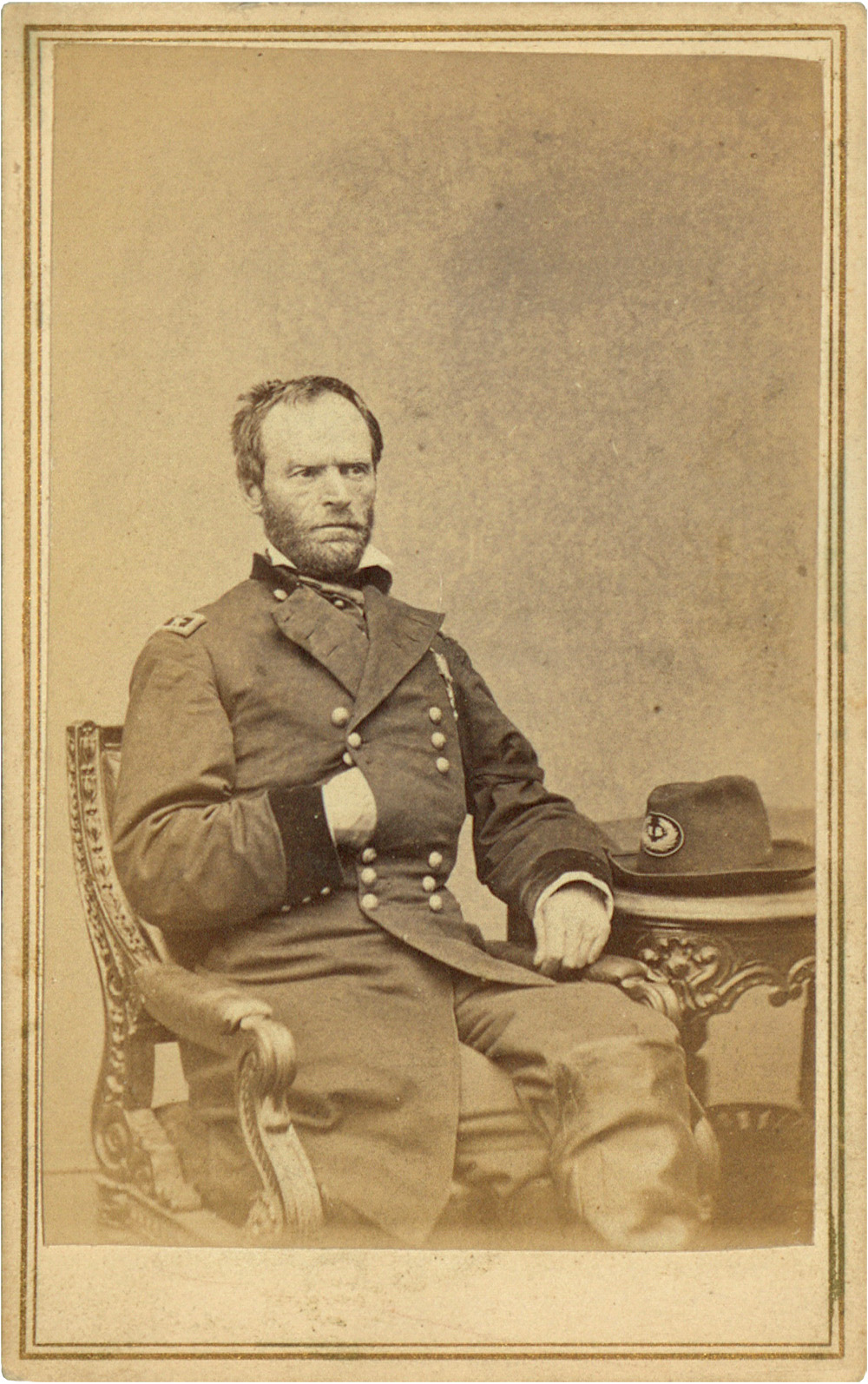
Matthew Brady, "United States Army Major General William T. Sherman" portrait, undated. GHS 1361-PH-41-65-01.
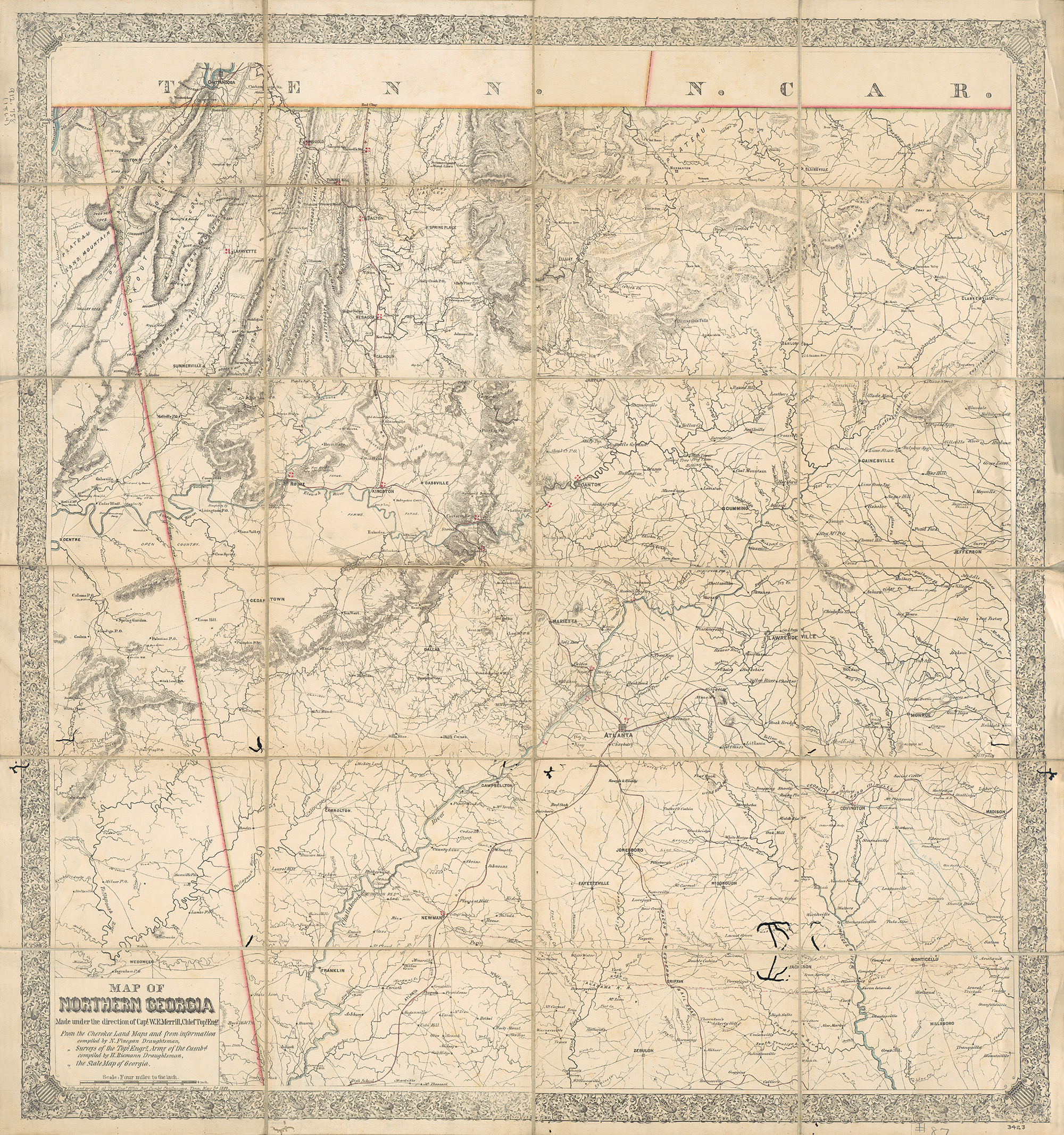
Map of Northern Georgia, 1864. GHS 1361-MP-087, used by Sherman.
Reconstruction
Reconstruction, the period following the Civil War, was one of the most divisive and consequential in American history. The United States attempted to implement interracial democracy for the first time, as newly freed men and women sought to take their rightful place in American political, social, and economic life. At the national level, constitutional amendments permanently altered state-federal relations, the definition of American citizenship, and granted Black men the right to vote. In the South, a politically mobilized Black community joined with White allies to bring the Republican Party to power. Tunis Campbell, an African-American native of New Jersey, settled in McIntosh County after the war, organized an association of Black landholders along the coast, and became the highest-ranking, most influential African-American politician in 19th-century Georgia. He led an effective political movement that registered Black voters and elected Black delegates to Georgia's constitutional convention in 1867 and the Georgia legislature in 1868. Campbell became a symbol of all that White Democrats wanted to resist, and his 1872 letter to Governor Benjamin Conley, reproduced here, details the threats and violence that he faced on a daily basis. Ultimately, Black political engagement could not overcome the inevitable White backlash, led by the Ku Klux Klan, that ended the promise of Reconstruction and saw the triumph of White supremacy and Jim Crow. Interracial democracy would have to wait for the Civil Rights Movement nearly a century later.
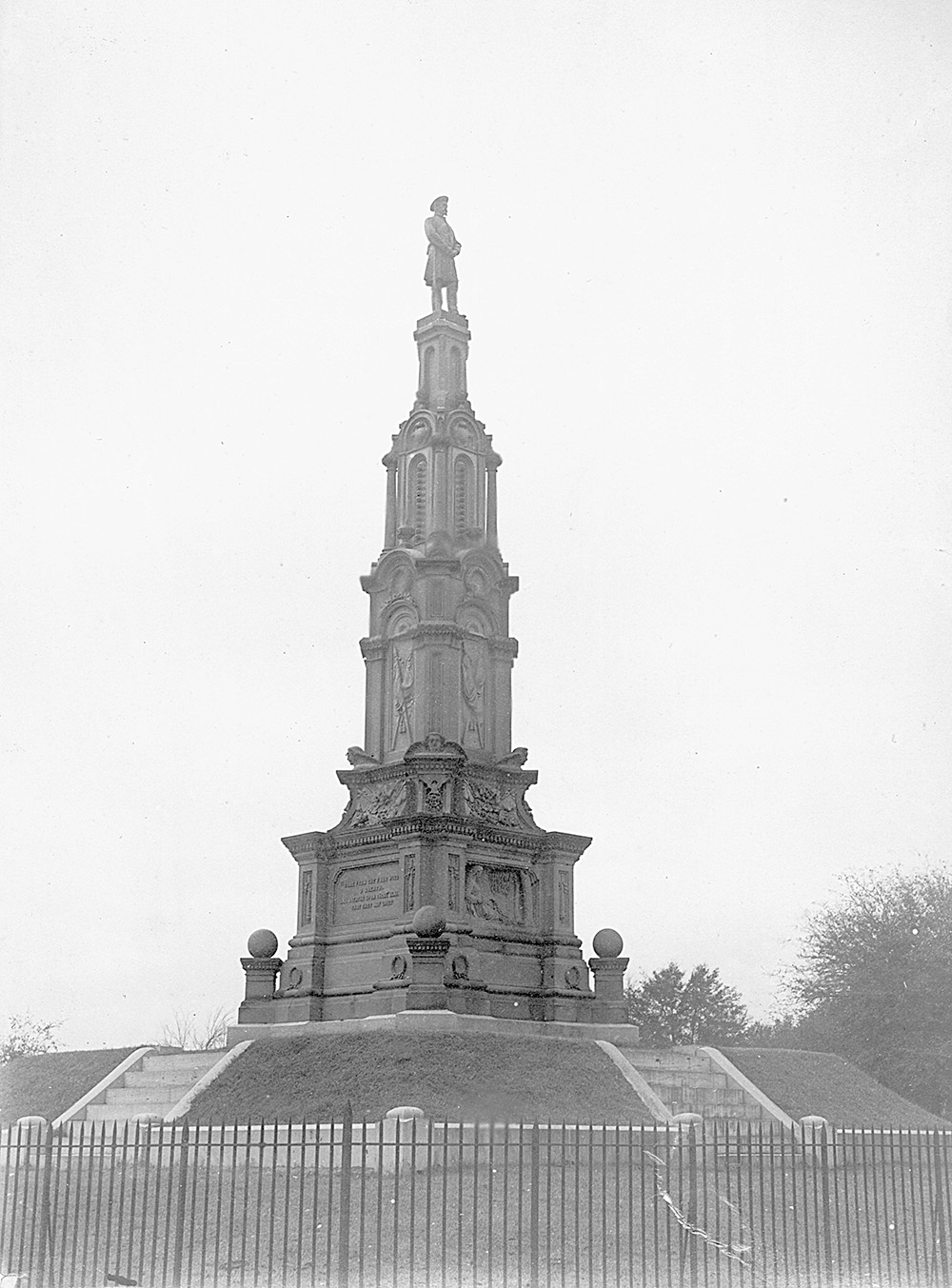
Confederate Monument, Savannah, GHS 1361-PH-22-03-4369.
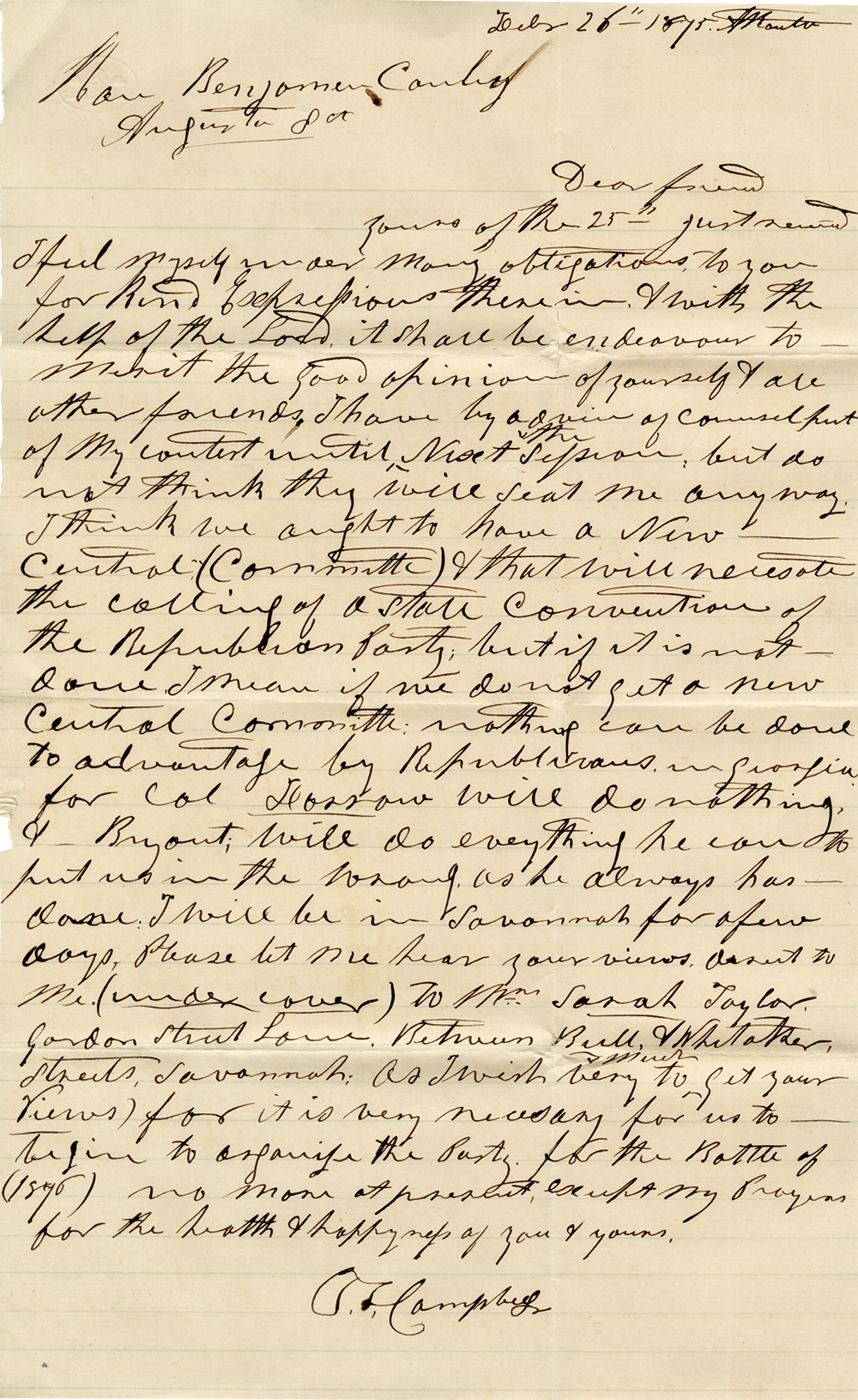
Tunis Campbell letter to Benjamin Connoly, Benjamin F. Conley Papers, GHS 2688.
Jim Crow
The indignities of Jim Crow seeped into every facet of social, political, and economic life in segregated America. That reality is nowhere better illustrated than in the architectural drawing of a segregated waiting room in the Central of Georgia Railway station depot in Monticello, Georgia, dated 1901, and the shackles used on Black convict labor chain-gangs in the late nineteenth century. The harsh and humiliating realities of Jim Crow are sanitized in the precise architect's handwriting denoting the White and Colored bathrooms. Note that White women are referred to as "Ladies," a social distinction denied to all Black women. It was no accident that the movement to destroy the institutionalized dehumanization of African Americans in this country-and the violent White backlash it provoked-would begin in places of public accommodation like those rendered so bloodlessly here in black and white.
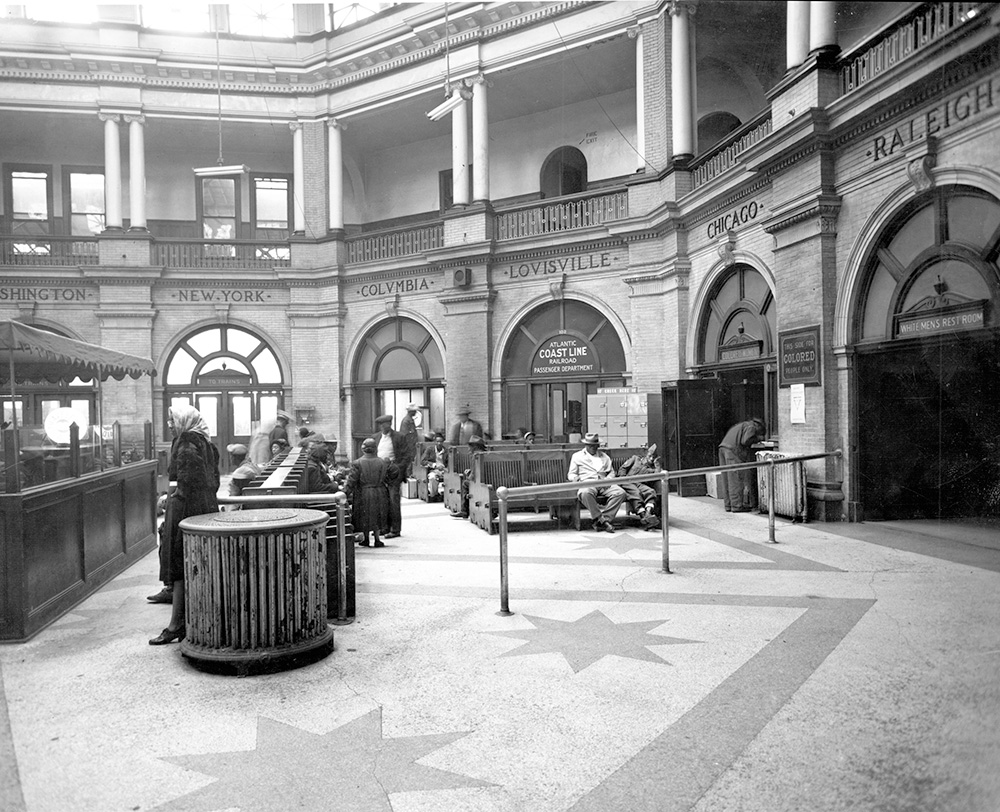
Central of Georgia Railway Depot, Monticello, Georgia, 1901, Central of Georgia Railway Records, 1835-1971, GHS 1362.
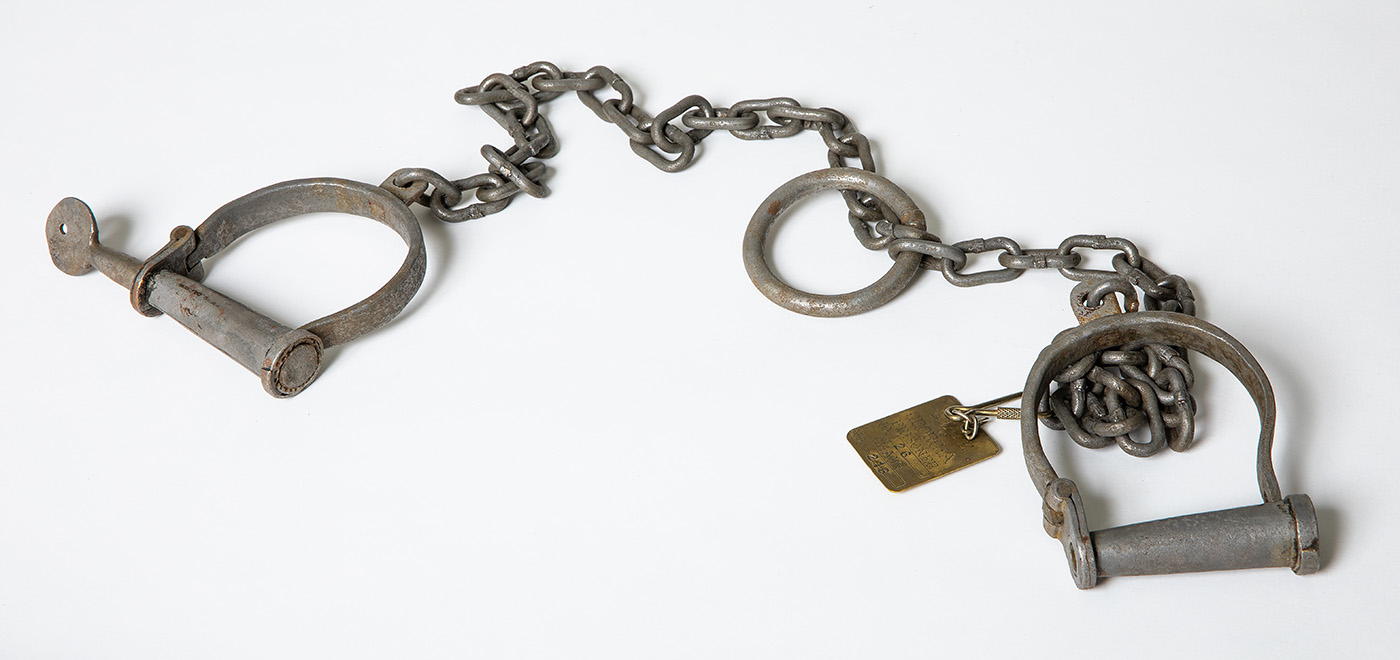
Convict labor shackles, GHS 2746-AF-0005; Union Station, Savannah, 1950, GHS 1361-PH-29-05-5904.
The Progressive Era
Few people had the impact on young women that one Georgian has for over a century. Juliette Gordon Low was partially deaf, mentally depressed, with no children of her own, yet she founded the Girl Scouts of the USA in Progressive-era Georgia. The Savannah native married William Low, a wealthy British merchant, but their marriage was falling apart when he died suddenly in 1905. Six years later, Juliette met Sir Robert Baden-Powell, the British founder of the Boy Scouts, and the meeting changed her life. In 1912 she returned to Georgia and started the Girl Scouts of the USA (five 1920s-era Girl Scout badges pictured here), which grew to become the largest voluntary association for women and girls in the United States. By 1925, there were 90,000 Girl Scouts. Today there are 3.2 million, still influenced by the vision and dream of the Georgian known as Daisy.
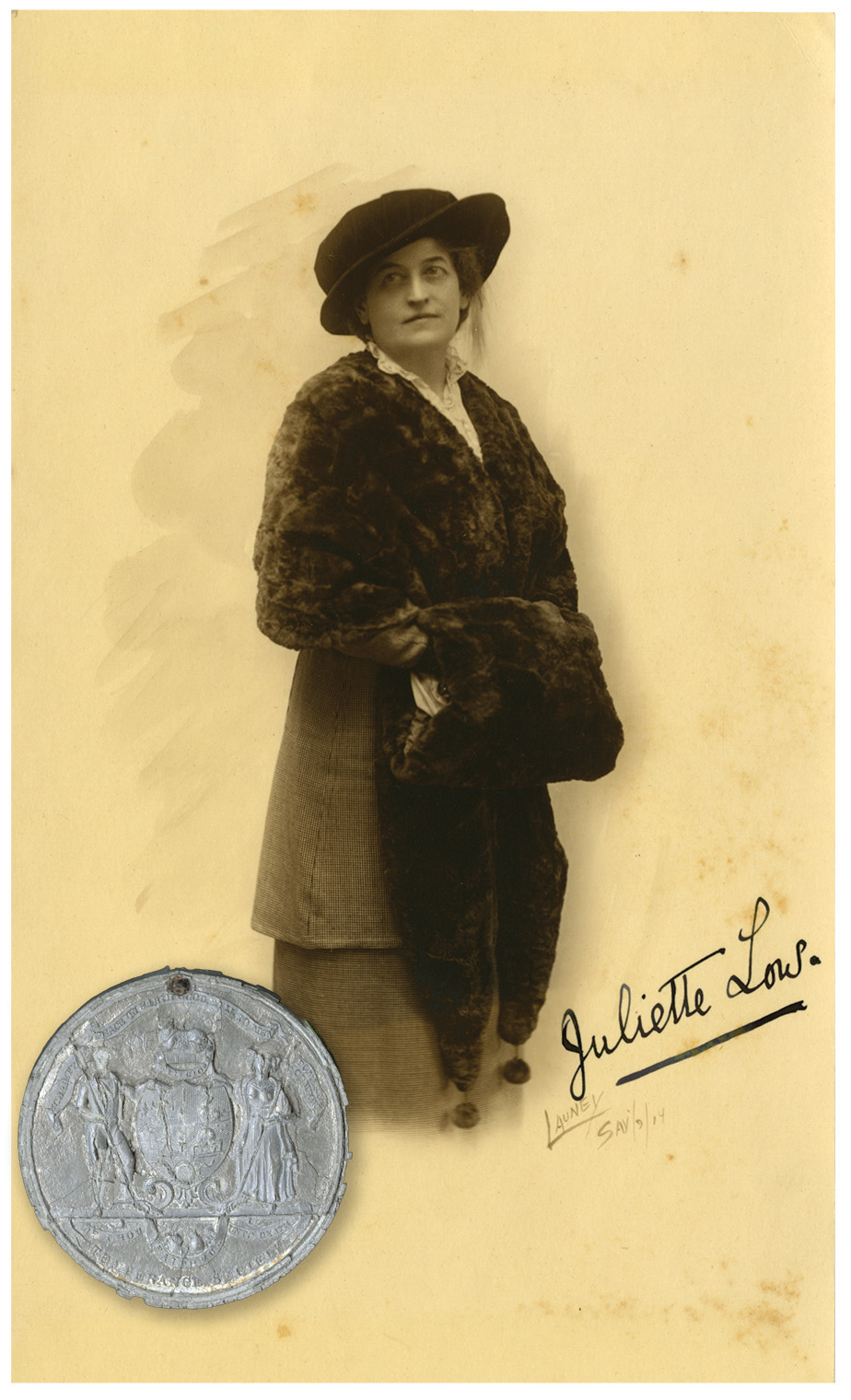
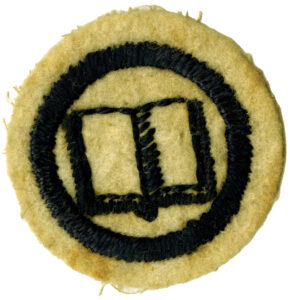
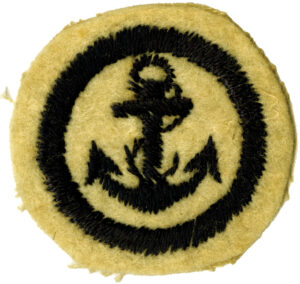
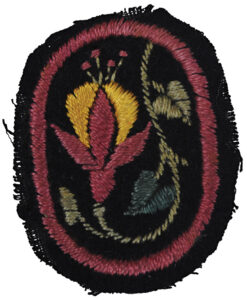
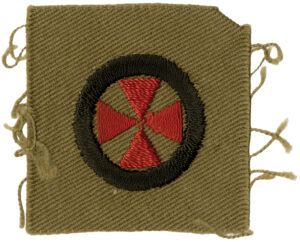
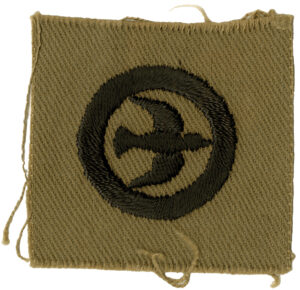
Juliette Gordon Low's Girl Scout Badges, c.1920s, Gordon Family Papers, GHS 0318-AF-0134-005, 006, 014, 016, 019; Juliette Gordon Low Photograph, Gordon Family Papers, GHS 318-PH-40-443-3729; Girl Scout Troop Certificate, GHS 2351; Temperance Declaration Medal, GHS 1361-AF-012-155.
The Rise of Atlanta and the Railroad
In 1837 the Western and Atlantic Railroad staked out a point on a ridge seven miles east of the Chattahoochee River as the southern end of a rail line they planned to build south from Chattanooga, Tennessee. The town was called Terminus, which literally means "end of the line." Two other railroad lines later converged in the center of town, and the city now called Atlanta was on its way to becoming the commercial and transportation center that it remains to this day. The railroad made Atlanta a transportation hub and the target of Gen. William Sherman's US Army in 1864. The railroad also transformed antebellum Georgia. It revolutionized the way that people and goods moved from place to place, reconfiguring Georgia's economic and social landscape. As Georgia's first railroad, the Central of Georgia (founded 1833) linked Savannah with upland cotton plantations. The Central of Georgia grew into one of the most significant rail and banking corporations in the American South, serving as a vital part of Georgia's transportation and financial infrastructure for more than a century. Atlanta rose from the ashes in the years after the Civil War, as city leaders hosted a series of "cotton expositions," the most ambitious of which was the 1895 Cotton States and International Exposition. It showcased Atlanta as a regional business center and helped to attract investment that would be essential to the city's prominence in the twentieth century.
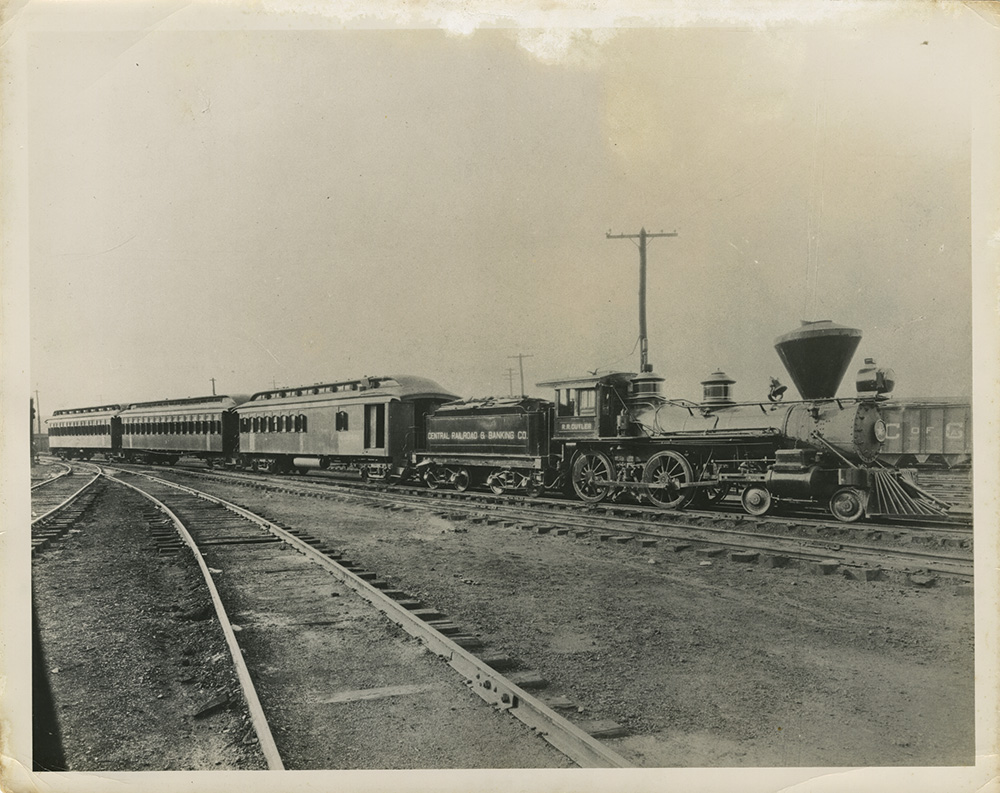
Central of Georgia photograph, undated, GHS 1360-PH-28-11-01.
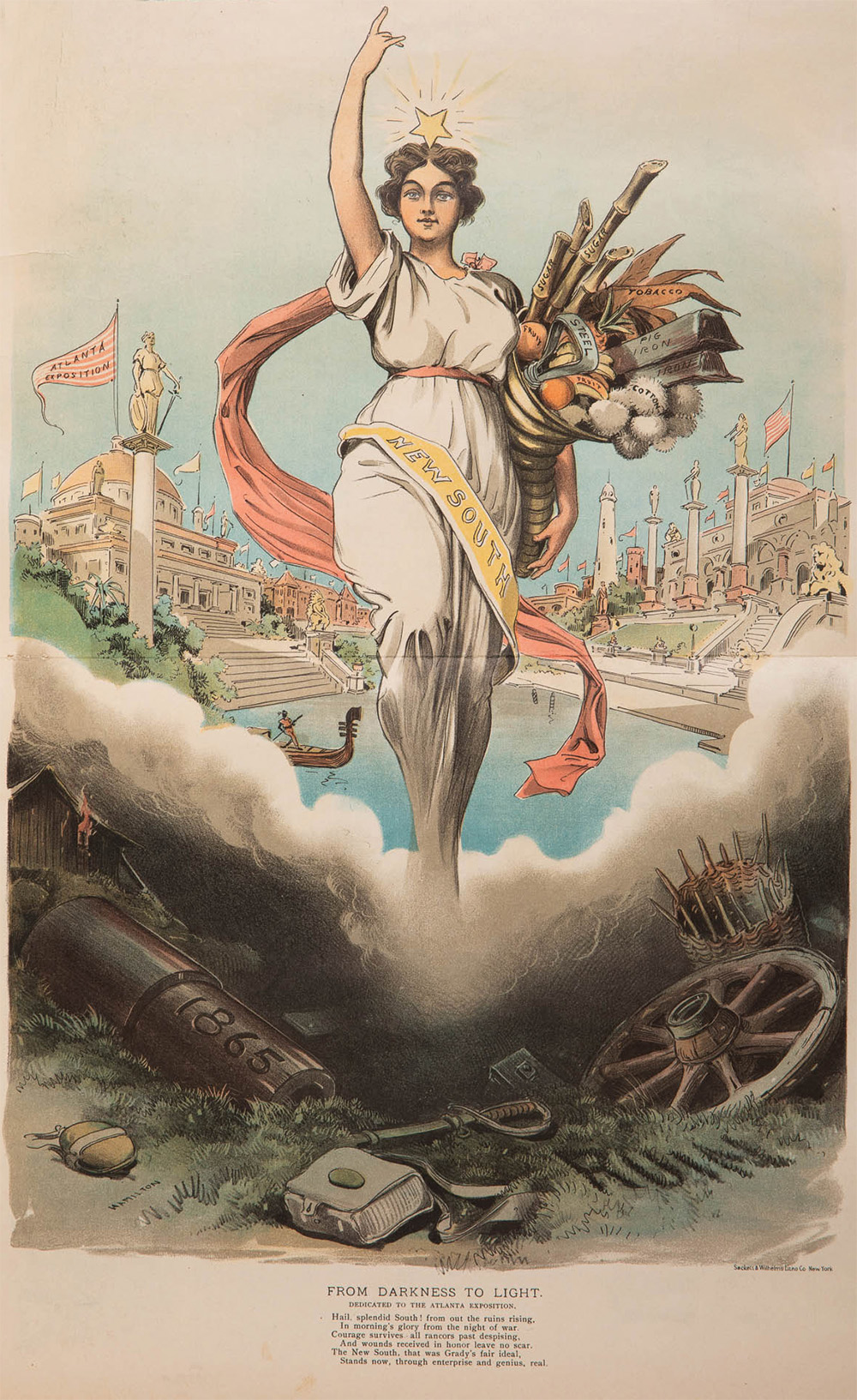
"From Darkness to Light," Cotton State and International Exposition poster, 1895, GHS 1361PR-OS1-59-01
White Supremacy
The early twentieth century was a particularly bleak period for race relations in Georgia and America. The workforce demands of the emerging industrial revolution brought increased immigration from deeply Catholic southern and eastern Europe, and the Great Migration sent many African Americans from the southern countryside to northern urban centers. America's changing demographics and increasing economic dislocation brought with it a corresponding rise in Protestant nativism and White supremacy, which attained broad political support. The Ku Klux Klan, created originally during Reconstruction, was revived atop Stone Mountain in Georgia in 1915 following the lynching of Leo Frank in August. Its popularity peaked in the 1920s, with membership surpassing 4 million nationally. Along with continued racial hostility toward Blacks the new Klan-particularly strong in the Midwest-was militantly opposed to Roman Catholics, Jews, immigrants, and organized labor. The Klan declined during World War II but found new life during the Civil Rights Movement. The felt fez seen here, complete with tassel, belonged to Edra C. Moore (1899-1960), a native of Shiloh, Georgia, who joined the Klan in 1929. He graduated from Georgia State Military Academy, became a police officer in Washington, DC, and served in the Army Reserve during World War II. The Klan application and Crusade card date from the Civil Rights Movement.
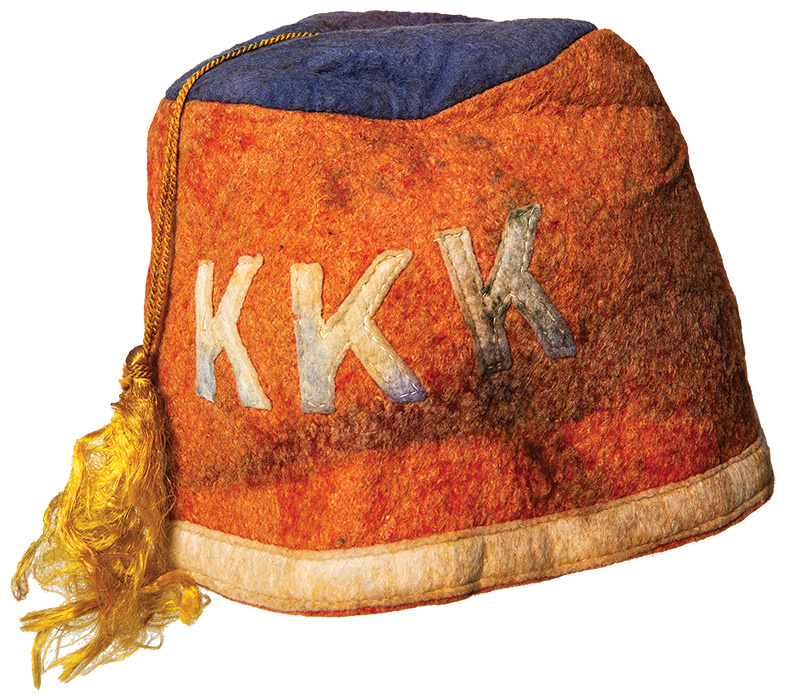
KKK Headgear, c.1929, GHS 2452.
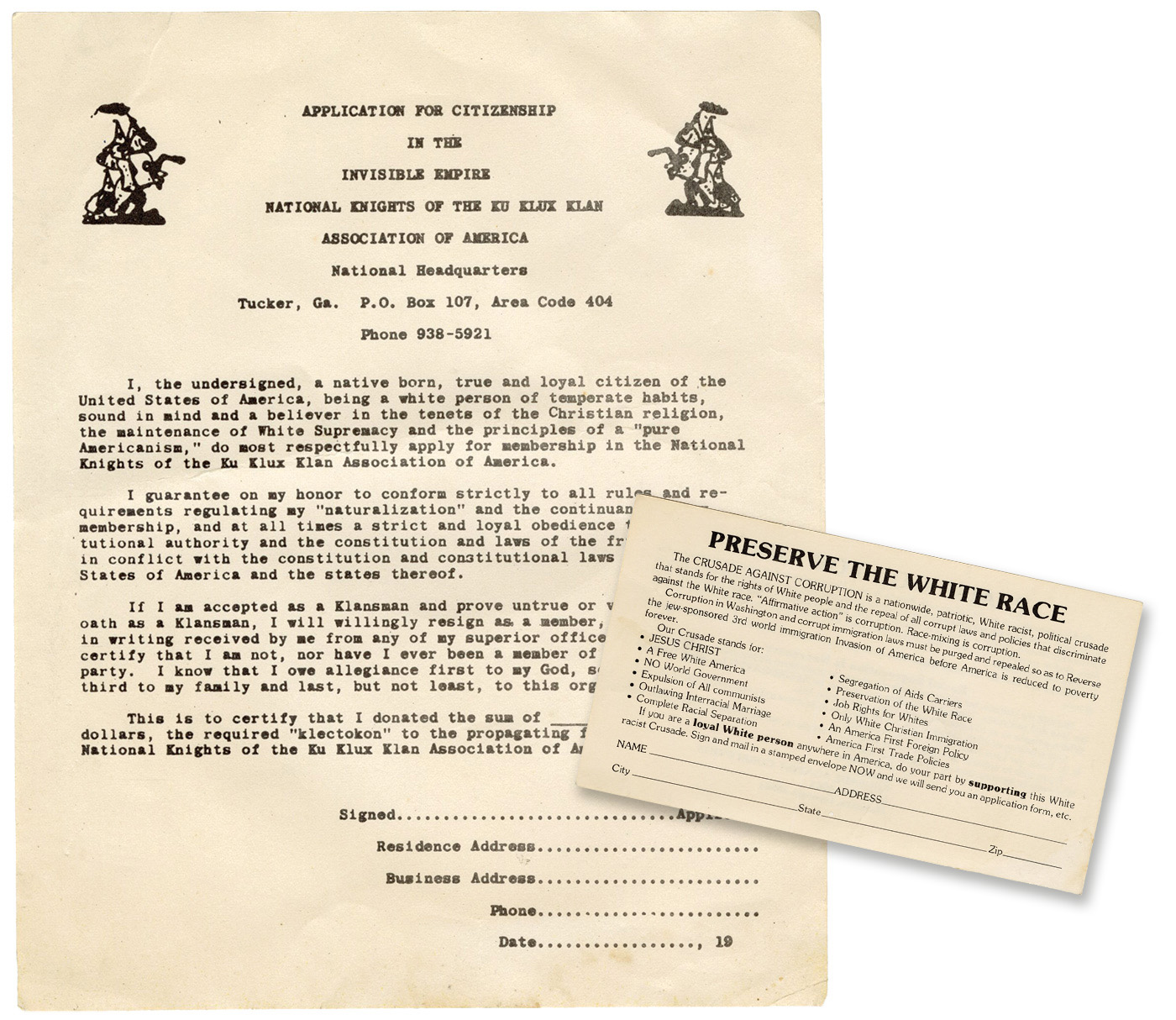
Application for Citizenship in the Invisible Empire, "Preserve the White Race," Edwin L. Jackson Collection, GHS 2746
World War I
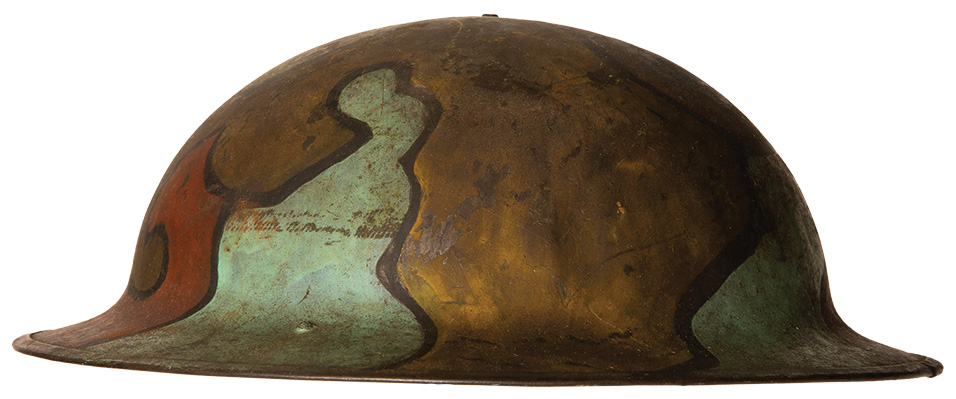
World War I cast a long shadow over the 20th century, launching America onto the world stage for the first time. One Georgia native, Frank O'Driscoll "Monk" Hunter, played an important role in that conflict and the larger one to come. Hunter was Georgia's only World War I flying ace, shooting down nine German planes as part of Eddie Rickenbacker's 94th Aero Squadron and the 103rd Aero Squadron, known previously as the Lafayette Escadrille. Hunter's pilot license, signed by aviation pioneer Orville Wright, is shown here, along with the US Army helmet worn in the conflict by another Georgia native, Fred W. Mingledorff Sr., whose son would fight in the Second World War (see p. 35). Hunter headed the Eighth Air Force Fighter Command in England during World War II and later took command of the First Air Force. Hunter Army Airfield in Savannah honors the native son for his service in two world wars and his skill and heroism as an aviator. His own rise mirrored that of his country as a world power.
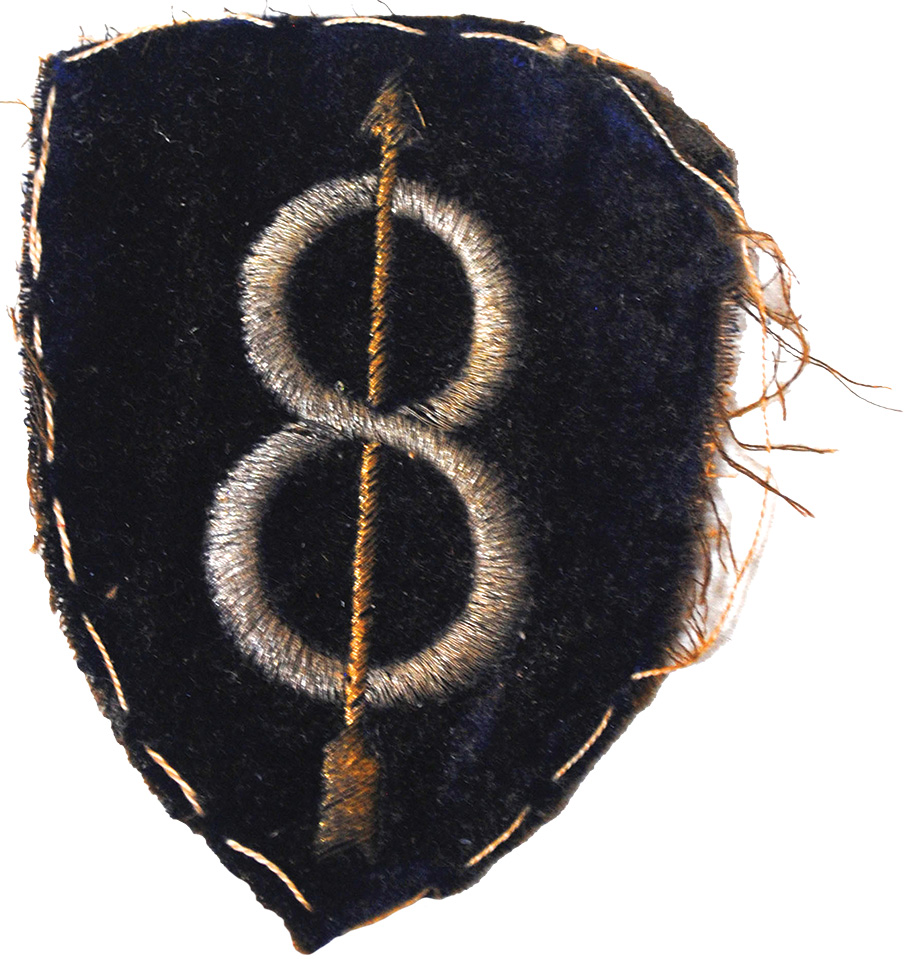
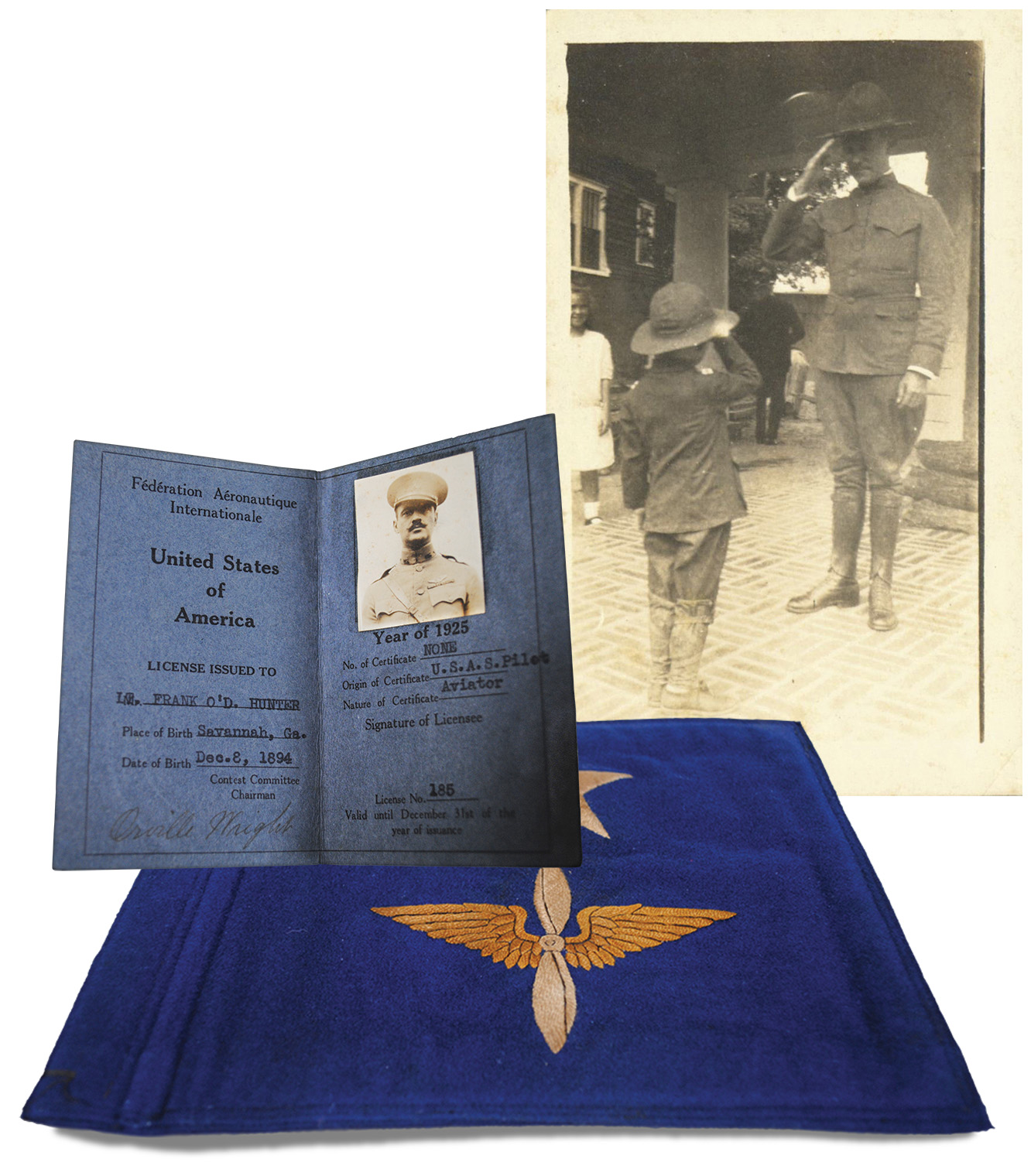
F. W. Mingledorff Sr.'s US Army Helmet, 1917-1918. Frederick William Mingledorff, Jr. Family Papers, GHS 1991; 8th Infantry Division Patch, Dr. and Mrs. Ralph Olin Bowden, Jr. Family Papers, GHS 2540. Pilot license, Frank O'Driscoll Hunter Papers, 1917-1982, GHS 1342; Flag from Frank O'Driscoll Hunter's Car While Commanding the Eighth Air Force Fighter Command in England, GHS 1342-AF-065-003; WWI soldier and child saluting, October 4, 1917, GHS 2835-PH-0003.
The Rise of the Automobile
Few inventions transformed the way that Americans live their lives more than the automobile in the twentieth century. With the rise of mass production, automobiles replaced the horse and revolutionized transportation. Americans were on the move as never before, and tourism become one of the most important economic engines of the century. The Dixie Highway, a network of roads connecting Canada to Florida in the early decades of the twentieth century, was an ambitious effort to build the nation's first north-south paved interstate highway. As the largest state east of the Mississippi River, Georgia proved critical to the project's success, mainly because the state's size and location controlled access to Florida for anyone driving by car. The Dixie Highway became so popular for Midwesterners and Canadians that Georgia entrepreneurs opened gas stations, garages, restaurants, souvenir shops, roadside produce stands, tourist lodging, and other attractions for the traveling public. In 1926, federal and state highway officials replaced named trails like the Dixie Highway with numbered highways. The Dixie Highway had a relatively short official life, but its roadbeds-now numbered highways like US 1-constituted important physical and cultural transportation corridors before the arrival of interstate highways. The highway brought tourists from other regions, spurring a host of entrepreneurial undertakings that made a dramatic impact on the culture and economy of twentieth-century Georgia.
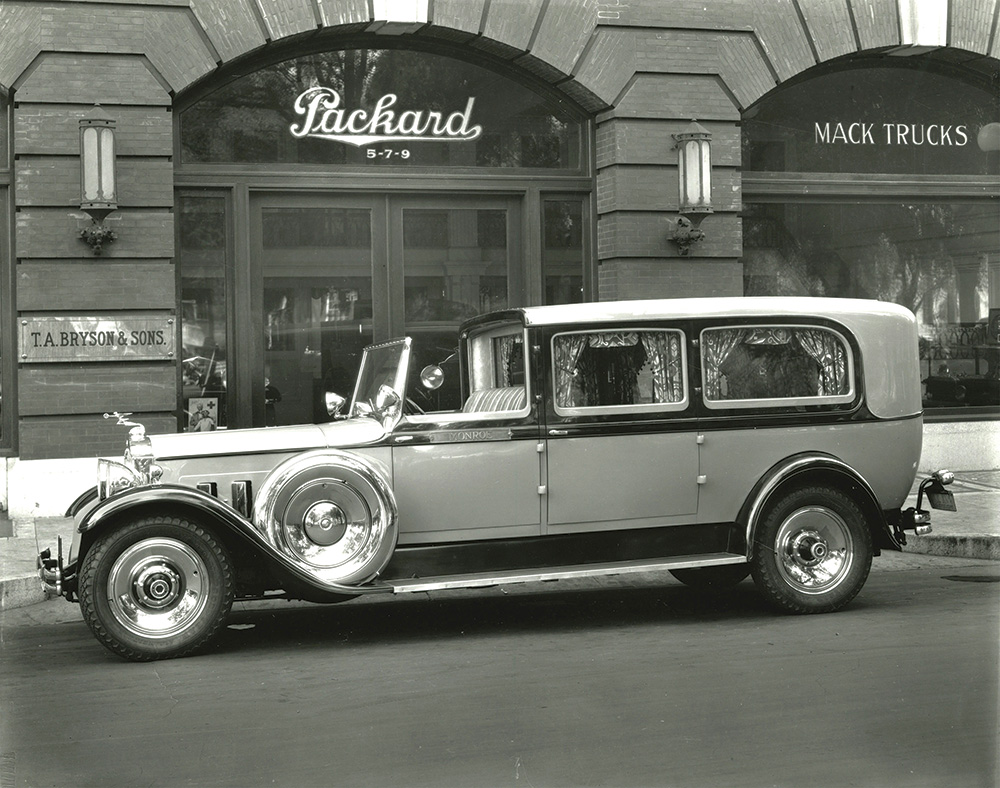
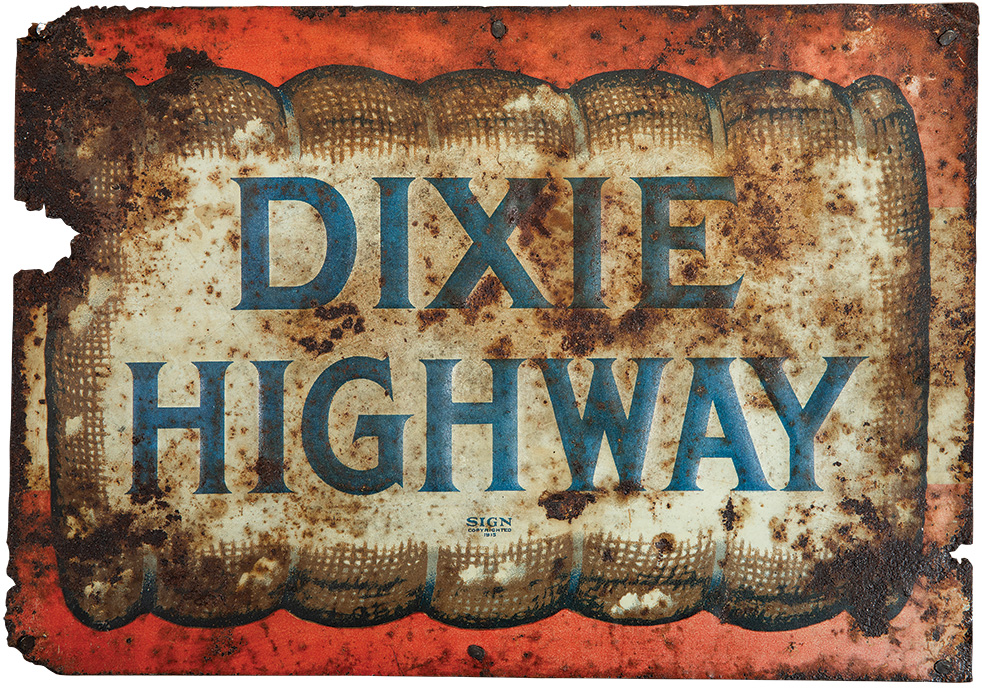
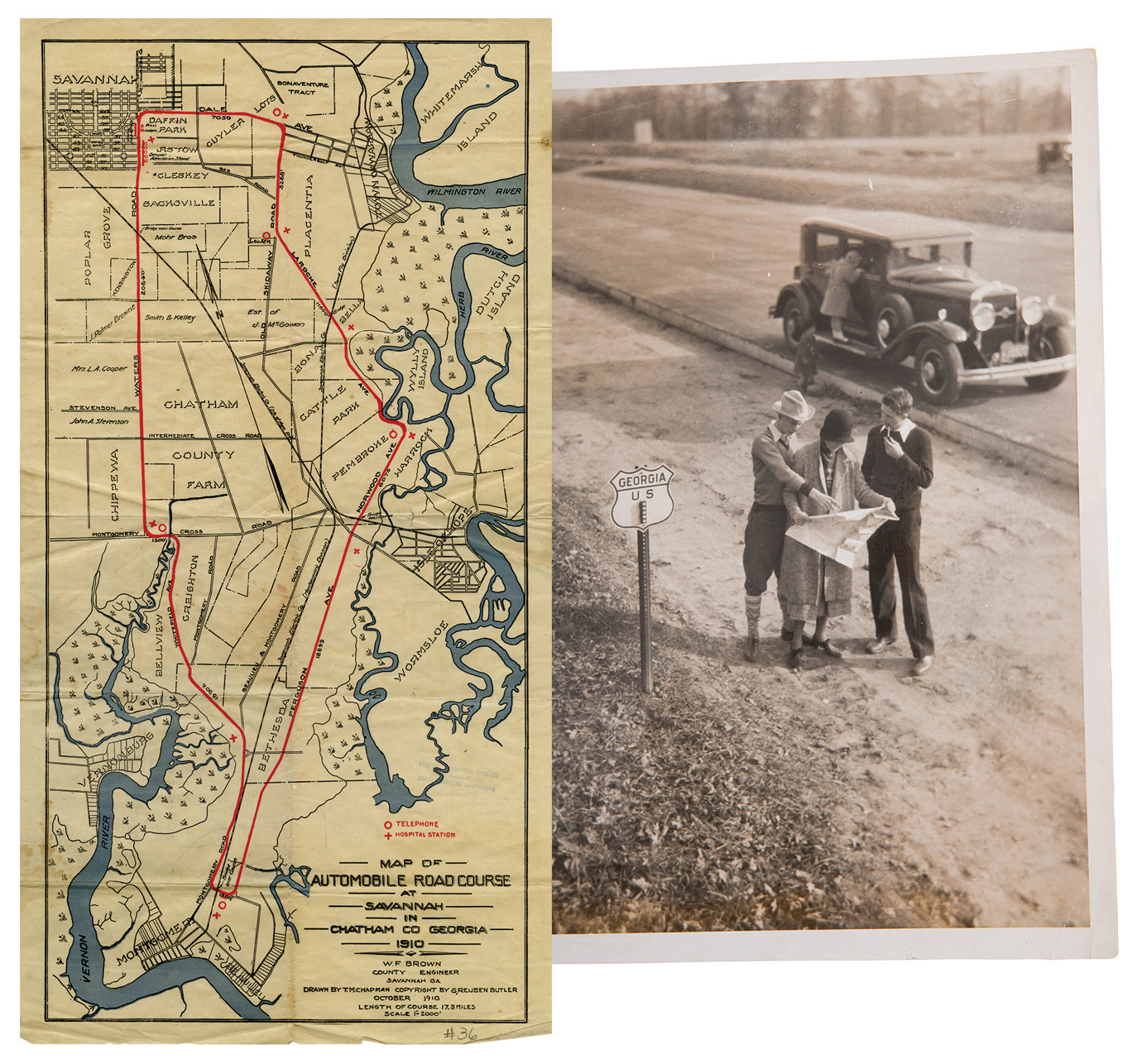
Dixie Highway sign, 1915; Hamilton Wright, "Motorists on United States Highway No. 1 near Augusta, Georgia, December 22, 1931," Edwin L. Jackson Collection, GHS 2746; Map of Automobile Road Course at Savannah, 1910, GHS 1361-MP-036; Packard Hearse in front of T.A. Bryson and Sons, January 8, 1930, GHS 1360-PH-27-28-01.
FDR and Georgia
Between 1924 and 1945 Franklin D. Roosevelt visited Warm Springs and Georgia 41 times. FDR contracted polio in August 1924 at age 39 while on a family vacation at Campobello Island in New Brunswick, Canada. In October 1924 he learned of Warm Springs and its beneficial waters. He grew to love Georgia and its people, and they welcomed him as their adopted son. In 1927 he established the Georgia Warm Springs Foundation. Known today as the Roosevelt Warm Springs Rehabilitation Center, the facility serves patients suffering from the effects of polio, strokes, spinal cord injuries, and other disabilities. After his election to the presidency in 1932, his home at Warm Springs, "The Little White House," became a Presidential retreat. He died there in 1945. To a generation of west Georgians, he was both the president and a trusted friend. Among the GHS treasues is a remarkable collection of photographs that belonged to Mariana Johnson, a Worcester, Massachusetts, native who received graduate training from the Georgia Warms Springs Foundation in 1943-1944 and then worked as a physical therapist there until the early 1950s. Her photos document the therapeutic techniques and exercises of polio patients, and the daily life at Warm Springs. She also photographed FDR's funerary procession after his death on April 12, 1945.
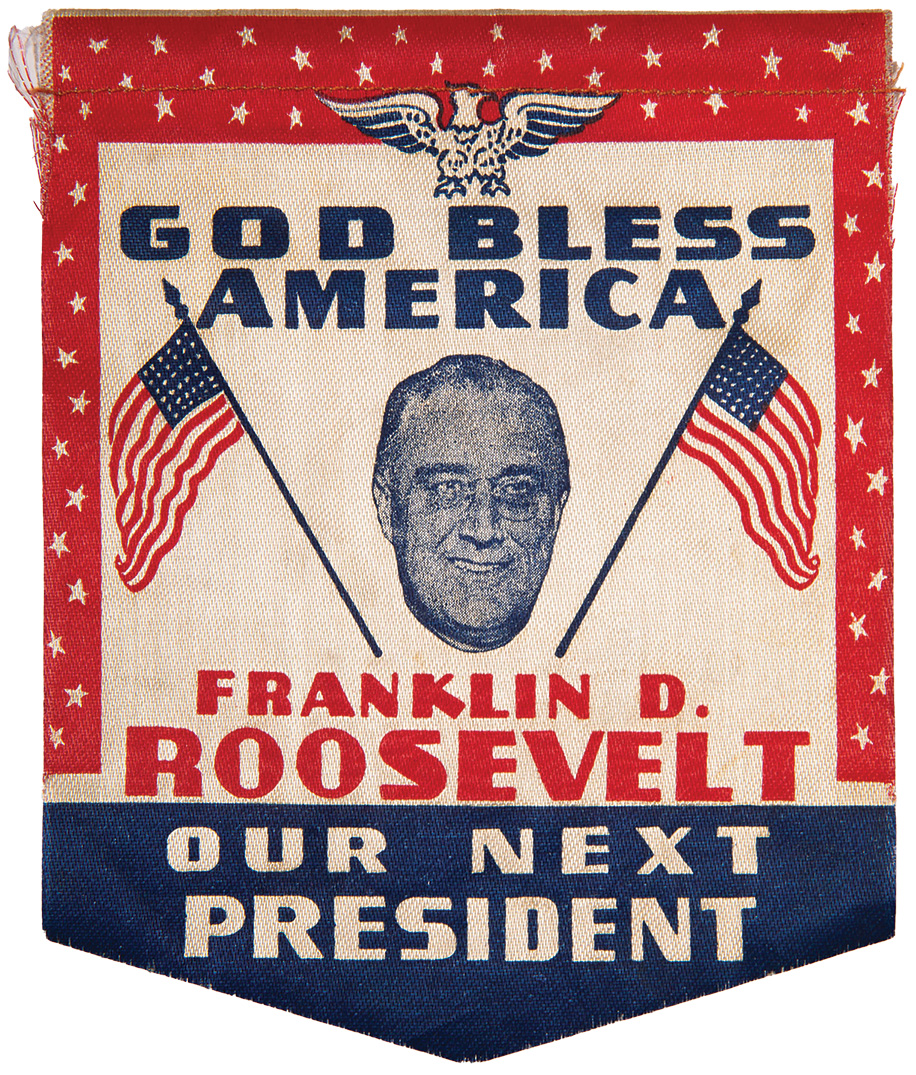
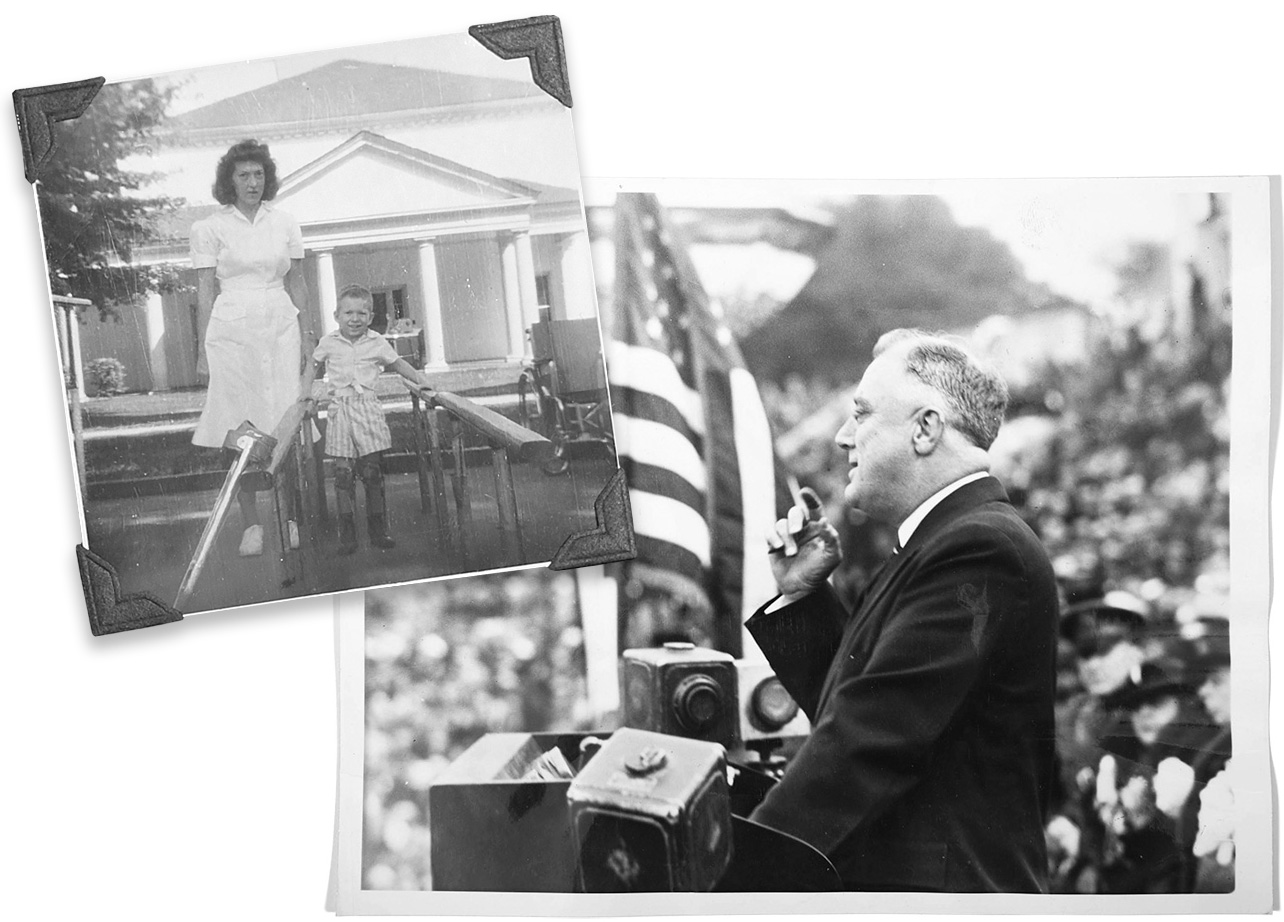
Franklin Delano Roosevelt God Bless America Flag, c.1932; "President Franklin D. Roosevelt delivering speech at Grant Field in Atlanta, Georgia," November 30, 1935, Edwin L. Jackson Collection, GHS 2746; Children at Warm Springs photograph, Mariana Johnson Collection, GHS 2827.
World War II on the Homefront
World War II brought women into the work force in record numbers, including a young woman from Athens named Evelyn "Lois" Dozier. During the war, Dozier sent and received letters from men and women in military service, and she published a monthly newsletter, Letters from Lois, about these soldiers. The Atlanta Journal published her popular column, "The Boys Write Home." Dozier, whose Georgia Press Association name badge is shown here, also wrote for the Newnan Herald and the Cobb County Times. She served for ten years as assistant editor and advertising manager of The Coca Cola Bottler in Atlanta, the company magazine for the Coca Cola Company. The war was a turning point for the country-and for one young woman who symbolizes the changing gender roles in the workplace that transformed American economic and social life.
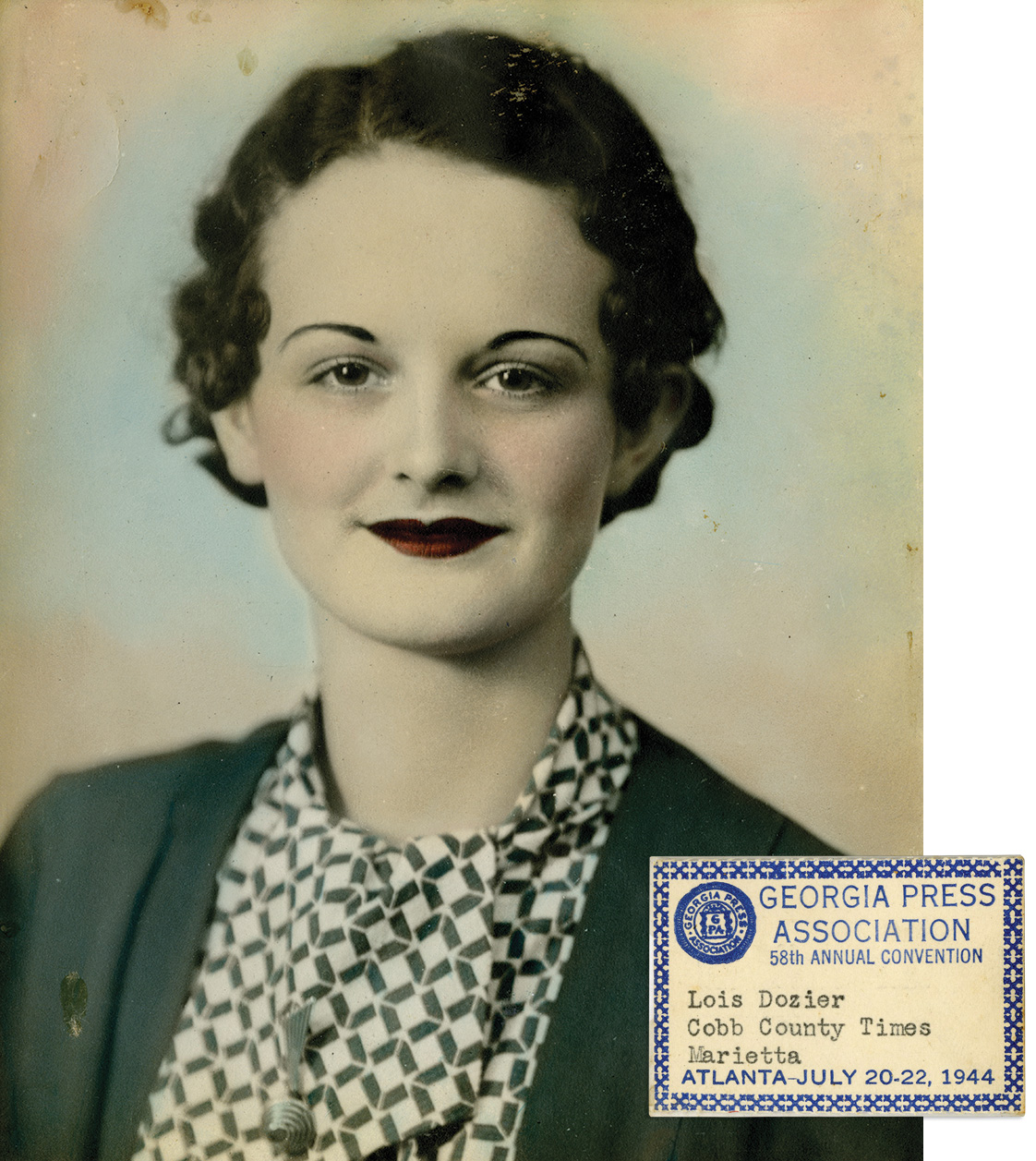
Nametag for the Georgia Press Association's 58th Annual Conference, Atlanta; Lois Dozier Norvell Photo, undated, Lois Dozier Norvell Papers, 1917-1994, GHS 1690.
World War II on the Battlefield
GHS holds materials related not only to Georgia, but also to Georgians who served on the world stage. Frederick Mingledorff, one of 320,000 Georgians who served in World War II, was a US Marine and participated in some of the fiercest fighting of the Pacific Theater. As a 19-year-old amphibious tractor driver, PFC Mingledorff ferried troops to the landing beaches at Roi-Namur in January 1944 during the Kwajalein operation. Under intense enemy fire Fred "learned for the first time what it meant to really be afraid." During the invasion of Guam, he picked up this Japanese "Good Luck Flag" (Fred is holding a flag in a wartime photograph below). Also pictured is his USMC KA-BAR knife. Fred contracted malaria in Guam and was evacuated to a hospital at Pearl Harbor. It was a fortuitous illness for Fred: months later at Iwo Jima his entire unit was virtually wiped out.
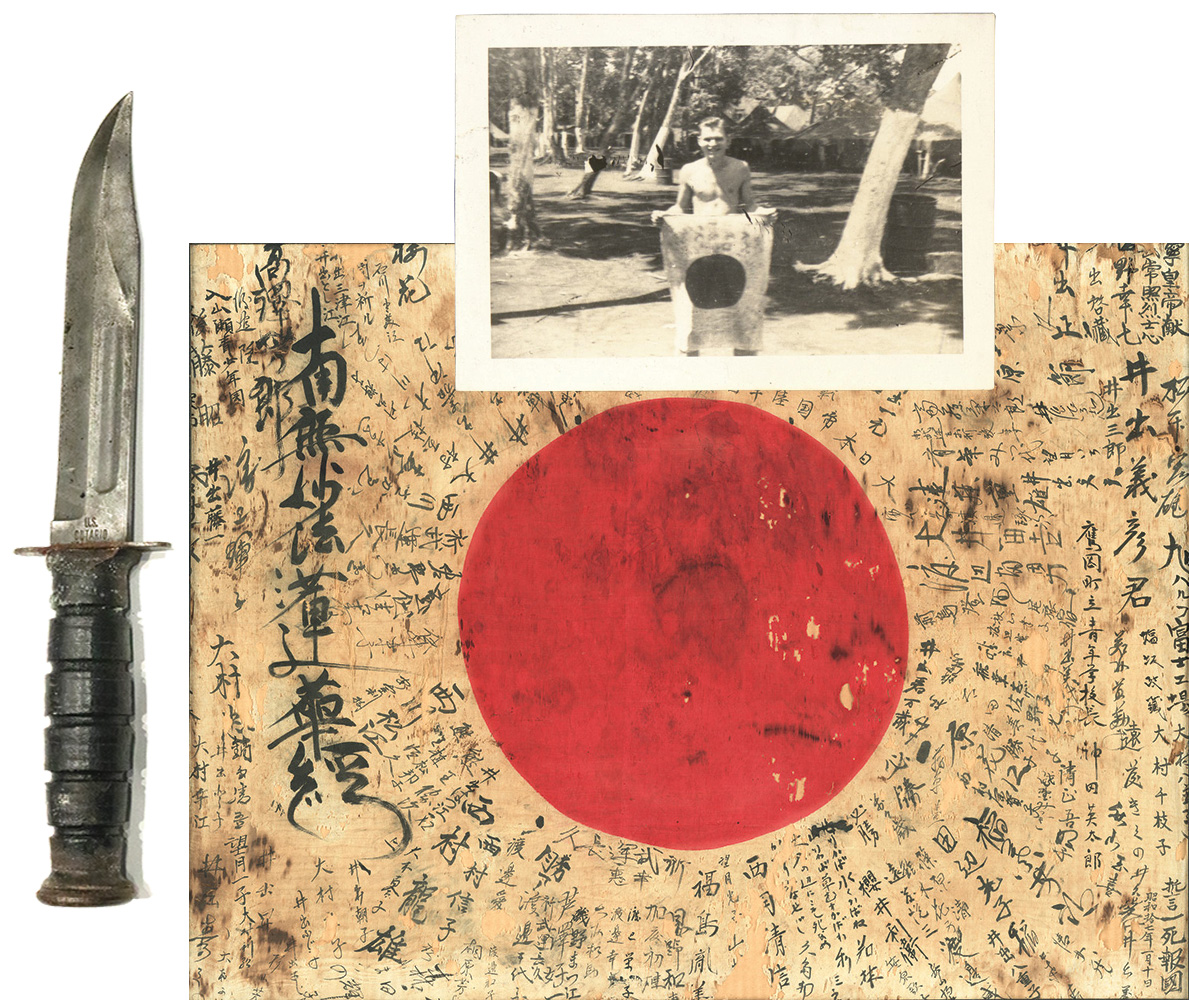
Japanese Flag, c. 1939-1945; Mingledorff photograph; KA-BAR, Frederick William Mingledorff, Jr. Family Papers, GHS 1991.
The Civil Rights Movement
The Civil Rights movement was accomplished in large places and small, by the famous and those from everyday walks of life. The Rev. Martin Luther King, Jr., pictured here, is widely credited as the national leader of the movement. On the local level, Ethel Hyer, like many women in the 1950s and 60s, served her community of Rome in a variety of religious, civic, and social organizations. She attended Spellman College and was a member for 65 years of Thankful Baptist Church. She was also a trailblazer. Hyer was the first woman to be president of the Rome Chapter of the National Association for the Advancement of Colored People (NAACP), a position she held for 15 years. W. W. Law was a Savannah postal worker who emerged as one the community's staunchest advocates for Civil Rights, including a July 1960 boycott of Savannah's Woolworth's, as seen here. He served as president of the Savannah chapter of the NAACP from 1950 to 1976 and came to be widely known as "Mr. Civil Rights." For her service on behalf of human equality, Ethel Hyer was honored by the city of Rome in 1973 and given the key to the city (pictured here, along with her membership card and an NAACP flyer). She and Law represent the untold number of Georgians who served as foot soldiers of a movement that would not have succeeded without them.
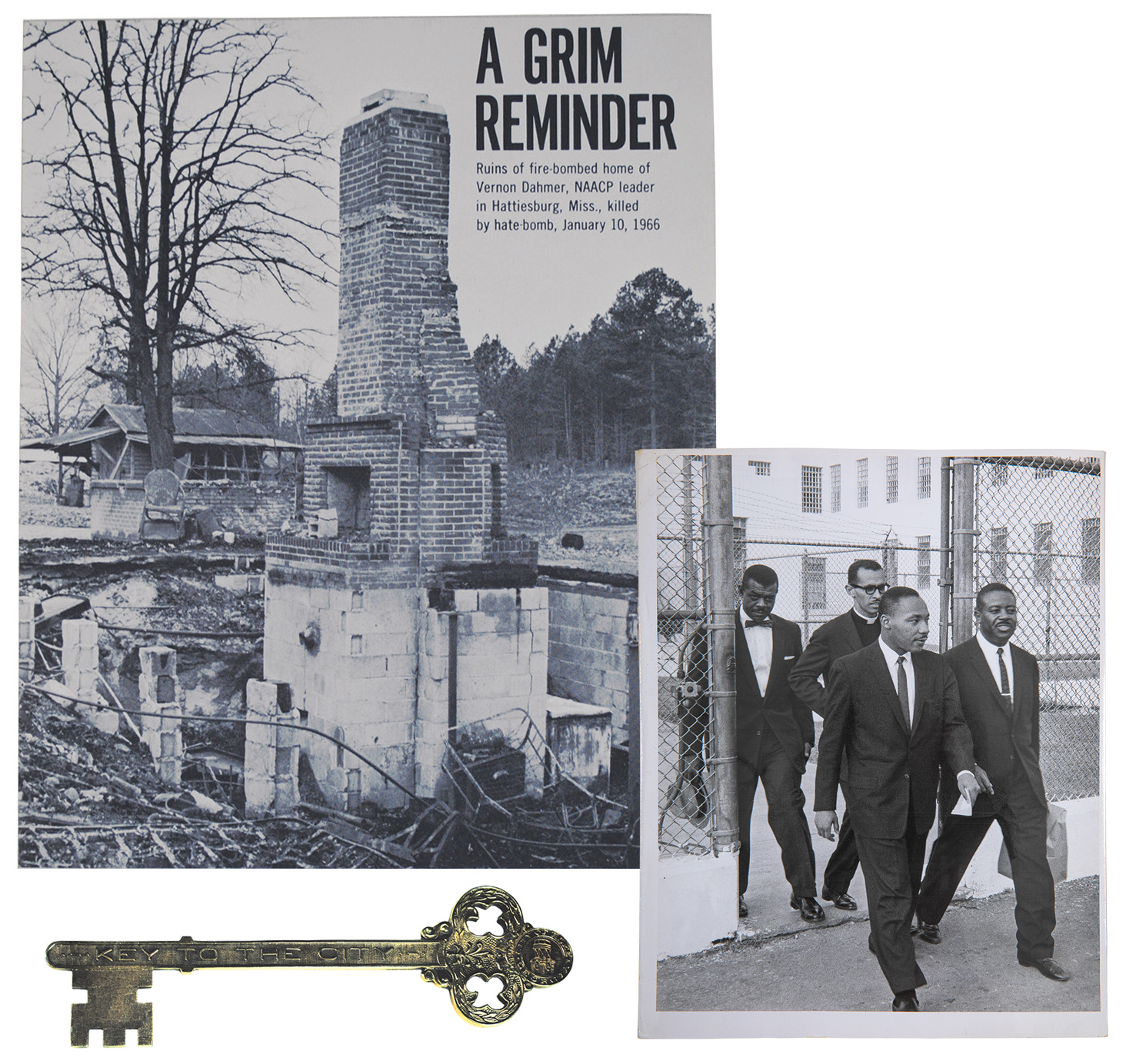
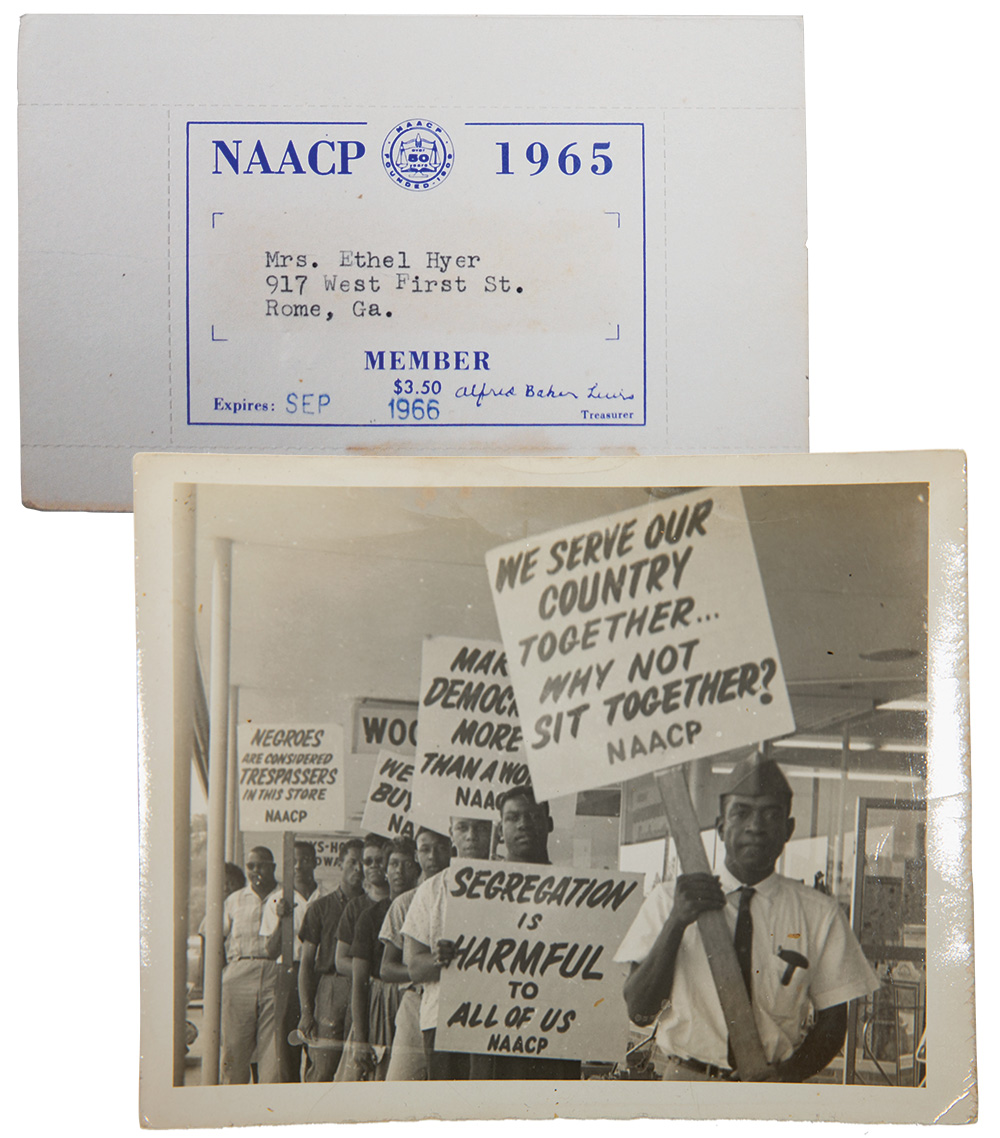
Martin Luther King, Jr., Ralph Abernathy, and others leaving jail, undated. Savannah Morning News Collection of Photographs and Negatives. GHS 2850; NAACP boycott protest of Woolworth, Savannah, July 1960, John Williams Collection of W.W. (Westley Wallace) Law Papers. GHS 2697; NAACP Flyer, Key to the City of Rome, GA, NAACP Membership Card, 1965, Ethel Hyers Papers, GHS 2117.
Vietnam
More than 2.7 million Americans served in the armed forces in the Vietnam War, including 228,000 from Georgia. One of those was William T. "Ted" Moore, who grew up in Brunswick. He entered the United States Army in 1967 at age 19 and was admitted to Officer Candidate School, graduating as a Second Lieutenant in January 1968. Following a tour in the 82nd Airborne Division, he was assigned to the 9th Infantry Division in Vietnam, and later served as an advisor with the South Vietnamese Army. Ted was decorated for valor, meritorious service, and received the Purple Heart for wounds received. He went on to a distinguished career in higher education. The Vietnam War also created deep division in American society as initial support for the conflict eroded and protests erupted as the war dragged on and casualties mounted. Georgia Civil Rights activist Julian Bond was an outspoken critic of the war who won election to the Georgia House of Representatives in 1965. But his anti-war stance prompted the legislature to deny Bond his seat-not once, but three times, as voters in Bond's district elected him as their representative only to have the legislature refuse his seat each time. In December 1966, the US Supreme Court ruled that the actions of the Georgia house were unconstitutional, and Bond was sworn in on January 9, 1967. He is pictured at right standing in front of the statue of Tom Watson at the State Capitol: Watson opposed the draft during WWI. Bond's long career in the Georgia legislature ended in 1987. The Vietnam War, like the Civil Rights Movement, had a profound impact on American society, including the lives of two young Georgians whose earliest years were irrevocably shaped by the Cold War conflict so far from home.

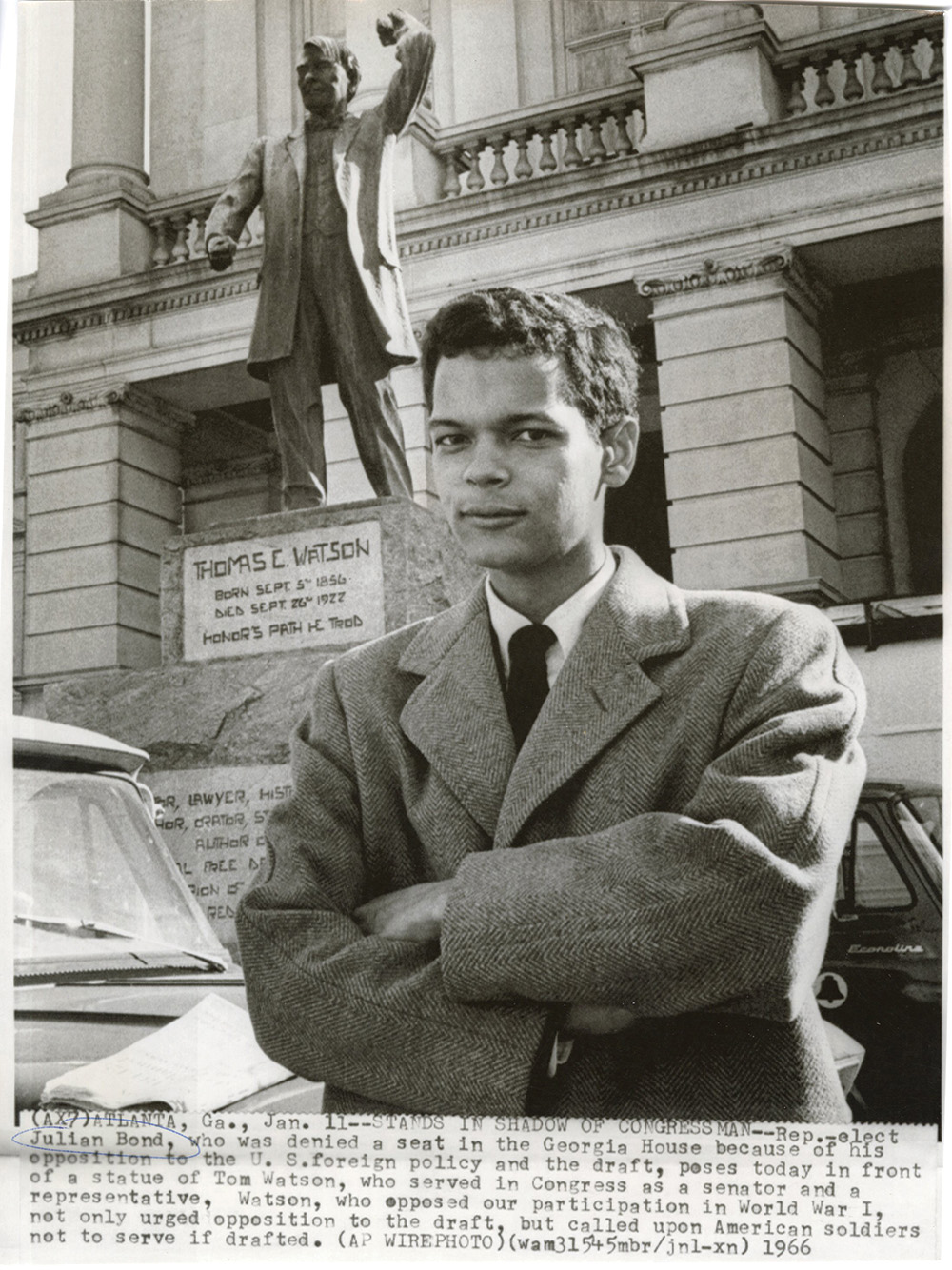
Ted Moore photograph, Army of the Republic of Vietnam Officer beret, Dr. William T. Moore Collection of Vietnam War Materials, GHS 2840; Julian Bond standing in front of statue of Tom Watson, January 11, 1966, GHS 1361-PH-44-15-02.
Georgia Legends
Few Georgians came from as diverse backgrounds as Vince Dooley and James Brown, but they became friends and Georgia legends. Dooley was born in Mobile, Alabama, in 1932 and in a long and storied career became the living embodiment of Georgia's flagship university. He became the University of Georgia's head football coach in 1963, at age 32, and led the Bulldogs to 201 victories over a 25-year career, including six SEC championships, 20 bowl games, and the 1980 national championship. James Brown was born into severe poverty in South Carolina in 1933 and grew up in segregated Augusta, where he developed an interest in music and sang in local talent shows. He rose to become one of the most influential musicians of the last half of the twentieth century, a tireless showman known as the "Godfather of Soul" who inspired an entire generation of younger musicians. Despite their different backgrounds and occupations, their paths often crossed, most famously when Brown recorded the song "Dooley's Junkyard Dawgs" about Dooley's 1975 Georgia team. The less famous part of their relationship is reflected in this heartfelt letter that Brown wrote to Dooley ca. 1976 about racism in America-on Delta Airlines stationery. Brown lamented his lack of a "decent education," the hardships faced by Black musicians, and pleaded that "being black is hell but I love America." Dooley was inducted into both the College Football Hall of Fame and the Georgia Sports Hall of Fame, while Brown was inducted into the Rock and Roll Hall of Fame and the Georgia Music Hall of Fame.
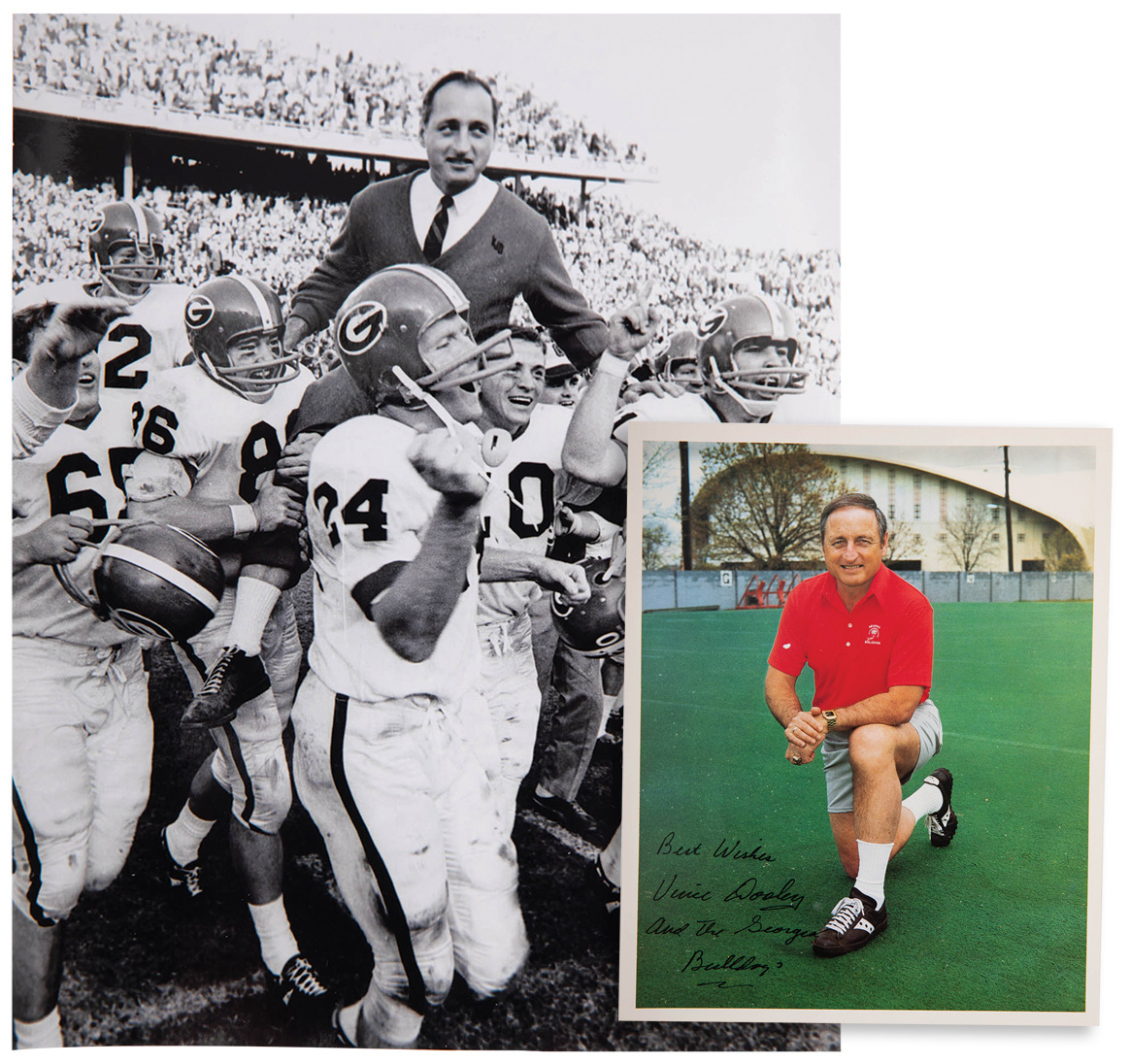
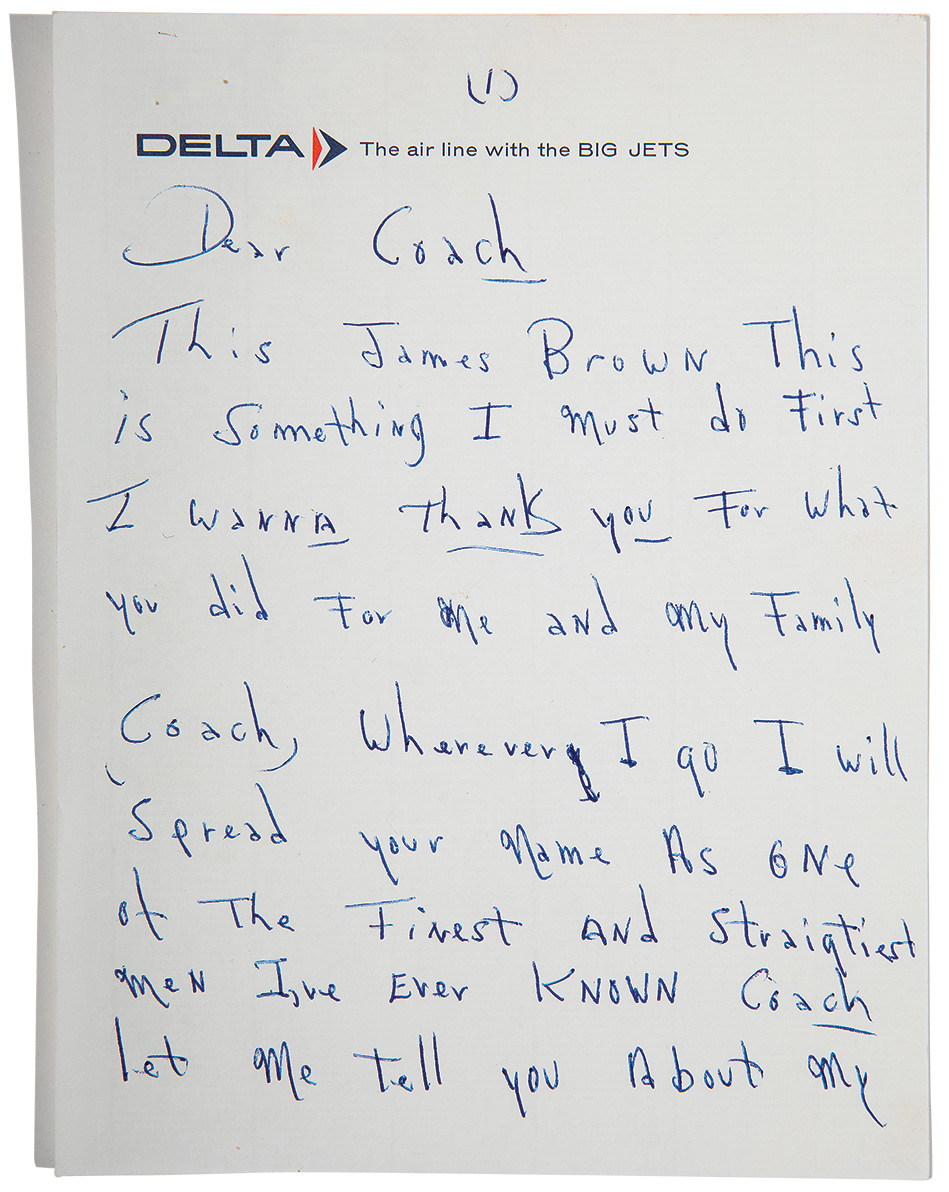
Vince Dooley Photographs, Vince Dooley Papers, James Brown to Vince Dooley, c. 1976-1977, GHS 2363.
Georgians on the National Stage
There have been three United States attorneys general from the state of Georgia and GHS holds the papers of two of them. Born in Sumter County in 1918, Griffin Bell went to law school at Mercer University. Bell moderated Georgia's response to the civil rights movement and facilitated desegregation. President Kennedy appointed Bell to the 5th Circuit Court of Appeals, where he acted as a voice of moderation while implementing desegregation across the South. Bell was already a legal legend when he agreed to serve as President Jimmy Carter's attorney general in 1977 (a sampling of transition team papers is shown here). As Attorney General, Bell restored public confidence in the Department of Justice after Watergate. He died as the dean of Georgia lawyers and one of the most respected legal minds in the country. Andrew Young served as MLK's trusted lieutenant during the Civil Rights Movement and in 1972 became the first African American since Reconstruction to be elected to Congress from Georgia. President Carter appointed Young as ambassador to the United Nations in 1977. He returned to Georgia and was instrumental in the development of Atlanta's reputation as an international city. He served as the city's mayor from 1981 to 1989 and played a key role in helping Atlanta secure the 1996 Olympic Games. Young was appointed as a Georgia Trustee in 2012.
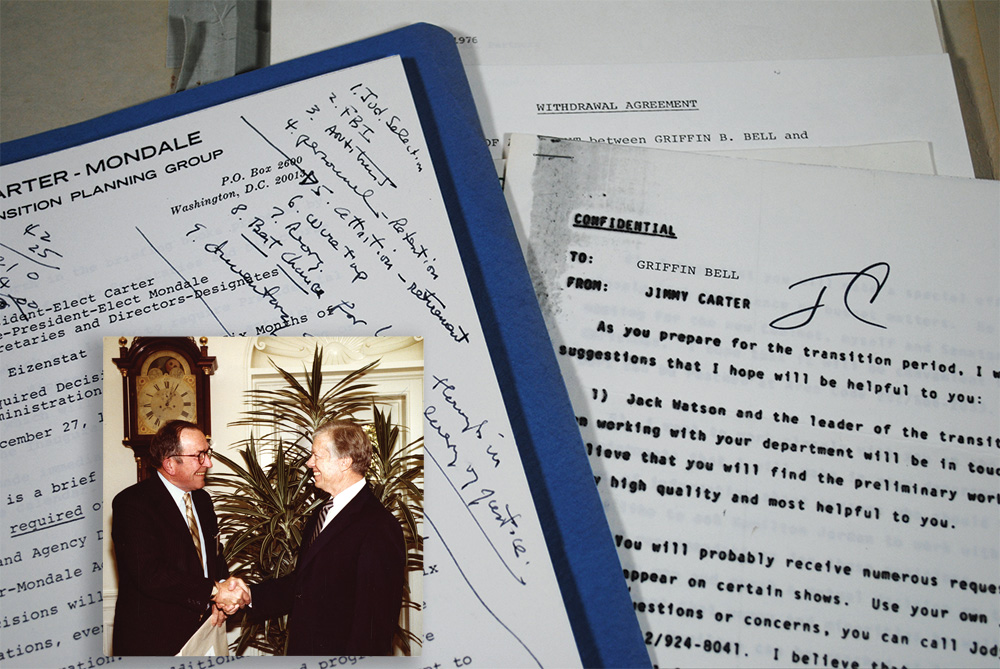
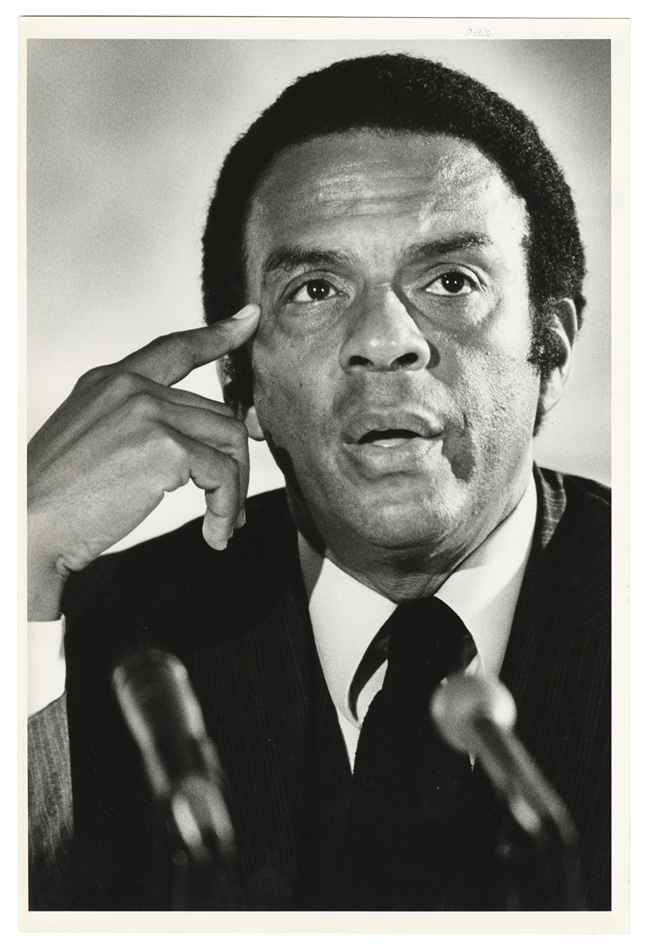
United States Attorney General Transition Files, Photograph of Griffin B. Bell with Jimmy Carter, Oval Office, undated, Griffin B. Bell Papers, GHS 2305. Atlanta Mayor Andrew Young, GHS 1361-PH-44-04-03.
Georgia's Iconic Companies
Coca Cola, Delta, and Home Depot are three of the most important global economic engines that powered Atlanta's rise in the late twentieth century. Coca-Cola traces its origins to Atlanta's Jacobs' Pharmacy in 1886, and the company grew under the ownership first of Asa Candler and then the Woodruff family to become one of the most recognizable global brands in the twentieth century. Delta Airlines was born in 1928 when C.E. Woolman led a group of investors in Louisiana to buy a crop-dusting company. Delta-named after the Mississippi Delta region where the company was then based-began offering passenger service in 1929 and moved its headquarters to Atlanta in 1941. Delta has grown to become the largest passenger carrier in the world, with global operations-symbolized here by a complete Delta Air Lines stewardess uniform "fashioned for Delta by Gilbert of Lady Simpson," ca. 1968. Home Depot's iconic orange apron became a symbol of the home improvement store and the two men who made it happen-Arthur Blank and Bernie Marcus, whose personal Home Depot apron is pictured here. The first two Home Depots opened in Atlanta in 1979. Those original stores have grown to more than 2,200. These three iconic companies helped transform Atlanta and Georgia into an economic powerhouse with influence far beyond the state.
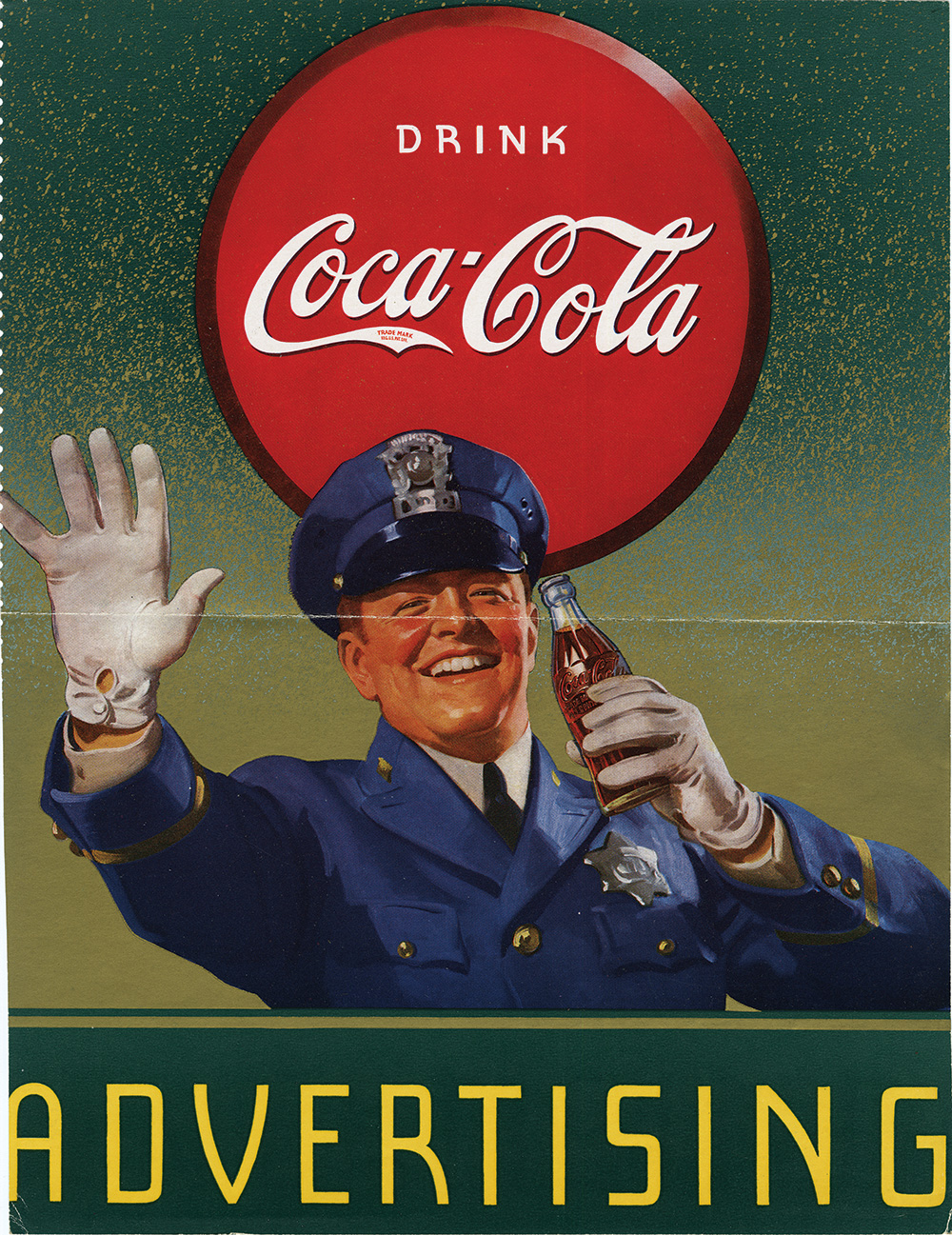
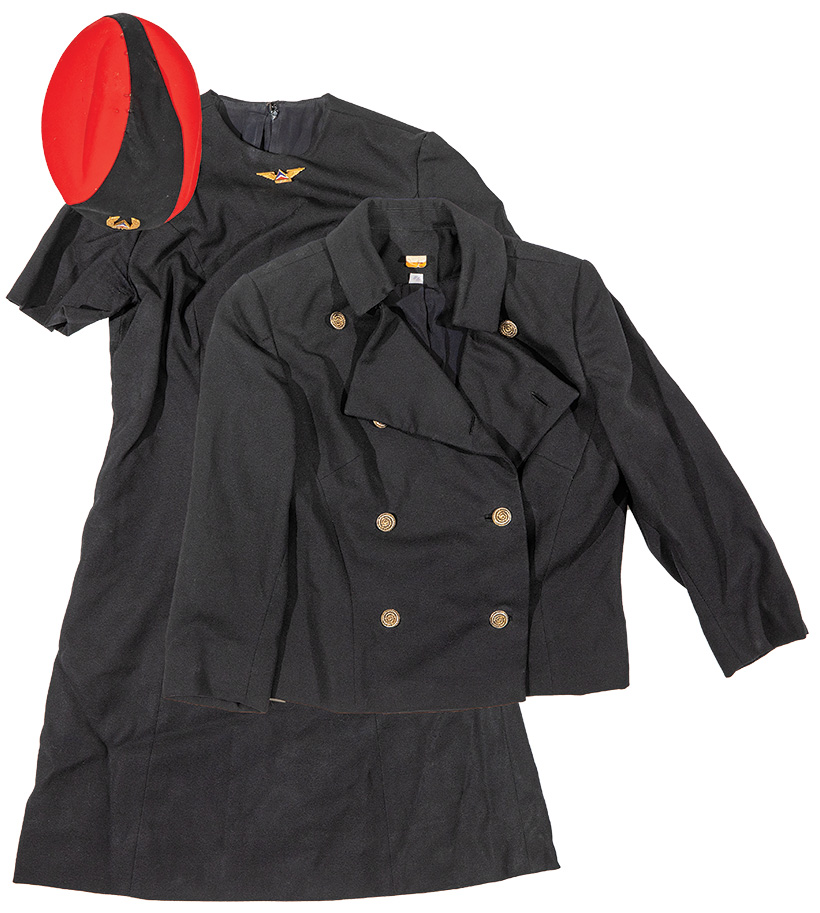

"Drink Coca-Cola," GHS 2018-PH-01-14-01; Delta Air Lines Stewardess Uniform, 1968-1970, GHS 2703; Home Depot Apron, undated, Bernard Marcus Papers, GHS 2456.
The Turn of the 21st Century, and Beyond
As the 21st century dawned Atlanta hosted the 1996 Centennial Olympic Summer Games, further raising the state's profile. More than 2 million people visited Atlanta for the games, and an estimated 3.5 billion watched worldwide. Another cultural phenomenon, author John Berendt's 1994 book about a Savannah murder, Midnight in the Garden of Good and Evil, boosted Savannah's tourism industry at the turn of the century into a $1 billion annual business that transformed the city. The book spent a record 216 weeks on the New York Times bestseller list and spawned a 1997 movie. Other cultural and social movements re-shaped the state in profoundly different ways. Though Atlanta avoided the ugly confrontations that shook other cities during the Civil Rights Movement, in 2020 the racially-motivated murder of Brunswick native Ahmaud Arbery placed the town at the center of a global protest movement. Arbery, a 25-year-old Black man, was killed as he jogged through a suburban neighborhood on February 23, 2020. Suspecting Arbery of burglary, three White men pursued Arbery in pickup trucks and shot him after a brief struggle. Video of Arbery's murder spread on social media. His name soon became linked to other victims of racial violence through the Black Lives Matter protests in the United States and around the world, and his trial in Brunswick was followed closely by global media. Pictured here are Atlanta Journal-Constitution reporter Bill Rankin's notebooks that he kept while covering the trial. Simultaneously with Arbery's murder and protests, the COVID-19 pandemic struck, transforming the way that Georgians and all Americans went about their lives. Georgia children submitted artwork to the Atlanta Journal-Constitution for the Art from the Heart Campaign, which called for children's artwork that showed appreciation to COVID-19 front line workers during the pandemic.
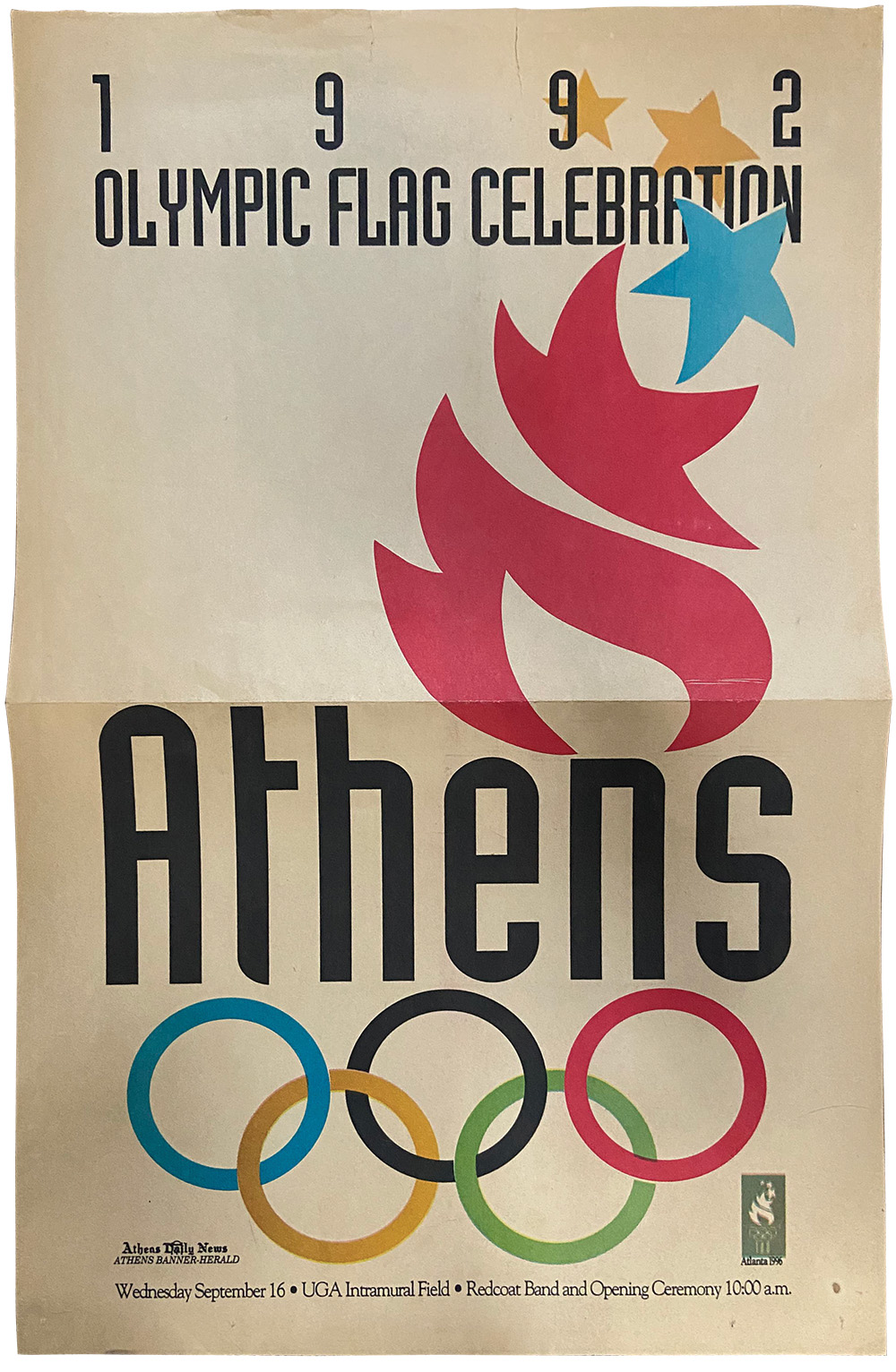
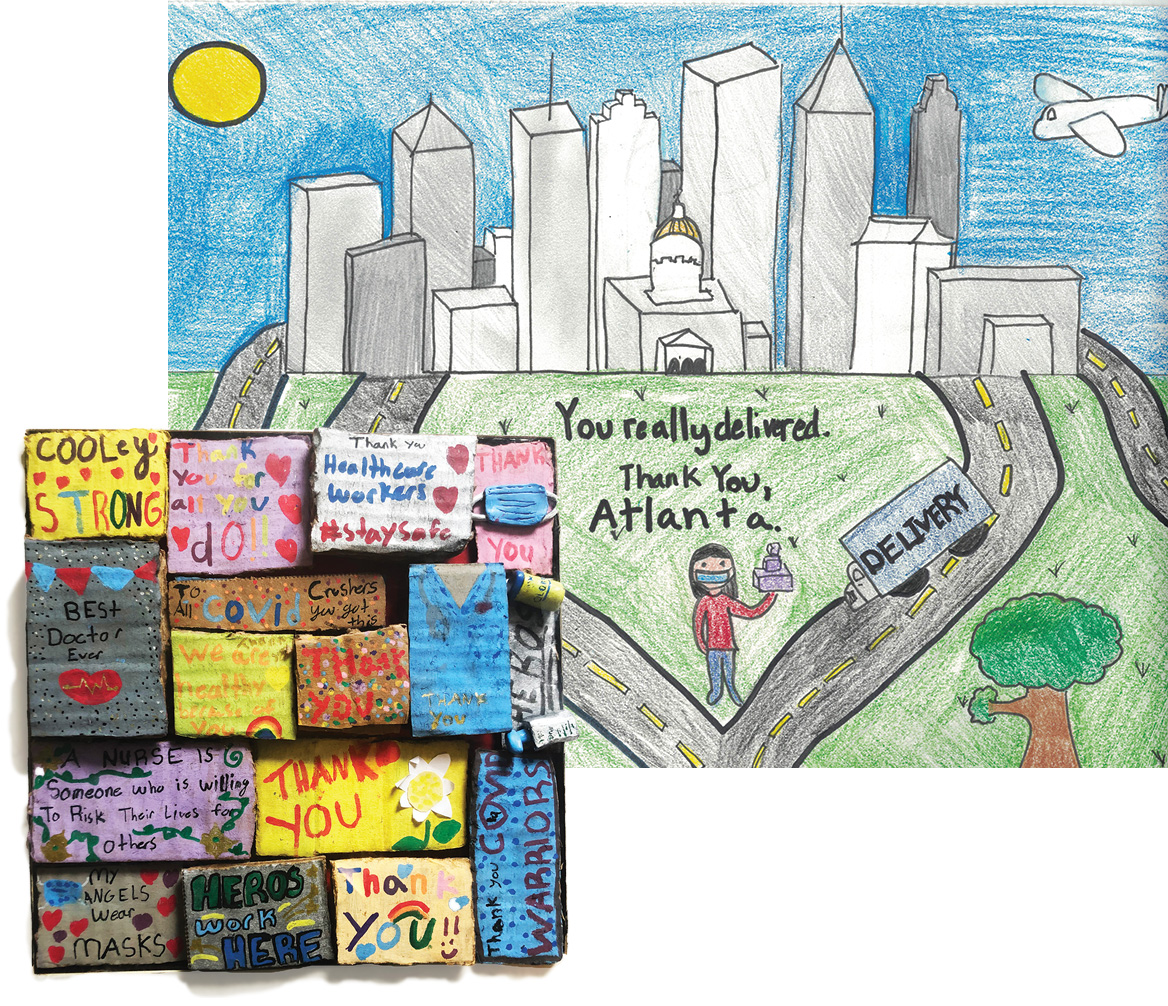
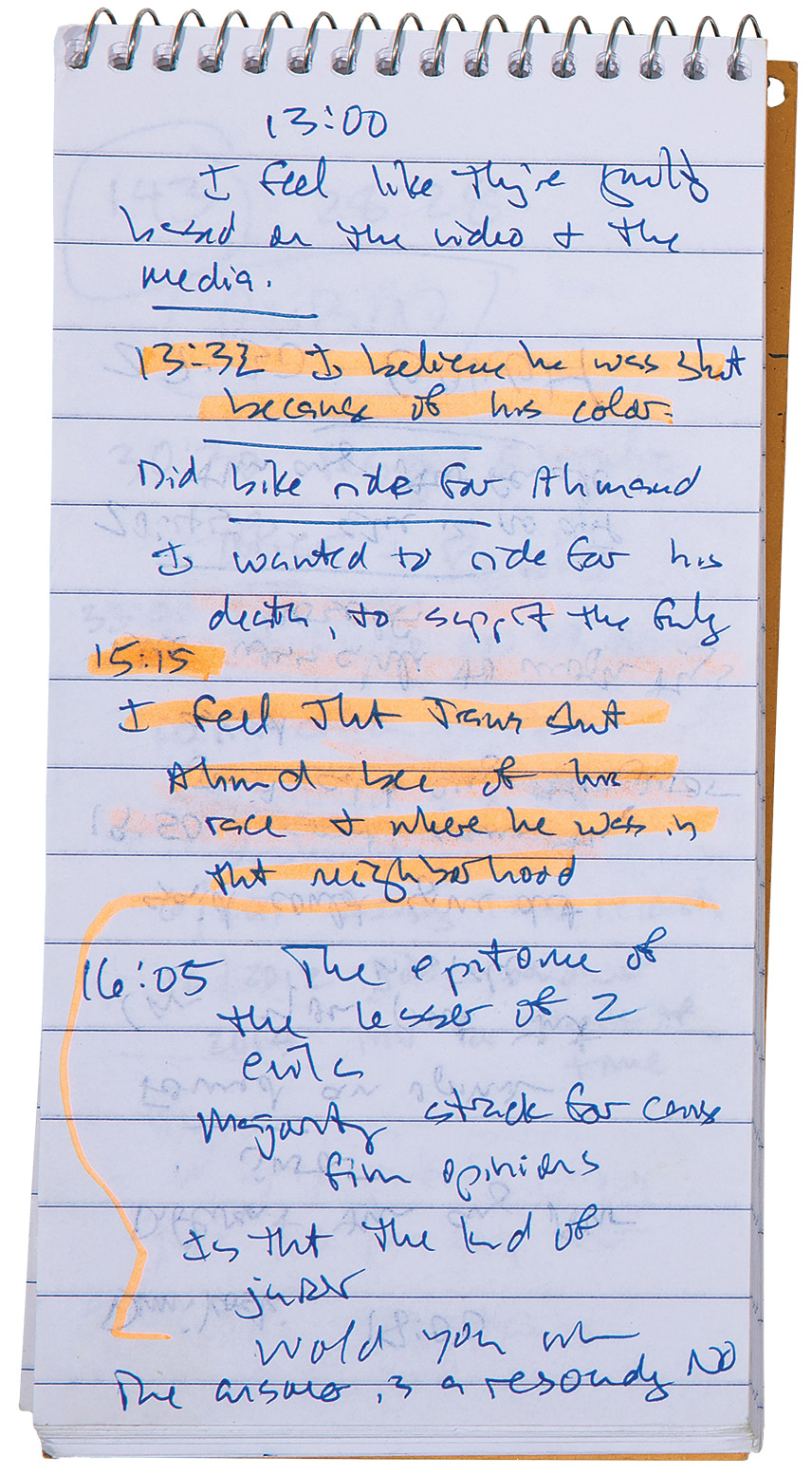

1992 Athens Poster for Olympic Flag Celebration, Edwin L. Jackson Collection, GHS 2746; Atlanta Journal-Constitution Art From the Heart Collection, GHS 2824; Ahmaud Arbery Trial Notes, GHS 2828; Dr. John Duncan Collection of Midnight in the Garden of Good and Evil Books and Materials, GHS 2843.
Commemorating America at 250
In commemoration of the 250th anniversary of the founding of the United States, the Georgia Historical Society is pleased to share a new publication, a history of Georgia using more than 50 objects and documents from its collection as a window into our shared past.
Use the following links to view the publication and to learn more about the work of GHS and other statewide partners to recognize the semiquincentennial of the United States.
Explore the GHS Collection
More than 5 million items document over 300 years of Georgia and American history, from the colonial period through the 21st century, plus 100,000 photographs, 30,000 architectural drawings, 20,000 rare and non-rare books, and thousands of maps, portraits, and artifacts.