
Lesson Plan
Democratic Beliefs, Rights, and Civic Participation
Lesson Goal
Students will understand that people in a democracy share important beliefs, such as fairness, respect, responsibility, freedom, and helping the common good. Students will also learn that citizens help democracy work by respecting others, following reasonable rules and laws, staying informed, voting, volunteering, and communicating with public officials.
Essential Question
How do citizens help a democracy work?
3rd Grade and 5th Grade
Time Needed: 50 minutes
Standards:
SS3CG2: Explain the importance of Americans sharing certain central democratic beliefs and principles, both personal and civic.
SS3CG2.b: Explain the necessity of obeying reasonable laws/rules voluntarily, and explain why it is important for citizens in a democratic society to participate in public/civic life, including staying informed, voting, volunteering, and communicating with public officials.
SS5CG1: Explain how a citizen’s rights are protected under the U.S. Constitution.
SS5CG1.a: Explain the responsibilities of a citizen.
Notes have been added to the presentation to help explain the information being presented and highlight when there are student handouts to go along with content.
Student-Friendly Learning Targets
By the end of the lesson, students will be able to:
- Explain why it is important to respect the rights of others.
- Describe what it means to promote the common good.
- Explain why citizens should follow reasonable rules and laws.
- Identify ways citizens can participate in civic life.
Materials

- Google Slide Presentation
- Copies of “Exit Tickets”
- Copies of “Letter Writing Template” for each student
- Copies of “Independent Activity: Engaging in Civil Life” for each student
Key Vocabulary

Democracy: A form of government where people have a voice in decisions, usually by voting.
Citizen: A person who belongs to a community, state, or country.
Rights: Freedoms and protections people have.
Responsibility: Something a person should do to help themselves, others, or the community.
Common Good: What helps the whole community, not just one person.
Rule: A direction people are expected to follow.
Law: An official rule made by the government.
Civic Life: The ways people participate in and help their community or government.
Public Official: A person elected or chosen to serve the community, such as a mayor, governor, school board member, or city council member.
Introduction / Hook: What Makes a Classroom Work?
(5 minutes)

Ask students to imagine the classroom with no shared expectations.
Ask:
- What if everyone talked at the same time?
- What if only one person got to use all the supplies?
- What if people ignored each other’s ideas?
- What if no one helped clean up?
Then ask:
What beliefs or actions help our classroom work well?
Record student responses on the board. Guide them toward words such as:
- Respect
- Fairness
- Responsibility
- Kindness
- Safety
- Listening
- Helping others
- Following rules
Explain:
A classroom works best when people share certain beliefs about how to treat one another. A democracy works in a similar way. People may not always agree, but democracy works better when citizens respect rights, follow fair laws, and help their community.
Direct Instruction: Shared Democratic Beliefs and Principles
(20 minutes)
Tell students:
Americans live in a democracy. In a democracy, people have rights and a voice in their government. But democracy only works well when citizens also accept responsibilities.
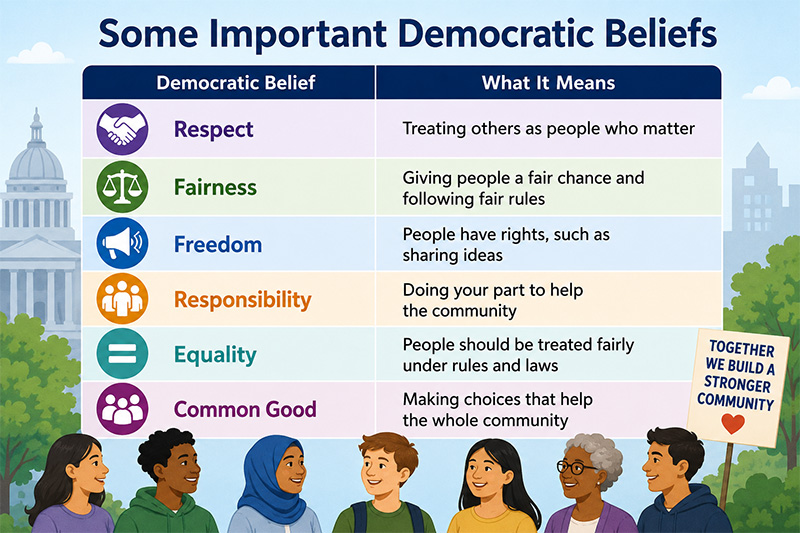
Image included in the Google Presentation for full class discussion
Explain:
People in a democracy do not have to think exactly alike. In fact, people often disagree. But they need to share basic beliefs, such as respecting rights, listening to others, and solving problems peacefully.
Part 1: Respecting the Rights of Others
Ask students:
What rights do students have in our classroom?
Possible answers:
- The right to learn
- The right to feel safe
- The right to be treated fairly
- The right to share ideas
- The right to ask questions
Explain:
Having rights does not mean we can do anything we want. Our rights come with responsibilities. One person’s choices should not take away another person’s rights.
Examples:
- You have the right to speak, but you have the responsibility to let others speak too.
- You have the right to learn, but you have the responsibility not to interrupt others.
- You have the right to use classroom materials, but you have the responsibility to take care of them.
Quick Check
Ask students to decide whether each example shows respect for the rights of others.
- A student listens while a classmate shares an idea.
Yes. This respects the classmate’s right to speak.
- A student grabs all the markers and refuses to share.
No. This does not respect others’ right to use shared materials.
- A student laughs at another student’s answer.
No. This does not respect the student’s right to participate and feel safe.
- A student waits their turn in line.
Yes. This respects fairness and the rights of others.
Part 2: Promoting the Common Good
Explain:
The common good means what helps the whole group or community. Sometimes citizens make choices that are not just about what they want, but about what helps everyone.
Examples of promoting the common good:
- Picking up trash on the playground
- Helping a new student feel welcome
- Taking turns with supplies
- Following safety rules
- Volunteering to help at school or in the community
- Reporting a problem that could hurt others
Ask:
How is the common good different from just getting what you want?
Use this example:
If one student wants to play music loudly while others are reading, that may help one person have fun, but it does not help the common good. The common good means thinking about how our choices affect everyone.
Part 3: Why Citizens Follow Reasonable Laws and Rules
Explain: Rules and laws help people live, learn, and work together. In a democratic society, citizens should follow reasonable laws and rules voluntarily. That means they follow them because they understand they help the community, not only because someone might punish them.
A rule or law should help keep people safe, protect their rights, and ensure everyone is treated fairly.
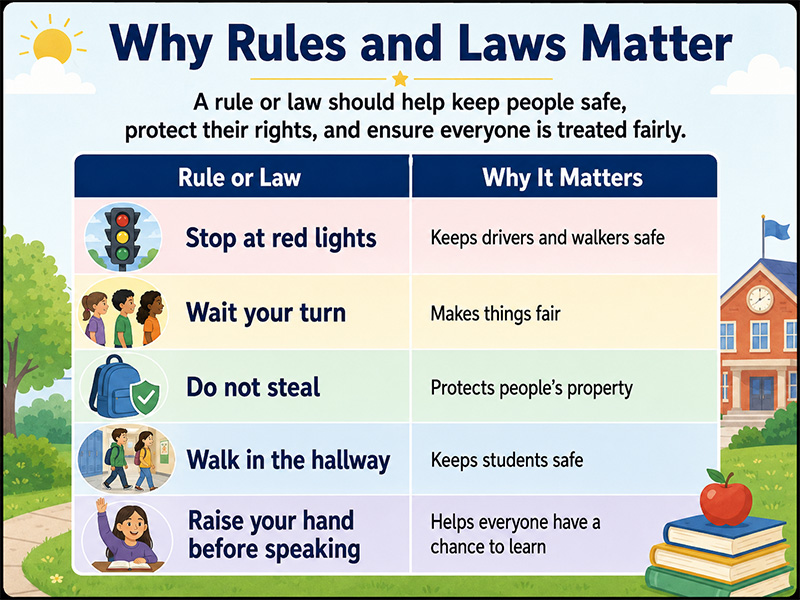
Image included in the Google Presentation for full class discussion
Explain:
When people choose to follow reasonable rules and laws, the community works better. It is like a game: if everyone makes up their own rules, the game falls apart faster than a cheap paper straw.
Part 4: Participating in Civic Life
Explain:
Citizens in a democracy do more than follow rules. They also participate in civic life. Civic life means helping your community and government work well.
Citizens can participate by:
Staying Informed
Citizens learn about what is happening in their community, state, country, and world.
Student example: A student listens to school announcements or learns about a community issue.
Voting
Adults vote to help choose leaders and make decisions.
Student example: A class votes on a book to read or a game to play.
Volunteering
Citizens give their time to help others.
Student example: A student helps clean up a park, collects food for a food drive, or helps a classmate.
Communicating with Public Officials
Citizens can respectfully share ideas or concerns with leaders.
Student example: Students write a letter to the mayor, principal, city council, or school board about a community need.
Explain:
In a democracy, citizens help shape the community. Even children can practice civic participation by staying informed, helping others, speaking respectfully, and solving problems.
Guided Practice: Civic Life Sorting Cards
(10 minutes)

Included in the Google Presentation for full class discussion
Read each example aloud. Students decide which type of civic action it shows.
Choices:
- Staying informed
- Voting
- Volunteering
- Communicating with public officials
- Respecting rights
- Promoting the common good
- Following reasonable rules/laws
Examples
- A student watches a short classroom news video about the local community.
Staying informed
- A class votes on which service project to complete.
Voting
- A family helps clean up litter at a park.
Volunteering / Promoting the common good
- Students write a letter to the mayor asking for safer sidewalks near school.
Communicating with public officials
- A student lets a classmate share their opinion, even though they disagree.
Respecting rights
- A student follows the playground rules even when the teacher is not watching.
Following reasonable rules voluntarily
- A student helps collect canned food for people in need.
Volunteering / Promoting the common good
- A student waits their turn to use classroom supplies.
Respecting rights / Following reasonable rules
Group Activity: What Should a Good Citizen Do?
Included in the Google Presentation for full class discussion
Divide students into small groups. Give each group one situation.
Situation 1: The Playground Problem
Some students are taking all the balls at recess and will not let others play.
Ask:
- Whose rights are not being respected?
- What rule could help?
- What would promote the common good?
Situation 2: The Messy Park
A local park has trash on the ground, and people are complaining.
Ask:
- How could citizens help?
- How could volunteering help the common good?
- Who could citizens contact for help?
Situation 3: The Unsafe Street
Cars are driving too fast near the school.
Ask:
- Why is this a problem for the common good?
- What law or rule might help?
- How could citizens communicate with public officials?
Situation 4: The Class Decision
The class needs to choose between two activities, but students disagree.
Ask:
- How can students listen respectfully?
- How could voting help?
- What should students do if their choice does not win?
Have each group share their solution.
Independent Practice: Engaging in Civil Life
(5 minutes)

Have students complete the following chart.
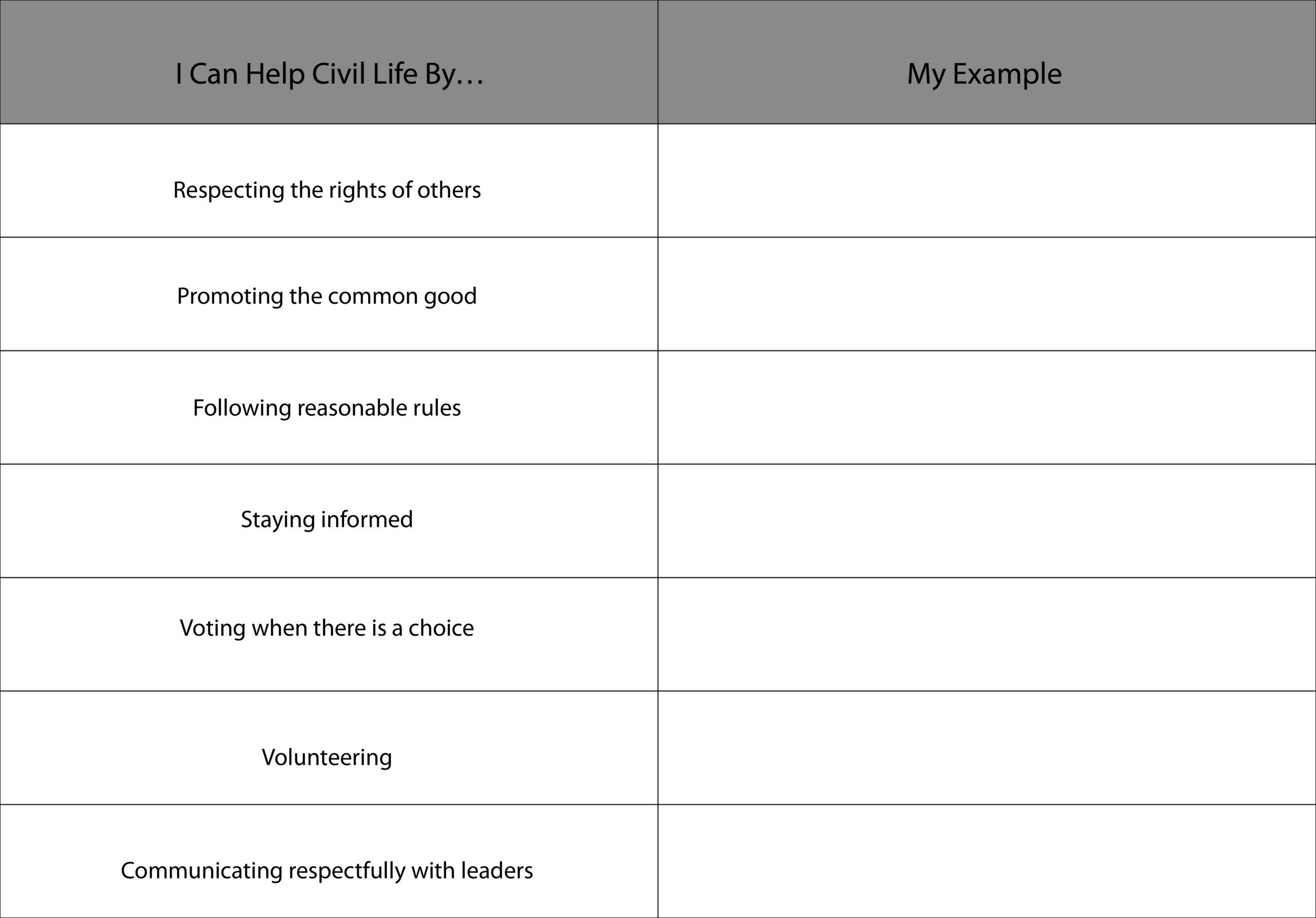
For younger students, allow drawings instead of complete sentences.
Closing / Skill Review: Closing Discussion
(5 minutes)
Return to the essential question:
How do citizens help a democracy work?
Guide students toward this answer:
Citizens help democracy work by respecting the rights of others, helping the common good, following reasonable rules and laws, staying informed, voting, volunteering, and communicating respectfully with public officials.
Exit Ticket
Have students complete two of the following sentences:
- One democratic belief is ____________________.
- Respecting rights means ____________________.
- The common good means ____________________.
- One way citizens participate in civic life is ____________________.
- One reasonable rule or law is important because ____________________.
Optional Extension: Letter to a Public Official
As a class, choose a school or community issue students care about, such as:
- More recycling bins
- Safer crosswalks
- Cleaner parks
- More books for the library
- Better playground equipment
Have students write a short respectful letter.
Letter Frame
Dear ____________________,
We are learning about how citizens participate in civic life. We noticed that ____________________.
We think this is important because ____________________.
One idea that could help is ____________________.
Thank you for helping our community.
Sincerely,
Teacher Wrap-Up
Remind students:
A democracy is not just something adults talk about in government buildings. It is something people practice every day by listening, helping, following fair rules, respecting rights, and speaking up respectfully when something needs to improve. Good citizenship begins in small choices.