
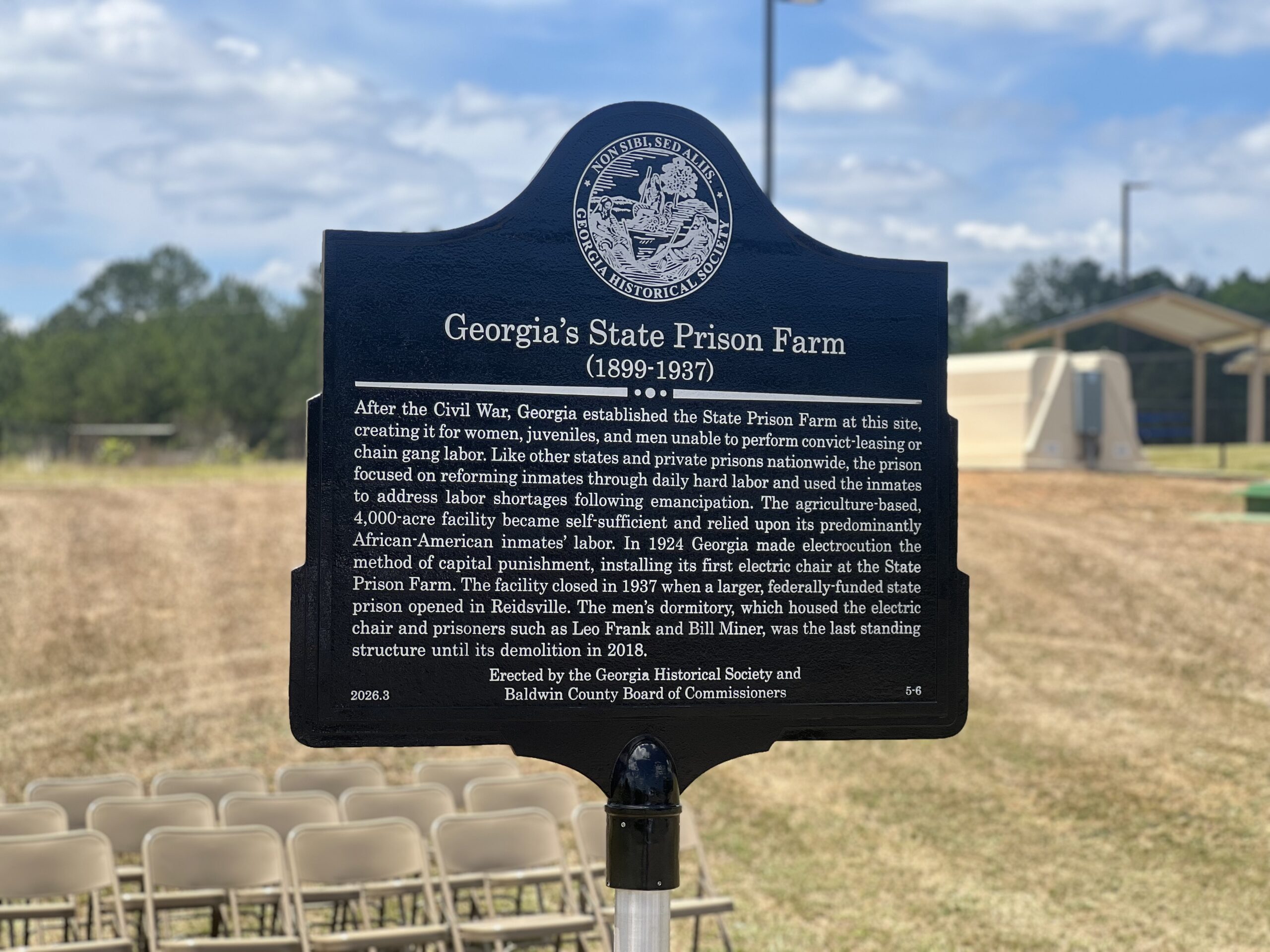
Milledgeville, GA, May 19, 2026 – A new Georgia historical marker in Milledgeville now stands recognizing Georgia’s State Prison Farm (1899–1937) and its role in the evolution of Georgia’s prison system following the Civil War. The marker was dedicated on May 19, 2026, by the Georgia Historical Society (GHS), in partnership with the Baldwin County Board of Commissioners.
The marker was unveiled at Walter B. Williams Park, the site of the former prison farm, where the state established a facility for the incarceration of women, juveniles, and men unable to perform convict-leasing or chain gang labor in 1899. Community members, local leaders, and partners gathered for the dedication and remarks on the site’s historical significance.
Established in 1899, Georgia’s State Prison Farm reflected broader changes in corrections that emphasized reform through labor. Like similar institutions across the country, the facility also relied heavily on inmate labor, predominantly African-American, to replace the enslaved labor that the South’s economy depended on prior to emancipation. The farm became largely self-sufficient, sustaining its agricultural operations across more than 4,000 acres.
"The Georgia Historical Marker Program shares our state's and nation's rich and complex history," said Breana James, Program Manager, Georgia Historical Society. "The establishment of the State Prison Farm was a critical moment in our national journey and philosophy regarding our prison systems. We are grateful to work with the Baldwin County Board of Commissioners to tell this story. Markers like this one allow us to remember and reflect on the past and the effect it has on today."

The Honorable Kendrick Butts shares remarks with community members and guests during the historical marker dedication.
In 1924, following a national trend, Georgia designated electrocution as its method of capital punishment, installing its first electric chair at Georgia’s State Prison Farm. The facility remained in operation until 1937, when a larger, federally-funded state prison opened in Reidsville, Georgia. The men’s dormitory, which once housed the electric chair and notable prisoners like Leo Frank and Bill Miner, remained the last standing structure at the site until its demolition in 2018, and is the location of the new historical marker.
“The historical marker recognizes the significance of the former prison site and its role in the history and development of the community,” said the Honorable Kendrick Butts, Chairman and District 2 Commissioner, Baldwin County Board of Commissioners. “The dedication ceremony honored the individuals connected to the site while preserving an important piece of local history for future generations."
The new marker provides historical context for understanding how systems of incarceration and labor evolved in Georgia after the Civil War. Through the Georgia Historical Marker Program, GHS works with partners across the state to make these stories accessible, offering the public an opportunity to learn about Georgia’s history in the places where it happened.
Speakers included Breana James, Program Manager, Georgia Historical Society; Edwin C. Atkins, historian and great-grandson of the prison's chaplain, Rev. E.C. Atkins; and the Honorable Kendrick Butts, Chairman and District 2 Commissioner, Baldwin County Board of Commissioners.
The historical marker reads:
Georgia’s State Prison Farm (1899-1937)
After the Civil War, Georgia established the State Prison Farm at this site, creating it for women, juveniles, and men unable to perform convict-leasing or chain gang labor. Like other states and private prisons nationwide, the prison focused on reforming inmates through daily hard labor and used the inmates to address labor shortages following emancipation. The agriculture-based, 4,000-acre facility became self-sufficient and relied upon its predominantly African-American inmates’ labor. In 1924 Georgia made electrocution the method of capital punishment, installing its first electric chair at the State Prison Farm. The facility closed in 1937 when a larger, federally-funded state prison opened in Reidsville. The men’s dormitory, which housed the electric chair and prisoners such as Leo Frank and Bill Miner, was the last standing structure until its demolition in 2018.
Erected by the Georgia Historical Society and Baldwin County Board of Commissioners
For additional details about the Georgia Historical Society, please contact Keith Strigaro, Director of Public Relations and Communications, at 912.651.2125, ext. 153, or by email at kstrigaro@georgiahistory.com.
###
ABOUT THE GEORGIA HISTORICAL SOCIETY
The Georgia Historical Society (GHS) is the premier independent statewide institution responsible for collecting, examining, and teaching Georgia and American history. GHS houses the oldest and most distinguished collection of materials related exclusively to Georgia history in the nation.
To learn more visit georgiahistory.com.
As part of Georgia’s commemoration of the 250th anniversary of the founding of the United States, GHS offers additional programs, resources, publications, and a statewide historical marker trail exploring Georgia’s role in the founding of the nation. Start exploring at georgiahistory.com/america250.
ABOUT THE GEORGIA HISTORICAL MARKER PROGRAM
The Georgia Historical Marker Program is an important part of the Georgia Historical Society’s (GHS) statewide educational mission. Through a public-private partnership with the State of Georgia, GHS is responsible for erecting new historical markers and maintaining more than 2,000 markers installed by the State prior to the program’s privatization in 1998. Online mapping tools allow users to explore themed marker trails and design custom driving routes. Visit georgiahistory.com for more ways to use Georgia’s historical markers and experience history where it happened.