
Hidden Histories, Historical Marker Resource
Site of Colonial Shipyard
This Hidden History(opens in new tab) was created by SCAD student Nicholas Carosso as part of their SCAD art history department coursework, with guidance from art history professor Holly Goldstein, Ph.D., in 2026.
The Site of the Colonial Shipyard historical marker was dedicated in 1958. View the Colonial Shipyard historical marker listing.(opens in new tab)
Gallery
- Live Oaking, “Laying down” a small vessel in the mould loft, 1981.
- Nicholas Carosso, The Final Arbitration Award (April 18, 1772), April 2026.
- Mike Stroud, Site of Colonial Shipyard Marker, July 2008. Courtesy of hmdb.org.
- Walter Channing, Typical Cross Section of a New Bedford Whaleship, Date Unknown.
- Walter Channing, US Frigate Constitution, 1926.
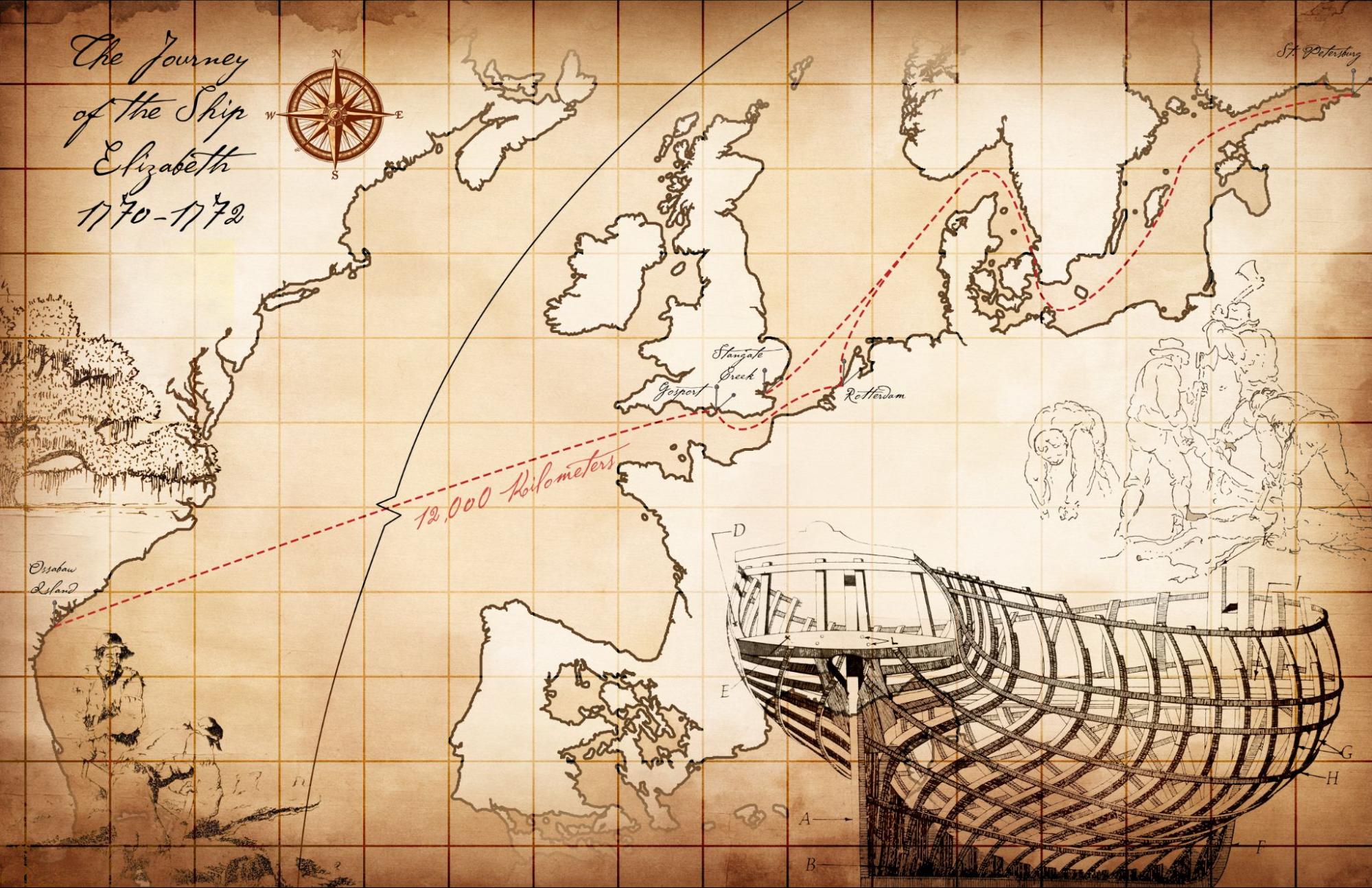
- Nicholas Carosso. The Journey of the Ship Elizabeth, May 2026.
- Captain Lang's Petition to the King (December 16, 1771). Photograph by Nicholas Carosso, April 2026.
- Logbook Abstract & Unloading Timelines (1771–1772). Photograph by Nicholas Carosso, April 2026.
- Live Oaking, Timbers of a Ship, 1981.
This piece depicts the journey undertaken by the Ship Elizabeth, built by John Wand in 1770. I became interested in the Elizabeth because I was able to uncover historical records documenting the vessel within the Georgia Historical Society archives. Discovering evidence of a specific ship transformed the project from a general investigation of shipbuilding into an opportunity to reconstruct the life and movement of an individual vessel. I felt that showcasing the different regions of the world touched by this ship highlighted how interconnected the world was, even as far back as 250 years ago. More specifically, I wanted to communicate how Georgia, despite often being viewed as a distant colonial frontier, was deeply tied to international systems of trade and exchange. Inspired by the travel sequences from the Indiana Jones films, a dashed red line follows the ship’s journey from its construction at Ossabaw Island to Gosport, Rotterdam, and St. Petersburg before ending at its recorded terminus in Stangate Creek. Rather than creating a traditional illustration of the ship itself, I chose a travel-map format because very little descriptive information about the Elizabeth survives. Instead of inventing visual details, I focused on documenting its movement and geographic reach. The perimeter of the map is decorated with woodblock prints and sketches from Live-Oaking and Tidecraft, which provide insight into shipbuilding practices and reconstruct a world before photography. The faded map aesthetic contrasts intentionally with the image’s digital creation. A break line separating hemispheres also serves as an homage to my architectural education and traditions of technical representation.
"Elizabeth (Ship) Research Notes." Georgia Historical Society, ArchivEra database. Accessed April 29, 2026. https://7063.sydneyplus.com/archive/final/Portal/Default.aspx?component=AABC&record=1ccef105-ad25-4d33-8922-d32f33a72755(opens in new tab).
"John Wand Papers." Georgia Historical Society Manuscript Collection. ArchivEra database. Accessed April 29, 2026. https://7063.sydneyplus.com/archive/final/Portal/Default.aspx?component=AABC&record=b1273ecb-3fc0-4ad1-9719-4c72bf154da9(opens in new tab)(opens in new tab).
National Park Service. Ossabaw Island. National Register of Historic Places Registration Form 10-900. Savannah, GA: Historic Preservation Division, Georgia Department of Natural Resources, 1996.
National Park Service. "(H)Our History Lesson: Shipbuilding in Savannah and Chatham County, Georgia." World War II Heritage City. Accessed April 12, 2026. https://www.nps.gov/articles/h-our-history-lesson-shipbuilding-in-savannah-and-chatham-county-georgia-world-war-ii-heritage-city.htm(opens in new tab).
The Georgia Gazette. Savannah, GA, April 18, 1770. Georgia Historic Newspapers, Digital Library of Georgia. https://gahistoricnewspapers.galileo.usg.edu/lccn/sn83016182/1770-04-18/ed-1/(opens in new tab).
The Royal Georgia Gazette. Savannah, GA, April 5, 1781. Georgia Historic Newspapers, Digital Library of Georgia. https://gahistoricnewspapers.galileo.usg.edu/lccn/sn83016191/1781-04-05/ed-1/(opens in new tab).
Tidecraft: The Boats of South Carolina, Georgia, and Northeastern Florida, 1550–1950. Georgia PINES Library Catalog. Accessed April 13, 2026. https://gapines.org/eg/opac/record/808845?locg=1(opens in new tab).
Wood, Virginia S. Live Oaking: Southern Timber for Tall Ships. Annapolis: Naval Institute Press, 1995.