
Lesson Plan
The Three Branches of Government and Checks and Balances
Lesson Overview
In this lesson, students will examine how the United States Constitution divides power among three branches of government: legislative, executive, and judicial. Students will study the purpose of separation of powers, analyze the system of checks and balances, and consider why the Framers believed that power needed to be divided, limited, and shared.
Students will move beyond simply identifying the three branches. They will analyze how the branches interact, why conflict between branches is built into the constitutional system, and how checks and balances can both protect liberty and slow government action. Students will apply these ideas to historical and contemporary scenarios involving vetoes, judicial review, executive orders, impeachment, confirmations, war powers, and congressional oversight.
Essential Question
How does the Constitution divide and limit government power, and why does that matter in a democratic republic?
Grade Level: High School Civics, Government, or U.S. History
Lesson Length: approximately 50–60 minutes
Topic: Separation of Powers, Checks and Balances, Constitutional Government
Standards: SSCG3.c, SSCG4.a, SSCG4.b, SSCG8.d
Notes have been added to the presentation to help explain the information being presented and highlight when there are student handouts to go along with content.
Learning Objectives
Students will be able to:
- Identify the constitutional responsibilities of the legislative, executive, and judicial branches.
- Explain the difference between separation of powers and checks and balances.
- Analyze why the Framers divided federal power among three branches.
- Describe specific ways each branch can check the others.
- Evaluate the strengths and weaknesses of a government system designed to divide power.
Apply checks and balances to real or hypothetical government scenarios.
Materials
- Google Presentation
- Copies of Federalist 51 for all students
- Copies of Checks and Balances Chart for all Students
- Copies of Branches in Conflict
- Copies of Student Support Organizer
- Copies of Formal Assessment (if using)
- Copies of Analytical Paragraph (if using)
- Copies of Scenario-based Assessment (if using)
Key Vocabulary
Republic: A system of government in which citizens elect representatives to make decisions and govern on their behalf.
Constitutional Government: A system in which government power is limited by a written or unwritten constitution.
Separation of Powers: The division of government authority among different branches so that no one branch controls all functions of government.
Checks and Balances: A constitutional system that gives each branch of government some power to limit or influence the actions of the others.
Legislative Branch: The branch of government responsible for making laws. At the federal level, this is Congress, made up of the House of Representatives and the Senate.
Executive Branch: The branch responsible for enforcing laws. It is led by the president and includes executive departments, agencies, and the federal bureaucracy.
Judicial Branch: The branch responsible for interpreting laws and resolving legal disputes. It includes the Supreme Court and lower federal courts.
Veto: The president’s constitutional power to reject a bill passed by Congress.
Override: Congress’s power to pass a bill into law after a presidential veto, requiring a two-thirds vote in both houses.
Judicial Review: The power of courts to determine whether laws or government actions are constitutional.
Impeachment: The constitutional process by which federal officials, including the president, may be formally accused of misconduct. The House impeaches, and the Senate conducts the trial.
Oversight: The power of Congress to monitor, investigate, and review the actions of the executive branch and federal agencies.
Standards Connections
This lesson can support high school government and U.S. history standards related to:
- The structure and function of the federal government.
- The principles of constitutional democracy.
- The powers and responsibilities of the three branches.
- The system of checks and balances.
- The protection of rights through limited government.
Historical and contemporary debates over federal power.
Teacher Background
The Framers of the Constitution were deeply concerned with the problem of power. They believed government was necessary to maintain order, protect rights, regulate public affairs, and provide for the common defense. However, they also believed that unchecked power could threaten liberty.
The American Revolution shaped these concerns. Many Americans believed that British imperial rule had abused political power by taxing the colonies without representation, limiting colonial self-government, and using royal authority to override local interests. At the same time, the weaknesses of the Articles of Confederation showed that a government with too little power could also fail. Under the Articles, the national government struggled to raise revenue, regulate commerce, enforce laws, or respond effectively to national crises.
The Constitution attempted to solve both problems. It created a stronger federal government, but it also divided that government into three branches. This division of authority is called separation of powers. The Constitution then gave each branch ways to limit or influence the others. This is called checks and balances.
James Madison explained this idea in Federalist No. 51, arguing that government must be designed so there were built in controls over government power. In other words, because people in power may try to expand their own authority, the structure of government itself must create limits. The branches were expected to disagree, compete, and restrain one another. Conflict within the government was not a flaw in the system. It was part of the design.
Introduction / Hook: Power and Limits
(10 minutes)

Begin by writing this question on the board:
Should the government be designed to act quickly, or should it be designed to make action difficult?
Have students respond in writing for two minutes. Then ask students to discuss their answers with a partner.
After discussion, ask:
- What are the benefits of a government that can act quickly?
- What are the dangers of a government that can act too quickly?
- What are the benefits of forcing government officials to debate, compromise, and share power?
- What are the drawbacks of that kind of system?
Explain that the Constitution was designed to balance two needs: the need for effective government and the need to prevent abuse of power.
Direct Instruction: The Three Branches
(10 minutes)
The Legislative Branch
The legislative branch is Congress. Congress is bicameral, meaning it has two houses: the House of Representatives and the Senate. The House was designed to be more directly responsive to the people, while the Senate was originally designed to represent the states more directly. Today, both senators and representatives are elected by voters.
The main responsibility of Congress is to make laws. However, Congress also has many other powers. It controls federal spending, raises revenue through taxes, declares war, regulates interstate and foreign commerce, confirms certain presidential appointments, ratifies treaties through the Senate, conducts investigations, and has the power of impeachment.
Congress is often called the “first branch” because Article I of the Constitution describes it before the executive and judicial branches. The Framers gave Congress many powers because it was meant to represent the people and the states in the lawmaking process.
The Executive Branch
The executive branch is led by the president. The president’s main responsibility is to enforce and carry out the laws passed by Congress. The president is also commander in chief of the armed forces, conducts foreign policy, appoints ambassadors, judges, and executive officials, negotiates treaties, and delivers recommendations to Congress.
The executive branch also includes the vice president, cabinet departments, federal agencies, and the broader federal bureaucracy. These departments and agencies carry out laws in areas such as defense, education, transportation, agriculture, homeland security, and justice.
The president has significant power, but that power is limited. The president cannot make laws alone, cannot spend money without congressional approval, and cannot appoint many officials without Senate confirmation. The executive branch is powerful, but it is not independent from constitutional limits.
The Judicial Branch
The judicial branch includes the Supreme Court and lower federal courts. Its main responsibility is to interpret laws, resolve legal disputes, and determine how the Constitution applies in specific cases.
The Constitution created the Supreme Court but allowed Congress to establish lower federal courts. Federal judges are appointed by the president and confirmed by the Senate. They serve during “good behavior,” which usually means life tenure unless they resign, retire, or are removed through impeachment.
The judicial branch’s most important check is judicial review, the power to declare laws or government actions unconstitutional. Although judicial review is not directly named in the Constitution, it became a central part of American government after the Supreme Court’s decision in Marbury v. Madison in 1803.
Core Concept: Separation of Powers vs. Checks and Balances
Separation of powers means that government authority is divided among different branches. Each branch has a primary role:
- Congress makes laws.
- The president enforces laws.
- The courts interpret laws.
Checks and balances means that each branch has some power to limit the others. The branches are separate, but they are not completely independent. They must interact with one another.
This system creates tension by design. Congress and the president may disagree over legislation. Courts may reject laws or executive actions. The Senate may refuse to confirm a nominee. Congress may investigate executive agencies. These conflicts can be frustrating, but they are part of a constitutional system designed to prevent concentrated power.
Federalist No. 51
(5 minutes)
Provide students with the following excerpt from James Madison’s Federalist No. 51:
“If men were angels, no government would be necessary. If angels were to govern men, neither external nor internal controls on government would be necessary. In framing a government that is to be administered by men over men, the great difficulty lies in this: you must first enable the government to control the governed; and in the next place oblige it to control itself.”
Ask students to answer:
- What does Madison mean by “oblige”?
- Why might unlimited control be dangerous in government?
- How can control also help protect liberty?
- How does this quote connect to checks and balances?
Explain that Madison believed the Constitution should not depend only on leaders being virtuous. Instead, the structure of government should make it difficult for any one branch to dominate the others.
Checks and Balances Chart
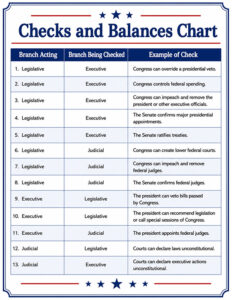
Guided Practice: Branches in Conflict
(10 minutes)
PDF for Students - Need one copy to be cut so each groups only gets the scenario they are working on
Divide students into small groups. Assign each group one scenario. Students should identify:
- Which branch is using power?
- Which branch is being checked?
- What constitutional principle is involved?
- Is this check more likely to protect democracy, slow democracy, or both?
- What could happen if this check did not exist?
Scenario 1: Presidential Veto
Congress passes a bill creating a new federal program. The president disagrees with the bill and vetoes it.
Scenario 2: Congressional Override
The president vetoes a bill, but two-thirds of both the House and Senate vote to pass it anyway.
Scenario 3: Senate Confirmation
The president nominates a person to serve on the Supreme Court. The Senate holds hearings and votes on whether to confirm the nominee.
Scenario 4: Judicial Review
Congress passes a law limiting certain types of speech. A lawsuit reaches the Supreme Court, and the Court decides the law violates the First Amendment.
Scenario 5: Executive Order
The president issues an executive order directing federal agencies to act in a certain way. A federal court rules that the order exceeds the president’s authority.
Scenario 6: Congressional Oversight
A congressional committee investigates how a federal agency spent public funds.
Scenario 7: Impeachment
The House of Representatives impeaches a federal official. The Senate then holds a trial to decide whether the official should be removed from office.
Scenario 8: War Powers
The president sends military forces into a conflict overseas. Members of Congress argue that Congress should have a larger role because the Constitution gives Congress the power to declare war.
After groups work through their scenario, have them present their analysis to the class.
Discussion: Is Gridlock a Problem or a Feature?
Included in the Google Presentation for full class discussion
Use the following question for a class discussion or written response:
The system of checks and balances can make it difficult for the federal government to act quickly. Is this a weakness of the Constitution, or is it part of the Constitution’s design?
Students should consider both sides.
Possible Arguments That Gridlock Is a Weakness
- It can prevent the government from solving urgent problems.
- It can encourage partisan conflict.
- It can make citizens frustrated with government.
- It can lead to delays in appointments, budgets, or policy decisions.
Possible Arguments That Gridlock Is Part of the Design
- It prevents sudden or extreme changes in law.
- It forces debate and compromise.
- It protects minority viewpoints.
- It reduces the risk of one branch becoming too powerful.
Students do not need to agree, but they should support their answers with evidence from the Constitution, class examples, or historical events.
Closing / Skill Review Options
(5 minutes)
Formative Assessment: Three-Branch Analysis
Have students complete the following sentence frames:
- Separation of powers means...
- Checks and balances means...
- One way Congress checks the president is...
- One way the president checks Congress is...
- One way the courts check Congress or the president is...
- The system protects liberty because...
- One possible weakness of the system is...
Summative Assessment Options
Option 1: Analytical Paragraph
Students respond to the following prompt:
Explain how the system of checks and balances reflects the Framers’ concerns about power. Use at least two examples of checks and balances in your answer.
A strong response should:
- Define checks and balances.
- Explain why the Framers feared concentrated power.
- Provide at least two accurate examples.
- Explain how those examples limit government power.
Option 2: Scenario-Based Assessment
Give students a new scenario:
Congress passes a controversial law. The president signs it. A group of citizens sues, arguing that the law violates the Constitution. The Supreme Court agrees and declares part of the law unconstitutional.
Students answer:
- Which branches were involved?
- What power did each branch use?
- Which branch had the final check in this scenario?
- How does this example show checks and balances?
- Do you think this system strengthens or weakens democracy? Explain.
Extension Activity: Historical Case Study
Students research one historical example of checks and balances and present it to the class. Possible examples include:
- Marbury v. Madison and judicial review.
- President Andrew Johnson’s impeachment.
- President Richard Nixon and United States v. Nixon.
- Congressional war powers debates during the Vietnam War.
- Presidential vetoes and congressional overrides.
- Senate confirmation battles over Supreme Court nominees.
- Congressional investigations of executive agencies.
- Supreme Court decisions limiting presidential or congressional power.
Students should explain:
- What happened?
- Which branches were involved?
- What constitutional power was used?
- How did the event show checks and balances?
- What was the long-term significance?
Differentiation
PDF of Organizer
Support for Struggling Students
Provide a graphic organizer with three columns:
| Branch | Main Power | Checks on Other Branches |
Provide sentence starters:
- The legislative branch checks the executive branch by...
- The executive branch checks the legislative branch by...
- The judicial branch checks the other branches by...
- This matters because...
Challenge for Advanced Students
Ask students to evaluate whether the modern presidency has become more powerful than the Framers intended. Students should consider executive orders, emergency powers, military authority, administrative agencies, and media influence. They should also identify how Congress and the courts can still check presidential power.
Closing Reflection
Have students respond to this final question:
The Constitution does not simply trust leaders to use power wisely. It creates a system that limits power through structure. Why might that idea still matter today?
Students should explain that checks and balances are not just a set of government facts to memorize. They are part of a larger constitutional effort to preserve liberty, prevent abuse, and require public power to be shared, debated, and limited.