
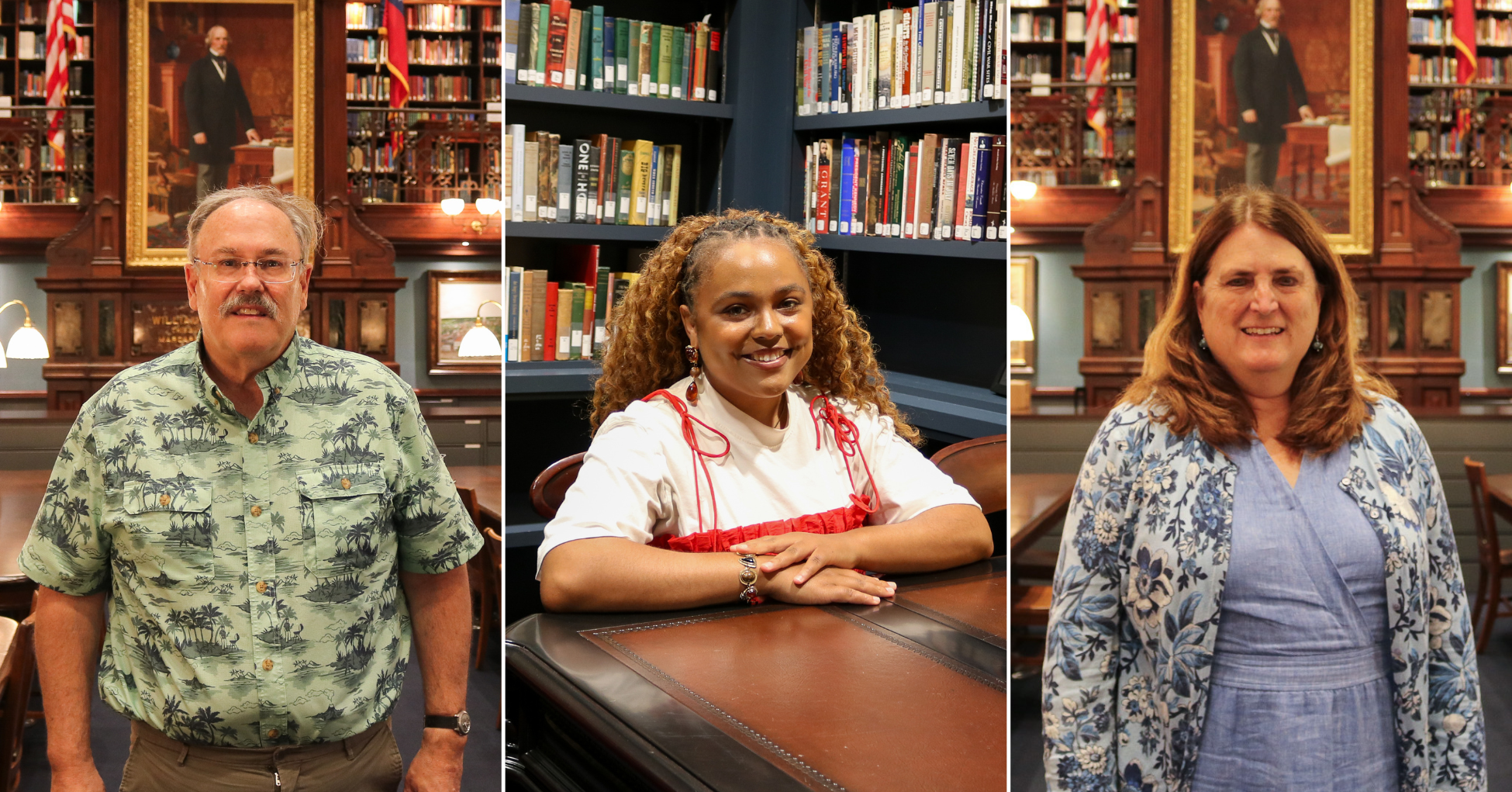
Left to right: Dr. Christopher Phillips, University of Cincinnati; Cheyenne Ross, Ph.D. student, Emory University; and Dr. Diane Mutti Burke, University of Missouri-Kansas City.
Savannah, GA, July 7, 2026 – The Georgia Historical Society (GHS) welcomed three scholars to its Research Center in Savannah in May as part of the 2026 Vincent J. Dooley Distinguished Research Fellows Program. The fellowship gave each scholar the opportunity to conduct research at the GHS Research Center while experiencing Savannah's history firsthand.
The Research Fellows were Dr. Diane Mutti Burke of the University of Missouri–Kansas City, Dr. Christopher Phillips of the University of Cincinnati, and Cheyenne Ross, a Ph.D. student at Emory University. Over the course of their fellowships, they used GHS collections to pursue research that ranged from the story of Jane DeVeaux, a free Black woman in Savannah who for decades secretly taught enslaved children to read and write, to the dissent and resistance that ran through the Confederacy, to the experiences of refugees displaced by the Civil War.
“The 2026 class of Vincent J. Dooley Research Fellows at the Georgia Historical Society fully embodied GHS’s hope when we established the program in honor of Vince Dooley—a young scholar at the dawn of an exciting career working on cutting-edge research, and two established scholars exploring new avenues of Civil War history, which Coach Dooley was passionate about,” said Dr. Stan Deaton, Senior Historian at the Georgia Historical Society. “Cheyenne, Chris, and Diane were exemplary scholars and researchers whose work will not only extend our collective knowledge about the American past but whose work will highlight the wealth of material available to students of history in the GHS Research Center.”
Dr. Mutti Burke, Professor of History at the University of Missouri–Kansas City, spent two weeks at GHS examining the experiences of refugees and displaced civilians during the Civil War. Her research looks at why people were forced from their homes, where they went, how they survived, who provided aid along the way, and what became of them once the war ended. At GHS, she consulted manuscripts, newspapers, and rare books documenting Georgia's refugee experience, paying particular attention to women, children, elderly residents, white civilians, and newly freed people whose lives were upended by the war—including by Sherman's March to the Sea and the capture of Savannah.
Dr. Phillips, University Distinguished Professor in the Arts, Humanities and Social Sciences and John and Dorothy Hermanies Professor of American History at the University of Cincinnati, spent two weeks at GHS studying dissent, resistance, and divided loyalties on the Confederate home front. Rather than focusing on the Confederate government in Richmond, his research looks at how civilians and local communities on the ground experienced and responded to the pressures of war, allegiance, displacement, and Confederate authority. At GHS, he focused on collections that document Georgia's wartime experience from the bottom up, including the lives of non-planter civilians, families, prisoners, and refugees whose stories complicate any notion of a unified Confederacy.
Cheyenne Ross, a Ph.D. student in African American Studies at Emory University, spent one week at GHS researching Jane DeVeaux, a free Black woman from Savannah who for thirty years taught enslaved children to read and write without ever being discovered, in the early nineteenth century. Her work uses DeVeaux's story as a window into the larger history of Black education, African-heritage learning traditions, and the many ways Black communities have understood and carried out education across space and time. At GHS, she studied materials related to nineteenth-century Savannah, the DeVeaux family, African American folklore, and the African Baptist Church to better understand the world DeVeaux lived and taught in.
The Vincent J. Dooley Distinguished Fellows Program was established by the GHS Board of Curators to recognize Coach Dooley's lifelong commitment to history and higher education. Funded by an endowment from his friends and admirers, the program supports both Teaching Fellows and Research Fellows, who use the GHS Research Center's extensive collections of manuscripts, photographs, books, maps, portraits, and artifacts to conduct advanced research.
For additional details about the Georgia Historical Society, please contact Keith Strigaro, Director of Public Relations and Communications, at 912.651.2125, ext. 153 or by email at kstrigaro@georgiahistory.com.
###
ABOUT THE GEORGIA HISTORICAL SOCIETY
The Georgia Historical Society (GHS) is the premier independent statewide institution responsible for collecting, examining, and teaching Georgia and American history. GHS houses the oldest and most distinguished collection of materials related exclusively to Georgia history in the nation. To learn more visit georgiahistory.com.
As part of Georgia’s commemoration of the 250th anniversary of the founding of the United States, GHS offers additional programs, resources, and publications exploring Georgia’s role in the founding of the nation. Start exploring at georgiahistory.com/america250.